Sunday, December 12, 2004

Monday Watch

Earnings of Note
Company/Estimate
CKR/.16
ORCL/.13

Splits
GDW 2-for-1

Economic Data
Advance Retail Sales for November are estimated to fall .1% versus a .2% rise in October.
Retail Sales Less Autos for November are estimated to rise .3% versus a .9% gain in October.
Business Inventories for October are estimated to rise .5% versus a .1% gain in September.

Weekend Recommendations
Rukeyser's Wall Street had guests that were positive on SZE, TIF, XOM, TMO, PTEK, AEE, D and GIS. Forbes on Fox had guests that were positive on LLL, IDTI, INTC, RPM, ZBRA and ANZ. Cashin' In had guests that were positive on HSY, LUK, HD and mixed on K, PZZA, SAFM, NUE. Bulls and Bears had guests that were positive on GSIC, NCC, EBAY, ERTS, GS, SFA, NVS and mixed on CSCO, CI, TOL. Barron's had positive comments on JPM, AES, RRI, CPN, ADM, EK, HL, WMT and INT. Goldman Sachs reiterated Outperform on ACS, DNA, EBAY, MER, X, NUE and SPP.

Weekend News
China has raised next year's economic growth target to 8%, the first time it has lifted its estimate above 7% since 1999, the Economic Observer reported. Ukrainian opposition leader Yushchenko said his administration would go to court to reverse illegal sales of state assets if he were to become president, the Financial Times reported. Taiwan President Chen Shui-bian's party failed to win more seats in a legislative vote, which could hamper his proposals to further the island's national identity that would have deepened a rift with China, Bloomberg said. The Canadian Internet pharmacy industry, which has more than $800 million in annual sales in transactions with the U.S., is facing increasing regulatory, political and economic pressures, the NY Times reported. U.S. stocks will rise next year as the economy strengthens, boosting the S&P 500 Index as much as 12%, money managers told Barron's. Job growth may accelerate in 2005 and the US trade deficit may narrow to as little as 5% of gross domestic product, helping GDP growth to rise 4%-5%, higher than the 3.5% forecast of economists, Barron's reported. Bristol-Myers Squibb is preparing to sell its consumer medicines unit for as much as $800 million, and GlaxoSmithKiline Plc and Johnson & Johnson may bid for it, London's Sunday Times reported. More than 300,000 U.S. students between eighth and 12th grade used steroids last year, Newsweek magazine said, citing analysis of a report from the Univ. of Mich. Honeywell Intl., the world's No.1 maker of cockpit electronics, plans to buy Novar Plc for $1.52 billion to obtain its building security, fire systems and services business, the Wall Street Journal reported. Permira, a European buy-out group has entered a joint venture with Apollo Management LP to make an offer for Toys R Us, which is worth about $3.5 billion, the Financial Times said. Procter & Gamble's Indian unit had a 25.5% sales growth in October compared with a 1.9% increase at rival Hindustan Lever, Economic Times said. Mahmoud Abbas, the chairman of the Palestinian Liberation Organization, apologized to Kuwait for Palestinian support for Iraq in the 1990-1991 Persian Gulf War, the AP reported. The oil minister for Saudi Arabia, OPEC's biggest oil producer, said the nation will reduce output by 500,000 barrels a day to enforce a recent accord. The supply of oil is still outstripping demand after OPEC, the producer of more than a third of the world's output, begins to reduce production to prop up falling prices, the Qatari oil minister said. General Motors and DaimlerChrysler AG will jointly develop a gasoline-electric power system to catch Toyota Motor and Honda Motor in the technology that saves fuel and cuts tailpipe emissions, Bloomberg reported. A number of economists say a gradually declining US dollar is good for equities, the AP reported.

Late-Night Trading
Asian indices are mostly lower, -.75% to +.25% on average.
S&P 500 indicated +.14%
NASDAQ 100 indicated +.31%.

BOTTOM LINE: I expect US stocks to open modestly lower in the morning on a bounce in oil prices, however shares will likely strengthen later in the day. The Portfolio is 100% net long heading into tomorrow.
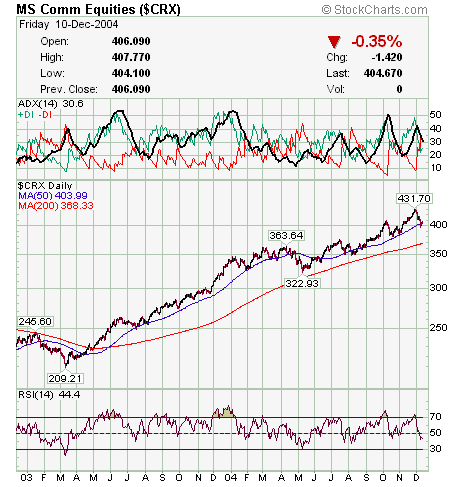
Chart of the Week

Morgan Stanley Commodity Related Index(CRX)


Bottom Line: The CRX has risen 28.1% over the last 12 months. However, I expect these stocks to underperform over the intermediate-term. An exodus by momentum investors, lower commodity prices, a stabilizing dollar, greater supply and slackening demand from Asia/Europe should provide the catalysts. I expect the CRX to test its 200-day moving-average over the coming months.

Weekly Outlook

There are a number of economic reports and some significant corporate earnings reports scheduled for release this week. Economic reports include (Mon.)-Advance Retail Sales, Business Inventories (Tues.)-Trade Balance, Industrial Production, Capacity Utilization (Wed.)-Empire Manufacturing, NAHB Housing Market Index (Thur.)-3Q Current Account Balance, Housing Starts, Initial Jobless Claims, Philadelphia Fed. (Fri.)-Consumer Price Index. Retail Sales, Industrial Production, Housing Starts, Philly Fed. and CPI all have market-moving potential.

Mon.-Oracle Corp.(ORCL) Tues.-FuelCell Energy(FCEL) Wed.-Bed, Bath & Beyond(BBBY), Best Buy(BBY), Biomet(BMET), Lehman Brothers(LEH), Lennar Corp. Thur.-Adobe Systems(ADBE), Apollo Group(APOL), Carnival Corp.(CCL), FedEx Corp.(FDX), Goldman Sachs(GS), Nike Inc.(NKE) Fri.-Circuit City(CC) are some of the more important companies that release quarterly earnings this week. There are also some other events that have market-moving potential. The SG Cowen Consumer Conference(Mon.-Tues.), FOMC policy announcement(Tues.), CSFB Small-cap Software Conference(Tues.-Wed.) and SEMI Book-to-Bill report(Thur.) could also impact trading this week.

Bottom Line: I expect U.S. stocks to finish the week higher on seasonal strength, strong earnings/economic reports, more optimism, a stabilizing US dollar, short-covering and bargain-hunting. I also expect long-term interest rates to move modestly higher and energy prices to fall slightly. I continue to believe commodity-related stocks will underperform in the intermediate-term. My short-term trading indicators are still giving Buy signals and the Portfolio is 100% net long heading into the week.

Market Week in Review

S&P 500 1,188.00 -.27%

Click here for the Weekly Wrap by Briefing.com.

Bottom Line: U.S. stocks finished slightly lower last week, led down by semiconductors after disappointing reports from Xilinx, Altera and Cymer. However, significant gains in the homebuilding sector, spurred by a very positive report from Toll Brothers, helped minimize losses in the major indices. Taking into account the 25% gain in the Morgan Stanley Tech Index since Aug. 12, losses in the sector were relatively muted considering the news. After basing for several weeks, the homebuilders broke to ALL-TIME highs last week on heavy volume. The index has now returned 41.4% since the bears and pundits said the "bubble" burst in May. It is good to see the AAII % Bulls fall, however investor complacency remains elevated as a whole. The plunge in energy prices is very positive for the U.S. economy and remains underreported by the mainstream press. While oil is at technical levels normally associated with a short-term bounce, still lower prices are likely. A few months ago I forecast oil would reach $35-$40/bbl. during the fourth quarter. However, more supply from the Middle-East, less demand from Asia/Europe, a stabilizing US dollar, less speculation and a lower terrorism/war premium may lead oil prices to overshoot on the downside in the intermediate-term. I would not be surprised to see crude approach $30/bbl within the next six months. This would be a very positive development with respect to measures of inflation and consumer spending. Disposable personal income has risen 4.3% from a year earlier versus a 2.5% gain in the Consumer Price Index. A substantial fall in energy prices would further bolster the US consumer. Finally, it was also a big positive to see the US dollar rebound and interest rates fall last week. I expect the dollar to continue its rebound and interest rates to rise slightly from current levels over the coming weeks.

Saturday, December 11, 2004

Economic Week in Review

ECRI Weekly Leading Index 133.00 +.45%

Final 3Q Non-farm Productivity rose 1.8% versus estimates of a 2.0% increase and a prior estimate of 1.9%. Final 3Q Unit Labor Costs rose 1.8% versus estimates of a 1.6% gain and a prior estimate of 1.6%. The productivity of U.S. workers grew in the third quarter at the slowest pace in almost two years, suggesting companies may need to boost hiring to meet demand, Bloomberg said. Moreover, hours worked rose at a 2.4% pace, the most since the third quarter of 1999. "Labor costs have moved from a downward influence on inflation to a neutral one," said Stephen Stanley, chief economist at RBS Greenwich Capital. "Fed officials have consistently noted that labor costs are the key to inflation, not material costs."

U.S. Household Net Worth advanced to another all-time high of $46.7 trillion as stock market and real estate values appreciated, the Fed said. Consumer Credit for October fell to $7.7B versus estimates of $6.0B and an upwardly revised $13.6B in September. The percentage of homeowners in foreclosure fell to 1.14%, the lowest level in 4 years. "Consumers are confident enough in the outlook for the economy to assume greater debt burdens," said Chris Rupkey, an economist at Bank of Tokyo-Mitsubishi. Personal bankruptcy filings across the country declined 2.6% for the fiscal year ended Sept. 30, suggesting most consumers are able to handle their rising debt, and that spending will continue, Bloomberg reported. Sales at U.S. retailers rose 3.3% during the first full week of the holiday season.

The Import Price Index for November rose .2% versus estimates of 0.0% and a 1.6% increase in October. The dollar's decline this year against other currencies makes imported goods more expensive, Bloomberg said. The report "echoes what we've seen in the broader price measures – big run-ups in prices of crude and intermediate goods but only a limited pass-through to consumer prices," said Stephen Stanley. "There is still little evidence as of yet that the Fed is risking a substantial acceleration in core consumer price inflation." "Import competition, particularly from China, is keeping downward pressure on manufactured products, such as apparel and fabricated metals," the Dallas Fed said in its regional report.

Initial Jobless Claims for last week were 357K versus estimates of 335K and 349K the prior week. Continuing Claims were 2796K versus estimates of 2746K and 2705K prior. "As oil prices come down, that should make companies a little less reluctant to hire," said John Shin, an economist at Lehman Brothers. Claims have fallen to a weekly average of 344,102 so far this year from 402,000 for all of 2003, Bloomberg said.

Wholesale Inventories rose 1.1% in October versus estimates of a .5% gain and a .6% increase in September. Consumer purchases rose the most in almost three years last quarter and business investment accelerated, recent reports have shown. Gains in spending caused inventories to rise at almost half the previous quarter's pace, leaving businesses room to add to stockpiles, boosting the economy this quarter, Bloomberg reported. "If you have sales booming, you have to have inventories keep pace," said Tom Rogers, chief economist at Briefing.com. Wholesalers had enough supply on hand to last 1.15 months at the current sales pace, the same as the prior month and up from an all-time record low of 1.12 months in April, Bloomberg said.

The Producer Price Index for November rose .5% versus estimates of a .1% increase and a 1.7% gain in October. The PPI Ex Food & Energy for November rose .2% versus estimates of a .2% increase and a .3% gain in October. "So far, businesses have been more successful in passing along cost increases to other business, but with consumers it's been much more difficult," said Nigel Gault, research director at Global Insight. The 26.4% decline in oil, the 31.9% plunge in natural gas and the 23.6% drop in heating oil should help restrain producer prices going forward, Bloomberg reported.

The preliminary Univ. of Mich. Consumer Confidence reading for December rose to 95.7 versus estimates of 93.5 and a reading of 92.8 in November. Job growth is helping bolster consumer spending and confidence and consumers have benefited from the decline in oil and gasoline prices, economists said. The U.S. economy has added 2.2 million jobs since August of last year, Bloomberg said. The current-conditions component of the index, which reflects Americans' perception of their financial situation and whether it's a good time to buy big-ticket items, rose to 106.8 from 104.7 in November. The expectations component of the index, based on optimism about the next one to five years, rose to 88.8 from 85.2, Bloomberg said. "With the recent drop in energy prices consumer spending will give us a good holiday season," said Lynn Reaser, chief economist at Banc of America Capital.

Bottom Line: Overall, last week's economic data were positive. Productivity has fallen to levels normally associated with increased hiring. However, mitigating forces should hold unit labor costs in check in the intermediate-term. A modest increase in the rate of US job creation, a stabilizing US dollar, deflationary forces in Asia, continuing overcapacity in some areas of the US economy and falling commodity prices should lead to decelerating inflation readings in 2005. This will allow the Fed to slow the pace of rate hikes. With Americans' net worth at ALL-TIME high levels, a modest rise in interest rates next year should not significantly damage consumer spending or the US economy. Inventories are rising to keep up with brisk demand and should contribute meaningfully to 4Q GDP. It is very good to see Consumer Confidence rebound from recent disappointments. A very strong housing market, rising stock market, declining energy prices, good labor market, elections in Iraq, less pessimism from politicians, relatively low interest rates and diminished domestic terrorism fears should lead to new highs in consumer sentiment for this cycle in the next few months. The Weekly Leading Index is now at its highest level since late June.

Friday, December 10, 2004

Weekly Scoreboard*

Indices
S&P 500 1,188.00 -.27%
Dow 10,543.22 -.46%
NASDAQ 2,128.07 -.93%
Russell 2000 632.24 -1.55%
S&P Equity Long/Short Index 999.51 -.85%
Put/Call .62 -10.14%
NYSE Arms 1.38 +.73%
Volatility(VIX) 12.76 -1.54%
AAII % Bulls 51.35 -9.53%
US Dollar 82.67 +2.15%
CRB 276.62 -2.74%

Futures Spot Prices
Gold 435.30 -4.83%
Crude Oil 40.71 -4.12%
Unleaded Gasoline 107.99 -4.43%
Natural Gas 6.84 +.34%
Heating Oil 122.57 -.83%
Base Metals 114.20 -2.56%
10-year US Treasury Yield 4.15% -2.38%
Average 30-year Mortgage Rate 5.71% -1.72%

Leading Sectors
Homebuilders +4.53%
HMOs +4.21%
Hospitals +3.27%

Lagging Sectors
Airlines -3.19%
Iron/Steel -4.79%
Semis -5.06%

*% Gain or loss for the week