Style Outperformer:
Sector Outperformers:
- 1) Gold & Silver +1.14% 2) Homebuilders +1.10% 3) Airlines +1.07%
Stocks Rising on Unusual Volume:
Stocks With Unusual Call Option Activity:
- 1) CAG 2) BSX 3) PPHM 4) WDAY 5) LMT
Stocks With Most Positive News Mentions:
- 1) DTV 2) SSYS 3) CALM 4) NWSA 5) CLF
Charts:
Weekend Headlines
Bloomberg:
- Budget Talks Stall Over Income, Estate Taxes. With
little more than a day remaining to avert tax increases for almost
every U.S. worker and to halt federal spending cuts, Senate Majority
Leader Harry Reid and Minority Leader Mitch McConnell worked to bridge
gaps over income tax rates, the estate tax and other issues. “There’s
still significant differences between the two sides but negotiations
continue,” Reid, a Nevada Democrat, said on the Senate floor today. The
Senate will resume its session tomorrow at 11 a.m. Washington time and “perhaps” have further announcements then, he said. “I certainly hope so.” McConnell, a Kentucky Republican, reached out to Vice President Joe Biden in an effort to break the impasse.
- Merkel Calls for German Patience as Euro Crisis ‘Far From Over’.
German Chancellor Angela Merkel said the economic environment will be
more difficult in 2013 than this year, and that Europe’s sovereign debt
crisis is “far from over,” though progress has been made. “The reforms
that we’ve agreed on are starting to take
effect,” Merkel, who faces federal elections in September, said
in a New Year’s television speech to the nation, sent today in
advance by e-mail. “Nevertheless, we still need a lot of
patience. The crisis is far from over.”
- French Court Says 75% Tax Rate on Rich Is Unconstitutional. President Francois Hollande’s 75
percent millionaire-tax is unconstitutional because it fails to
guarantee taxpayer equality, France’s top court ruled today. The tax, one of Hollande’s campaign promises, had become a
focal point of discontent among entrepreneurs and other wealth
creators, some of whom have quit French shores as a result. The
ruling comes as the president seeks to cut France’s public
deficit to 3 percent of gross domestic product next year from a
projected 4.5 percent this year. “Politically, this has an impact because it was a symbol
for French public opinion, and was considered abroad as the
emblem of French tax excess, of French tax hell,” said
Dominique Barbet, senior economist at BNP Paribas SA in Paris.
“In deficit terms, it’s truly negligible.”
- Spain’s Iberdrola Has Four Units Taken Over by Bolivian State. Bolivian
army and police seized buildings occupied by Iberdrola SA (IBE)
yesterday, hours after President Evo Morales ordered the nationalization
of four business units owned by Spain’s largest utility. “We have been forced to make this decision as we want to
have egalitarian electricity rates in rural and urban areas,”
Morales said yesterday morning in a broadcast from the
presidential palace.
- PBOC to Control Risks, Seek Appropriate Financing Growth. China’s
central bank said it will
focus on controlling risks in the financial system and will seek
“stable and appropriate” growth in aggregate financing, a
measure of funding that includes loans, stock and bond sales. The
People’s Bank of China also said it will stick to a prudent monetary
policy next year and try to stabilize growth, rebalance the economy and
contain inflation. The four-paragraph statement released late Dec.
28 after a quarterly meeting of the monetary policy committee, mostly
reiterated the stance set out at a government work conference earlier
this month. The PBOC’s addition of “controlling risks” as a policy
objective may signal growing concern that a surge in non-bank lending
over the past two years will lead to defaults that could trigger social
unrest. Regulators “may tighten control on the quality and quantity of
credit supply, particularly through non-bank channels such as trust
loans” in the first half of 2013, Zhang Zhiwei, chief China economist at Nomura Holdings Inc. in Hong
Kong, said in a note after the central bank report. A slowdown
in credit growth would feed through to a moderation in economic
expansion, he said.
- BRIC Dominance Ebbs as State Meddling Means Equities Trail World. Stocks
in the biggest developing markets are lagging behind global equities
for a record third year as faster economic growth proves no lure for
investors amid concerns over government interference in markets. The
MSCI BRIC Index (MXBRIC) of shares in Brazil, Russia, India and China
rose 11 percent this year, trailing the MSCI All-Country World Index by
1.6 percentage points. The trend will probably persist in 2013,
according to John-Paul Smith, a Deutsche Bank AG strategist. Mutual
funds that invest in BRIC nations have posted $1.65 billion of outflows
as Brazilian politicians intervened to cut utility rates, China
maintained control of its biggest companies and Russian businesses spent
shareholder money
on projects favored by the government.
- Lumber Prices May Tumble 25% After Leading Commodities in 2012.
Lumber futures may tumble as much as 25% from a seven-year high as
output increases in Canada, the world's biggest exporter, according to
Forest Economic Advisors LLC. The price may touch $300 per 1,000 board
feet in 2013, Paul F. Jannke, a principal at the consulting company,
said in a telephone interview. In mid-October, he correctly forecast the
rally. "We're pretty close to the peak," Jannke said. "The initial
spike tends to be the highest, then production ramps up. If the mills
increase shifts from a 40-hour week to a 50-hour week, that's a big
jump, and everybody is ratcheting up their work weeks."
- Hedge Funds Cut Bullish Bets to Lowest Since June: Commodities. Hedge funds cut bullish commodity
bets to a six-month low as mounting concern that slowing
economic growth will erode demand drove prices toward the first
fourth-quarter retreat since the global recession. Speculators
reduced net-long positions across 18 U.S. futures and options by 11
percent to 675,625 million contracts in the week ended Dec. 24, the
lowest since June 19, U.S.
Commodity Futures Trading Commission data show. Gold holdings
reached a four-month low, while those for copper dropped for the
first time in five weeks. Investors are the most bearish on
natural gas since May.
- Russia Says No Chance of Convincing Assad to Quit. Syrian President Bashar Al-Assad
told a top United Nations envoy this week that he won’t quit
before his term ends in 2014, Russian Foreign Minister Sergei Lavrov said. “It’s impossible to change his position,” Lavrov said at
a joint press conference after talks in Moscow today with UN and
Arab League special envoy to Syria, Lakhdar Brahimi, who met
Assad in Damascus on Dec. 24.
- UN Envoy Warns of Syria ‘Hell’ as Beheaded Bodies Found. UN special envoy Lakhdar Brahimi
warned yesterday that the war in Syria is spiraling into
“hell” and giving rise to warlords. The Syrian army killed 143 people across the country
yesterday, the opposition Local Coordination Committees said in
an e-mailed statement. Fifty unidentified beheaded corpses with
signs of torture were recovered behind Tishreen Military
Hospital in Damascus, the group said. “The situation is bad and it’s getting worse,” Brahimi
said in Cairo. “I can’t see anything other than these two
paths: Either there will be a political solution that will meet
the ambitions and legitimate rights of the Syrian people, or
Syria will turn into hell.”
- Japan Detains Chinese Fishing Boat Amid Tensions Over Islands. Japan
detained a Chinese fishing boat that entered its waters, bringing the
captain and two of the vessel’s crew members in for questioning, China’s official
Xinhua News Agency reported. The boat’s captain, Lin Shiqin, admitted his vessel entered
Japanese waters, Xinhua reported. China sent a diplomat to visit
the three crew members detained by the Japanese coast guard,
Xinhua said, citing the Chinese Consulate General in Fukuoka.
Wall Street Journal:
- Unthinkable Cuts Almost a Reality. Mandatory federal spending cuts designed to be prohibitively drastic
will become a reality on Wednesday if negotiators remain unable to reach
an agreement to avert the reductions.
- France Seeks New Path to High Tax. The government of Socialist President François Hollande on Sunday
said it would consider other ways of imposing a top income-tax rate of
75% on high-wealth individuals after the country's top constitutional
authority scrapped the plan. The Constitutional Council's decision is a political blow to Mr.
Hollande, who had vowed to shift to the rich the burden of efforts to
improve the country's finances. "Humiliating," French weekly newspaper Le Journal du Dimanche said in
a front-page banner headline Sunday. The council sanctioned Mr.
Hollande's "fiscal bludgeoning," former Prime Minister François Fillon
told French radio.
- Gauging the Guidance That Models Give the Fed. When the Federal Reserve said in December that it would keep
short-term interest rates near zero until the unemployment rate falls to
6.5%, it was backed by a team of geeks who get little attention outside
the central bank but a lot of attention inside.
The geeks have names such as Ferbus,
Edo and Sigma. They are computer-modeling programs the central bank uses
to make predictions about how various policies and events will play out
across the economy.
In December, the Fed wanted to
telegraph how long it would keep interest rates low. To do that it used
forecasting models to map out different scenarios. Looking to the models
for guidance, Fed officials decided to announce they would keep
interest rates near zero until the unemployment rate drops to 6.5%. The
models told them such a commitment would help nudge unemployment
lower—it was 7.7% in November—and wouldn't risk a big burst of
inflation.
But here is the problem: The models are
deeply flawed. They failed to foresee the financial crisis in 2008 and
have tended to overestimate the strength of the economy for several
years. Could they fail the Fed again? Of course, no model or human can perfectly predict the future. But the
Fed models have a more specific problem. Despite all their complexity
and sophistication, they have long been plagued by gaps in how they read
and project the economy. One of the biggest is that they have ignored
the nuances of the financial system—one of the primary channels through
which Fed policy works.
- Flying Is Safest Since Dawn of Jet Age. Air travel is now the safest it has been since the dawn of jet
planes, with the global airline industry set to mark its lowest rate of
fatal accidents since the early 1960s.
There have been 22 fatal crashes
world-wide this year, a number that includes all passenger and cargo
flights, down from 28 crashes in 2011, according to data assembled by
the Aviation Safety Network, which compiles accident and incident
information online. That crash count is down from a 10-year average of
34 fatal accidents per year. The figures were compiled before Saturday's
crash of a Russian-built jet near Moscow, in which four people were
killed when the plane careened off a runway and caught fire.
- Container Ships Bulk Up, and Slow Down.
Grappling with excess container capacity and declining shipping
fares, companies such as CMA CGM of France, owner of the Marco Polo, and
A.P. Møller Maersk of Denmark are racing to operate the
biggest-possible ships so they can
benefit from economies of scale, and run them at moderate speeds to
save on fuel costs.
- Pension Funds Call For Insider Curbs. A group of pension funds that oversee more than $3 trillion in assets
asked U.S. securities regulators to revamp rules on how corporate
executives can trade their company stock.
Marketwatch.com:
- China stocks bear risk of capitulation in 2013.
Commentary: China’s new leaders can expect short honeymoon. Many of the
factors that plagued mainland Chinese stocks last year remain in the
year ahead. China may have new faces in its leadership, but it faces the same old problems with its economy.
Fox News:
CNBC:
- If There's a 'Fiscal Cliff' Deal, It's Likely to Be Small. Whether negotiated in a rush before the new year or left for early
January, the fiscal deal President Barack Obama and Congress cobble
together will be far smaller than what they initially envisioned as an
alternative to purposefully distasteful tax increases and spending cuts. Instead,
their deal, if a deal they indeed cut, will put off some big decisions
about tax and entitlement changes and leave other deadlines in place
that will likely lead to similar moments of brinkmanship, some n just a
matter of weeks.
Zero Hedge:
Business Insider:
New York Times:
- Settlement Expected on Past Abuses in Home Loans. Banking
regulators are close to a $10 billion settlement with 14 banks that
would end the government’s efforts to hold lenders responsible for
foreclosure abuses like faulty paperwork and excessive fees that may
have led to evictions, according to people with knowledge of the discussions.
- Family of Chinese Regulator Profits in Insurance Firm’s Rise.
Relatives of a top Chinese regulator profited enormously from the
purchase of shares in a once-struggling insurance company that is now
one of China’s biggest financial powerhouses, according to interviews
and a review of regulatory filings.
Denver Post:
TechCrunch:
-
Intel’s(INTC) Cable TV Service And Set Top Box Will Soon Roll Out City By City.
Intel is preparing to launch its rumored virtual cable TV service and
set top box and has a plan to overcome licensing hurdles. Rather than
roll out nationwide, the launch will happen on a city-by-city basis so
Intel has more flexibility in negotiating licensing with reluctant
content providers, according to a video industry source. The Intel box
may also eliminate a core frustration with DVRs.
Reuters:
- China academics warn of "violent revolution" if no political reform. A prominent group
of Chinese academics has warned in a bold open letter that the country
risks "violent revolution" if the government does not respond to public
pressure and allow long-stalled political reforms. The 73 scholars, including
well-known current and retired legal experts at top universities and
lawyers, said political reform had not matched the quick pace of economic expansion. "If
reforms to the system urgently needed by Chinese society keep being
frustrated and stagnate without progress, then official corruption and
dissatisfaction in society will boil up to a crisis point and China will
once again miss the opportunity for peaceful reform, and slip into
the turbulence and chaos of violent revolution," they wrote.
- Bad China bets ruin 2012 for Asia's star fund managers. The Warren
Buffetts of the East failed to live up their reputations in 2012, when
big-name investment gurus made the wrong calls on China while markets in
India and Southeast Asia raced ahead to rank among the top performers globally.
itv:
- Al Qaeda offers gold bounty for US ambassador in Yemen. Al Qaeda-linked militants in Yemen have pledged to give three kilograms of
gold - worth around £100,000 - to anyone who can kill the US ambassador in
Sanaa. An audio message posted on militant websites also offered around £15,000 for
the head of any American soldier found fighting in the country. A statement from the al Malahem Foundation, reported by the Associated Press,
said the bounties would be valid for six months and were issued to "inspire and
encourage our Muslim nation for jihad."
Telegraph:
Frankfurt Allgemeine Sonntagszeitung:
- Bundesbank's Weidmann Warns Euro Crisis Not Yet Over. The causes
of the crisis haven't been resolved, says Germany Bundesbank President
Jens Weidmann in an interview. Govt. bond purchases by the ECB bear
stability risks and the danger of mixing monetary and fiscal policies,
Weidman said. The euro system shouldn't mutualize state solvency risks,
Weidmann said. Weidmann proposes to limit banks' holding of govt. bonds
and that govt bonds need to be secured with capital.
- Siemen's Loescher Expects Headwinds From Euro Zone. Siemens AG,
Europe's largest engineering company, expects declining economic growth
rates in 2013 with a slight recession in the euro zone, CEO Peter
Loescher said in an interview.
Der Spiegel:
- General Motors Co.'s(GM) European division plans production cut of more than 10% to 845,000 vehicles in 2013.
- German
Finance Ministry Prepares Spending Cuts. German Finance Minister
Wolfgang Schaeuble has mandated a task force to work out details for a
budget restructuring plan. Proposals include abolishing the reduced VAT rate and increasing working years before retirement.
To Vima:
- Greece's main opposition Syriza party, which opposes terms agreed
to by the government in exchange for bailout funds from the European
Union and IMF, has 22.6% voter support, a poll by Kapa Research shows.
PM Antonis Samaras's New Democracy party would get 21.5% if elections
were held now. Nationalist Golden Dawn party would place third with 9.8%
voter support.
Xinhua:
- China's small businesses continue to face difficulty
getting loans as lenders view them as risky, citing the chief engineer
of the Ministry of Industry and Information Technology.
China Securities Journal:
- China
should expand the scope of property and resource tax trials, citing Li
Wei, head of the State Council's Development Research Center. China
should develop new "revenue sources" for local governments, citing Li.
Weekend Recommendations
Barron's:
- Bullish commentary on (MSI), (V), (AAPL), (PAY), (CRUS), (NOV), (ROST) and (MA).
Night Trading
- Asian indices are -.50% to +.25% on average.
- Asia Ex-Japan Investment Grade CDS Index 112.50 +2.0 basis points.
- Asia Pacific Sovereign CDS Index 88.25 +.5 basis point.
- NASDAQ 100 futures -.01%.
Morning Preview Links
Earnings of Note
Company/Estimate
Economic Releases
Upcoming Splits
Other Potential Market Movers
- The Dallas Fed Manufacturing Activity Index for December and the China Manufacturing PMI could also impact trading today.
BOTTOM LINE: Asian indices are mostly lower, weighed down by technology and financial
shares in the region. I expect US stocks to open modestly
higher and to weaken into the afternoon, finishing modestly lower. The
Portfolio is 25% net long heading into the week.
U.S. Week Ahead by MarketWatch (video).
Wall St. Week Ahead by Reuters.
Weekly Economic Calendar by Briefing.com.
BOTTOM LINE:
I expect US stocks to finish the week modestly lower on rising US
fiscal cliff concerns, Eurozone debt angst, technical selling, more
shorting
and global growth fears. My intermediate-term trading indicators are
giving neutral signals and the Portfolio is 25% net long heading into
the week.
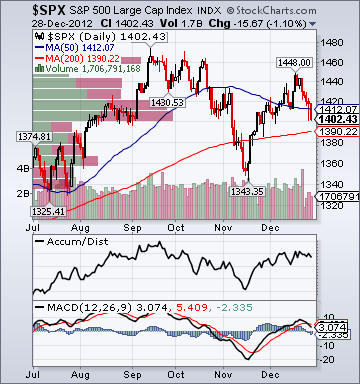
S&P 500 1,402.43 -2.86%*
The Weekly Wrap by Briefing.com.
*5-Day Change
Indices
- Russell 2000 832.10 -2.39%
- Value Line Geometric(broad market) 361.11 -2.60%
- Russell 1000 Growth 646.70 -2.75%
- Russell 1000 Value 705.27 -2.87%
- Morgan Stanley Consumer 826.75 -2.61%
- Morgan Stanley Cyclical 1,024.37 -2.64%
- Morgan Stanley Technology 673.04 -3.46%
- Transports 5,220.98 -2.55%
- Bloomberg European Bank/Financial Services 89.49 -1.65%
- MSCI Emerging Markets 43.61 +.40%
- Lyxor L/S Equity Long Bias 1,074.97 -.17%
- Lyxor L/S Equity Variable Bias 805.25 -.18%
Sentiment/Internals
- NYSE Cumulative A/D Line 158,018 -1.88%
- Bloomberg New Highs-Lows Index -91 -403
- Bloomberg Crude Oil % Bulls 50.0 +39.7%
- CFTC Oil Net Speculative Position 194,707 +6.45%
- CFTC Oil Total Open Interest 1,476,652 -1.15%
- Total Put/Call 1.06 +1.92%
- ISE Sentiment 85.0 -59.13%
- Volatility(VIX) 22.72 +28.58%
- S&P 500 Implied Correlation 71.38 +10.53%
- G7 Currency Volatility (VXY) 8.14 +5.03%
- Smart Money Flow Index 10,913.17 -.68%
- Money Mkt Mutual Fund Assets $2.665 Trillion +1.1%
Futures Spot Prices
- Reformulated Gasoline 279.99 +1.50%
- Bloomberg Base Metals Index 211.72 +.57%
- US No. 1 Heavy Melt Scrap Steel 349.67 USD/Ton unch.
- China Iron Ore Spot 139.40 USD/Ton +2.95%
- UBS-Bloomberg Agriculture 1,574.28 -.48%
Economy
- ECRI Weekly Leading Economic Index Growth Rate 5.4% +80 basis points
- Philly Fed ADS Real-Time Business Conditions Index .3922 -4.5%
- S&P 500 Blended Forward 12 Months Mean EPS Estimate 112.10 -.08%
- Citi US Economic Surprise Index 47.70 -7.1 points
- Fed Fund Futures imply 60.0% chance of no change, 40.0% chance of 25 basis point cut on 1/30
- US Dollar Index 79.68 +.53%
- Yield Curve 145.0 -4 basis points
- 10-Year US Treasury Yield 1.70% -6 basis points
- Federal Reserve's Balance Sheet $2.890 Trillion -.44%
- U.S. Sovereign Debt Credit Default Swap 36.0 -5.51%
- Illinois Municipal Debt Credit Default Swap 178.0 -1.16%
- Western Europe Sovereign Debt Credit Default Swap Index 110.43 +.26%
- Emerging Markets Sovereign Debt CDS Index 161.54 +.25%
- Israel Sovereign Debt Credit Default Swap 135.98 +1.99%
- Iraq Sovereign Debt Credit Default Swap 465.57 +1.92%
- China Blended Corporate Spread Index 369.0 +3 basis points
- 10-Year TIPS Spread 2.44% -4 basis points
- TED Spread 30.25 +4.75 basis points
- 2-Year Swap Spread 14.25 +1.25 basis points
- 3-Month EUR/USD Cross-Currency Basis Swap -21.25 +4.0 basis points
- N. America Investment Grade Credit Default Swap Index 95.52 +3.49%
- European Financial Sector Credit Default Swap Index 140.96 +1.53%
- Emerging Markets Credit Default Swap Index 210.49 -.24%
- CMBS Super Senior AAA 10-Year Treasury Spread 90.0 unch.
- M1 Money Supply $2.432 Trillion -1.80%
- Commercial Paper Outstanding 1,065.60 +.70%
- 4-Week Moving Average of Jobless Claims 356,800 -11,000
- Continuing Claims Unemployment Rate 2.5% unch.
- Average 30-Year Mortgage Rate 3.35% -2 basis points
- Weekly Mortgage Applications 817.0 n/a
- Bloomberg Consumer Comfort -32.1 -.2 point
- Weekly Retail Sales +2.40% +20 basis points
- Nationwide Gas $3.28/gallon +.05/gallon
- U.S. Heating Demand Next 7 Days n/a
- Baltic Dry Index 699.0 -8.75%
- China (Export) Containerized Freight Index 1,113.58 +.54%
- Oil Tanker Rate(Arabian Gulf to U.S. Gulf Coast) 27.50 unch.
- Rail Freight Carloads 240,119 -4.71%
Best Performing Style
Worst Performing Style
Leading Sectors
Lagging Sectors
Weekly High-Volume Stock Gainers (2)
Weekly High-Volume Stock Losers (3)
Weekly Charts
ETFs
Stocks
*5-Day Change
U.S. Week Ahead by MarketWatch (video).
Wall St. Week Ahead by Reuters.
Stocks to Watch Monday by MarketWatch.
Weekly Economic Calendar by Briefing.com.
BOTTOM LINE:
I expect US stocks to finish the week modestly lower on rising US
fiscal cliff concerns, Eurozone debt angst, technical selling,
profit-taking, more shorting
and global growth fears. My intermediate-term trading indicators are
giving neutral signals and the Portfolio is 25% net long heading into
the week.

