I originally wrote this post for The Street.com's Street Insight 2 weeks ago. I usually post 10-12 times a day on The Long/Short Trader inside of Street Insight. To try a free trial or subscribe click here.
Editor's Picks
7/19/2005 1:19 PM EDT
The Second-Half Bull Run Has Begun
Looking for 10%-Plus by Year-End
Since my last intermediate-term outlook, the S&P 500 has returned about 4.5%; 3.13 percentage points of this has occurred since June 30.
I said that I expected much better performance by the major averages in the second half of the year based on slowing but stable growth, lower inflation expectations, a stable dollar, declining commodity prices, reasonable valuations and excessive pessimism. I continue to hold these views.
Europe and Asia Will Pressure U.S. Growth
Growth in Europe, already near stagnation at around 1.0%, will likely continue to slow or turn negative as a result of the London bombings and political turmoil in the region. Europe's problems run deep and a quick solution is not forthcoming. However, political developments in Germany are encouraging.
As well, numerous signs abound of slowing Chinese growth. Even a modest decline in China's growth rate would send ripples throughout Asia and, therefore, the world. Almost every leading indicator in China is pointing to slowing growth. Demand growth for commodities from the country is plunging from last year's brisk levels. Excess capacity has been generated in China in numerous sectors, which will likely result in a return of deflation worries in the region.
Decelerating inflation and lower prices for oil imports should help boost U.S. GDP growth in the near term. While economic growth has picked-up recently from average rates to around 3.7%-4.0%, weakening global economies will likely send U.S. GDP growth back to around 3.0% early next year.
Inflation Set to Decline Further
Rising commodity prices have been the largest source of inflationary pressures. The CRB Index rose about 77.0% from lows set in early 1999 through March 2005 highs. Specifically, crude oil prices have risen about 465% since lows set during the Asian crisis of 1998 to the highs of recent weeks. This spurred a cyclical upturn in U.S. inflation, which was modest by historic standards. However, as I surmised here, I believe the secular trend of disinflation remains intact and is beginning to reassert itself.
A Cyclical Bear for Commodities?
Declining global demand, excess supply created to satisfy emerging economies' booming growth of recent years and a firmer U.S. dollar will likely push the CRB into, at the very least, a cyclical bear market. I continue to believe oil prices will collapse during the second half of the year to around $35-$40 per barrel.
Recently, the CRB has had a very high correlation with measures of inflation. As well, a number of global economies have been big beneficiaries of the commodities boom. A cyclical commodity bear would disproportionately affect the economies of these nations, further damping global growth.
Unit Labor Costs Should Remain in Check
Disinflationary forces, as a result of the 90s bubble, are still impacting the tech, biotech, airline, retail, auto, telecom, broadcasting and financial sectors. Capacity utilization at 80.0% is still only back to average levels.
Globalization, technological innovation, outsourcing, immigration and excessive hiring during the 90s continue to result in relatively mild unit labor cost increases compared to past expansions. Finally, U.S. job growth will likely return to more sluggish levels by early next year, thus resulting in a moderation of recent unit labor cost increases, which will further diminish inflationary concerns.
U.S. Dollar Will Remain Firm
The negative effects that oil has had on the U.S. economy are understated in my opinion. Oil has hurt the consumer to an extent, however, other factors such as an improving labor market, soaring home values, low long-term interest rates and rising stock prices have mitigated its negative effects.
Obviously, the significant decline in oil that I foresee would boost consumer spending and sentiment. However, it would also help shrink the U.S. budget and trade deficits, thus spurring further gains in the dollar. While the budget deficit would likely continue improving meaningfully under this scenario, the trade deficit will only improve marginally until reforms accelerate and growth improves in foreign nations.
Also, the recent political setbacks for the European Union are significant and ramifications underestimated. I expect the European Central Bank to cut interest rates over the coming months, notwithstanding comments by bankers suggesting otherwise. Recent global central bank diversification into the euro currency will likely subside. Finally, the relative health of the U.S. economy compared to other industrialized nations will become even more pronounced, thus further boosting demand for U.S. assets and the dollar.
Interest Rates to Remain Relatively Low
I had anticipated the Fed "pausing" after last month's rate hike. However, this appears increasingly unlikely with U.S. economic growth accelerating back to above-average rates. Also, I still suspect the Fed will pause before year-end. I do not believe they are overly concerned about inflation at this point.
Any subsequent rate hikes are likely the result of worries over the U.S. housing market and the belief that they need "ammunition" for the next crisis. However, weak global growth, decelerating U.S. growth, a moderation in home price appreciation, falling commodity prices and subdued unit labor costs will likely prompt a "pause." The 10-year T-note yield will likely rise to around 4.3%-4.4% over the coming months before falling back below 4% by earlier next year.
Goldilocks Returns and the Negativity Bubble Bursts
Recent economic data have been "better-than-Goldilocks" as growth has accelerated to above-average rates while inflation has decelerated. Goldilocks will likely appear in full form early next year, characterized by average economic growth with low inflation. Investors appear to be in the initial stage of anticipating her return.
I believe there has been a negativity bubble (meaning exceptional pessimism relative to reality) in the U.S. that began with the tech sector meltdown in early 2000 and is currently in the initial stages of bursting. The bubble inflated as the Nasdaq collapse brought comparisons of the 1929 crash and its ensuing economic devastation. The Bush/Gore election turmoil, recession, the 9/11 terrorist attacks, corporate scandals, the Iraq war, record-setting hurricanes and other natural disasters helped further inflate the bubble.
The negativity bubble peaked shortly before the Bush/Kerry election when talk of an impending recession, a U.S. dollar collapse, soaring inflation, spiraling twin deficits, a housing collapse, a horrible job market and a consumer meltdown were all the rage. Since the election, the air has been slowly seeping from the bubble. However, high energy prices, continuing negative political rhetoric and talk of an impending bankruptcy at General Motors (GM) had kept it intact.
The historically bitter political rhetoric will clearly not end anytime soon and will likely escalate. However, the problems at GM are now at least temporarily under control and I expect Goldilocks return to provide the catalyst for the temporary death of the negativity bubble.
'Buy All Dips' Returns
After 2000, the prevailing wisdom of the "smart money" crowd was to "sell every rally" as the major indices imploded. From early 2003 through early 2004, a "buy the dips" strategy was the wisest. Then from early 2004 through mid-2005 the "buy every dip and sell every rally" strategy prevailed as the major indices consolidated gains. I believe we have now entered an intermediate-term period that a "buy all dips" strategy will once again outperform.
Has There Been a Short-Selling Mania?
Market-neutral and negatively correlated strategies have seen a historical flood of cash inflows over the last few years as the negativity bubble grew and long-biased strategies languished. Total short sales have risen around 252% since 1999. Public short sales have risen an astounding 776% during this same period.
Many day-trading message boards that used to be filled with tales of the next profitless Internet stock that would soon duplicate the success of Yahoo! (YHOO) or eBay (EBAY) are now filled with newly minted short-sellers talking about $200-per-barrel oil sending the U.S. economy into a depression. There is more money betting against the U.S. market than at any time in our history. I believe many nimble investors are now positioning for a sell-off after recent gains believing the trading range is still intact.
P/E Multiples Expand
A Goldilocks U.S. economy, stronger dollar, weaker overseas economies, increased merger activity and more optimism should allow for P/E multiples, which have been contracting for several years, to expand.
The forward P/E on the S&P 500 is 16.4 vs. a historic average of around 12.0. However, I would argue that in the current environment the market deserves a premium multiple not an average one. Moreover, I expect earnings to exceed relatively pessimistic forward estimates.
Growth Takes the Reins from Value
The growth style has lagged value since 2000; however, I expect this trend to reverse given the environment I foresee. The belief in most circles that the U.S. dollar has only temporarily stabilized will likely result in increased foreign takeovers of U.S. companies for a premium. Moreover, the recent trend of significant capital inflows into funds investing in overseas companies will likely reverse as global growth slows and the dollar remains firm.
U.S. Stocks Should See Substantial Intermediate-Term Gains
I expect cyclical, defense, utility, telecom, commodity, hospital and pharmaceutical stocks to underperform over the intermediate-term and technology, biotechnology, medical, retail, airline, homebuilding, restaurant and financial shares to outperform during this period. As well, small caps will likely continue to remain strong as the dollar stays firm, global growth slows and the popularity of emerging market funds wanes.
U.S. stocks are overbought short term and are due for a period of consolidation. However, I expect at least a double-digit return from current levels in the major indices by year-end as fundamentals remain relatively strong, demand increases for U.S. assets, interest rates remain relatively low, P/E multiples expand and short-covering increases.
Sunday, July 31, 2005
Saturday, July 30, 2005
Market Week in Review

S&P 500 1,234.18 +.04%*
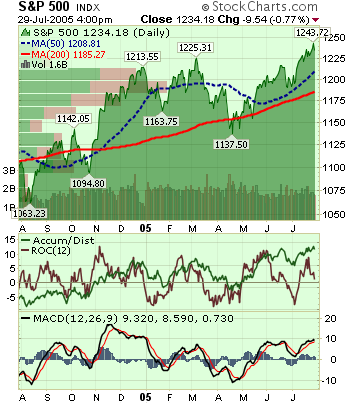
Click here for the Weekly Wrap by Briefing.com.
*5-day % Change
Click here for the Weekly Wrap by Briefing.com.
BOTTOM LINE: Overall, last week's market performance was modestly positive as stocks consolidated recent gains. With 70% of S&P 500 companies reporting, about 70% have exceeded expectations and earnings are running more than 10% above year-ago levels. The advance/decline line rose, almost every sector gained and volume was about average on the week. Measures of investor anxiety were mostly higher. However, the AAII % Bulls rebounded sharply for the week and is now at above-average levels. Mortgage rates rose again, but are still only 56 basis points away from all-time lows set in June 2003. The benchmark 10-year T-note yield continued to rise on very positive economic reports. Cyclical and technology stocks outperformed on economic optimism and strong earnings reports. Moreover, optimism over the possibility of sweeping telecommunications deregulation boosted the Telecom, Wireless and Networking sectors. Finally, oil rose for the week as multiple refinery fires and a strong US economy heightened fears of a fourth quarter crude supply shortfall.
*5-day % Change
Friday, July 29, 2005
Weekly Scoreboard*
Indices
S&P 500 1,234.18 +.04%
DJIA 10,640.91 -.10%
NASDAQ 2,184.83 +.23%
Russell 2000 679.75 +.29%
DJ Wilshire 5000 12,333.31 +.18%
S&P Equity Long/Short Index 1,045.30 +.31%
S&P Barra Growth 591.91 -.01%
S&P Barra Value 637.87 +.09%
Morgan Stanley Consumer 590.13 +.61%
Morgan Stanley Cyclical 761.37 +.38%
Morgan Stanley Technology 500.54 +.36%
Transports 3,799.95 +.53%
Utilities 397.29 +1.11%
S&P 500 Cum A/D Line 8,705.00 +5.94%
Bloomberg Crude Oil % Bulls 50.0 +146.67%
Put/Call .88 +10.0%
NYSE Arms 1.41 +38.23%
Volatility(VIX) 11.57 +9.98%
ISE Sentiment 166.00 +3.75%
AAII % Bulls 57.52 +39.68%
US Dollar 89.35 -.35%
CRB 312.00 +2.55%
Futures Spot Prices
Crude Oil 60.57 +3.27%
Unleaded Gasoline 172.61 +2.26%
Natural Gas 7.88 +6.12%
Heating Oil 167.62 +2.52%
Gold 435.30 +.79%
Base Metals 126.42 +1.35%
Copper 164.45 +1.70%
10-year US Treasury Yield 4.28% +1.35%
Average 30-year Mortgage Rate 5.77% +.70%
Leading Sectors
Wireless +2.87%
Telecom +2.60%
Networking +2.16%
Lagging Sectors
Computer Hardware -2.53%
Gold & Silver -2.60%
Oil Tankers -3.28%
*5-Day % Change
S&P 500 1,234.18 +.04%
DJIA 10,640.91 -.10%
NASDAQ 2,184.83 +.23%
Russell 2000 679.75 +.29%
DJ Wilshire 5000 12,333.31 +.18%
S&P Equity Long/Short Index 1,045.30 +.31%
S&P Barra Growth 591.91 -.01%
S&P Barra Value 637.87 +.09%
Morgan Stanley Consumer 590.13 +.61%
Morgan Stanley Cyclical 761.37 +.38%
Morgan Stanley Technology 500.54 +.36%
Transports 3,799.95 +.53%
Utilities 397.29 +1.11%
S&P 500 Cum A/D Line 8,705.00 +5.94%
Bloomberg Crude Oil % Bulls 50.0 +146.67%
Put/Call .88 +10.0%
NYSE Arms 1.41 +38.23%
Volatility(VIX) 11.57 +9.98%
ISE Sentiment 166.00 +3.75%
AAII % Bulls 57.52 +39.68%
US Dollar 89.35 -.35%
CRB 312.00 +2.55%
Futures Spot Prices
Crude Oil 60.57 +3.27%
Unleaded Gasoline 172.61 +2.26%
Natural Gas 7.88 +6.12%
Heating Oil 167.62 +2.52%
Gold 435.30 +.79%
Base Metals 126.42 +1.35%
Copper 164.45 +1.70%
10-year US Treasury Yield 4.28% +1.35%
Average 30-year Mortgage Rate 5.77% +.70%
Leading Sectors
Wireless +2.87%
Telecom +2.60%
Networking +2.16%
Lagging Sectors
Computer Hardware -2.53%
Gold & Silver -2.60%
Oil Tankers -3.28%
*5-Day % Change
Stocks Modestly Lower Mid-day on Rising Rates and Energy
Indices
S&P 500 1,240.02 -.30%
DJIA 10,693.61 +.10%
NASDAQ 2,192.48 -.27%
Russell 2000 681.35 -.25%
DJ Wilshire 5000 12,383.64 26%
S&P Barra Growth 594.91 -.35%
S&P Barra Value 640.96 -.20%
Morgan Stanley Consumer 592.29 -.09%
Morgan Stanley Cyclical 764.96 -.33%
Morgan Stanley Technology 502.11 -.50%
Transports 3,806.79 -.28%
Utilities 398.71 +.36%
Put/Call .88 +12.82%
NYSE Arms 1.13 +11.69%
Volatility(VIX) 11.33 +7.70%
ISE Sentiment 202.00 +36.49%
US Dollar 89.33 -.01%
CRB 311.56 +.33%
Futures Spot Prices
Crude Oil 60.30 +.60%
Unleaded Gasoline 175.10 +1.68%
Natural Gas 7.85 +2.03%
Heating Oil 164.00 -.33%
Gold 435.80 +.58%
Base Metals 126.42 +.32%
Copper 164.45 -.27%
10-year US Treasury Yield 4.29% +2.50%
Leading Sectors
Restaurants +1.73%
Papers +1.23%
Airlines +1.17%
Lagging Sectors
I-Banks -.88%
Software -.99%
Homebuilders -1.29%
S&P 500 1,240.02 -.30%
DJIA 10,693.61 +.10%
NASDAQ 2,192.48 -.27%
Russell 2000 681.35 -.25%
DJ Wilshire 5000 12,383.64 26%
S&P Barra Growth 594.91 -.35%
S&P Barra Value 640.96 -.20%
Morgan Stanley Consumer 592.29 -.09%
Morgan Stanley Cyclical 764.96 -.33%
Morgan Stanley Technology 502.11 -.50%
Transports 3,806.79 -.28%
Utilities 398.71 +.36%
Put/Call .88 +12.82%
NYSE Arms 1.13 +11.69%
Volatility(VIX) 11.33 +7.70%
ISE Sentiment 202.00 +36.49%
US Dollar 89.33 -.01%
CRB 311.56 +.33%
Futures Spot Prices
Crude Oil 60.30 +.60%
Unleaded Gasoline 175.10 +1.68%
Natural Gas 7.85 +2.03%
Heating Oil 164.00 -.33%
Gold 435.80 +.58%
Base Metals 126.42 +.32%
Copper 164.45 -.27%
10-year US Treasury Yield 4.29% +2.50%
Leading Sectors
Restaurants +1.73%
Papers +1.23%
Airlines +1.17%
Lagging Sectors
I-Banks -.88%
Software -.99%
Homebuilders -1.29%
BOTTOM LINE: The Portfolio is lower mid-day on losses in my Homebuilding, Medical and Retail longs. I have not traded today, thus leaving the Portfolio 100% net long. The tone of the market is slightly negative as the advance/decline line is modestly lower, most sectors are lower and volume is below average. Measures of investor anxiety are mostly higher. Today’s overall market action is neutral considering the rise in energy prices and interest rates. The ECRI Weekly Leading Index remained at 134.50 this week, the same as last week. This is still up from 132.00 during the last week of May and near cycle highs of 135.90 set in mid-March. It is still forecasting healthy growth.
Today's Headlines
Bloomberg:
- The People’s Bank of China will release some “technical” details of the yuan’s currency basket.
- NY Governor Patakki ordered “hundreds” of additional National Guard troops to active duty today to augment security for NYC trains and subways according to a statement from his office.
- Six-nation talks to end North Korea’s nuclear arms program have “entered a new phase” with all sides in broad agreement on solving the crisis.
- President Bush signed legislation to reduce the number of patient injuries and deaths caused by medical mistakes.
- Crude oil is rising near $61/bbl. in NY after a fire at BP’s Texas City refinery heightened concern that fuel producers will struggle to meet increasing demand.
- US Treasuries are falling, heading for their biggest monthly drop since November, after a report suggested the economy may be growing fast enough for the Fed to keep raising interest rates beyond year-end.
- The deadline for investors to get money from Wall Street’s $1.4 billion settlement over biased research is today – and almost half may have failed to file claims.
Wall Street Journal:
- The US bond market’s muted response to the revaluation of China’s yuan indicates that the influence of Asian central banks over the US economy is overrated.
- An Iraqi radio station dedicated to promoting women’s rights is leading a fight in the country for gender equality.
- Proposed new fuel-efficiency standards for light trucks sold in the US may hurt manufacturers such as Toyota Motor and benefit larger truckmakers, including Ford Motor.
NY Times:
- US Senate majority leader Bill Frist is expected to back a bill that would increase federal funding for embryonic stem-cell research.
NY Daily News:
- Hotel occupancy in NYC is up 5% so far this year, with June bookings at a record 90.4% of capacity.
- The People’s Bank of China will release some “technical” details of the yuan’s currency basket.
- NY Governor Patakki ordered “hundreds” of additional National Guard troops to active duty today to augment security for NYC trains and subways according to a statement from his office.
- Six-nation talks to end North Korea’s nuclear arms program have “entered a new phase” with all sides in broad agreement on solving the crisis.
- President Bush signed legislation to reduce the number of patient injuries and deaths caused by medical mistakes.
- Crude oil is rising near $61/bbl. in NY after a fire at BP’s Texas City refinery heightened concern that fuel producers will struggle to meet increasing demand.
- US Treasuries are falling, heading for their biggest monthly drop since November, after a report suggested the economy may be growing fast enough for the Fed to keep raising interest rates beyond year-end.
- The deadline for investors to get money from Wall Street’s $1.4 billion settlement over biased research is today – and almost half may have failed to file claims.
Wall Street Journal:
- The US bond market’s muted response to the revaluation of China’s yuan indicates that the influence of Asian central banks over the US economy is overrated.
- An Iraqi radio station dedicated to promoting women’s rights is leading a fight in the country for gender equality.
- Proposed new fuel-efficiency standards for light trucks sold in the US may hurt manufacturers such as Toyota Motor and benefit larger truckmakers, including Ford Motor.
NY Times:
- US Senate majority leader Bill Frist is expected to back a bill that would increase federal funding for embryonic stem-cell research.
NY Daily News:
- Hotel occupancy in NYC is up 5% so far this year, with June bookings at a record 90.4% of capacity.
Recent US Growth Best in 19 Years, Inflation Contained, Confidence Improving, Manufacturing Rebounding Vigorously
- 2Q Advance GDP rose 3.4% versus estimates of a 3.5% rise and a 3.8% gain in 1Q.
- 2Q Advance Personal Consumption rose 3.3% versus estimates of a 3.5% increase and a 3.5% gain in 1Q.
- 2Q Advance GDP Price Index rose 2.4% versus estimates of a 2.6% gain and a 3.1% rise in 1Q.
- The 2Q Employment Cost Index rose .7% versus estimates of a .8% increase and a .7% gain in 1Q.
- Final Univ. of Mich. Consumer Confidence for July was 96.5 versus estimates of 96.5 and a prior estimate of 96.5.
- Chicago Purchasing Manager for July rose to 63.5 versus estimates of 55.0 and a reading of 53.6 in June.
- 2Q Advance Personal Consumption rose 3.3% versus estimates of a 3.5% increase and a 3.5% gain in 1Q.
- 2Q Advance GDP Price Index rose 2.4% versus estimates of a 2.6% gain and a 3.1% rise in 1Q.
- The 2Q Employment Cost Index rose .7% versus estimates of a .8% increase and a .7% gain in 1Q.
- Final Univ. of Mich. Consumer Confidence for July was 96.5 versus estimates of 96.5 and a prior estimate of 96.5.
- Chicago Purchasing Manager for July rose to 63.5 versus estimates of 55.0 and a reading of 53.6 in June.
BOTTOM LINE: The US economy grew at a 3.4% annual pace in the second quarter, the ninth straight quarter exceeding 3%, as sales boomed, allowing companies to pare bloated inventories, Bloomberg reported. The string of quarterly growth increases exceeding 3% is the longest since the 13 quarters ended in the first three months of 1986. A measure of demand excluding inventories rose 5.8%, the fastest rate in almost 2 years. The measure of prices paid by consumers for goods and services excluding food and energy increased at a 1.8% annual rate versus a 2.4% increase in 1Q. A narrowing trade deficit added 1.6 percentage points to GDP, the most since the fourth quarter of 1996. I now expect US GDP growth to come in around 4% during 3Q.
Employment costs, the main component of inflation, rose less than expected as benefit costs showed the smallest gain in more than three years. The Fed said in its Beige Book report that wage pressure “remained moderate.” This is more evidence that inflation is contained.
US consumer confidence rose to the highest level this year, boosted by a booming housing market, rising stocks market and a healthy labor market. The current conditions index, which reflects Americans’ perception of their financial situation and whether it’s a good time to buy big-ticket items, rose to 113.5 from 113.2 the prior month. The expectations index rose to 85.5 from 85 in June. This is a positive considering the terrorist bombings in London and record gas prices. I expect confidence to increase through year-end.
The Chicago PMI soared in July by the most since 1983 as manufacturing accelerated from en early year slump. The new-orders index jumped to 69.6 from 56.5. The production index increased to 70.5 from 57.8 and the prices paid index increased modestly to 61.3 from 59.7 the prior month. The manufacturing correction is definitely over and should help boost GDP in subsequent quarters.
Subscribe to:
Posts (Atom)