Sunday, September 11, 2005
Economic Week in Review

ECRI Weekly Leading Index 135.90 +.44%
ISM Non-Manufacturing for August rose to 65.0 versus estimates of 60.0 and a reading of 60.5 in July. Growth at US service companies unexpectedly accelerated in August, suggesting the economy was strong even as energy prices rose before Hurricane Katrina struck, Bloomberg said. The new orders component of the index rose to 65.8, the highest in two years. Export orders soared from 53.5 in July to 63.5. The prices paid component of the index fell to 67.1 from 70.3 in July. Finally, the employment gauge rose to 59.6 from 56.2 in July. “The economy had a lot of momentum before the hurricane,” said James O’Sullivan, a senior economist at UBS Securities. “September numbers are going to be a lot weaker just because of the local hit to Alabama, Mississippi and Louisiana. More likely it will prove to be a temporary weakening.
Final 2Q Non-farm Productivity rose 1.8% versus estimates of a 2.1% increase and a 2.2% prior estimate. Final 2Q Unit Labor Costs rose 2.5% versus estimates of a 1.4% gain and a 1.3% prior estimate. US worker productivity grew at a slower-than-expected pace from April through June and labor costs accelerated, which may prompt the Fed to keep raising interest rates, Bloomberg reported. “This is an argument for the Fed raising rates. We expect they’ll continue to do so even with the effects of the hurricane,” said David Sloan, senior economist at 4Cast Inc.
The US economy expanded in the six weeks before Hurricane Katrina struck, led by car sales and tourism, the Fed’s Beige Book report stated. Eleven of the 12 Fed districts reported increased economic growth, Bloomberg reported. “Growth was widespread,” the report said. “A few districts reported softening in residential real estate markets, albeit from still brisk levels,” Bloomberg reported. Forecasts for US economic growth are being pared back after the hurricane. The effects of the storm, especially rising energy costs, may slow growth by as much as a full percentage point during the second half of the year, according to the Congressional Budget Office.
Initial Jobless Claims for last week fell to 319K versus estimates of 315K and 320K the prior week. Continuing Claims fell to 2593K versus estimates of 2582K and 2598K prior. The number of Americans filing first-time claims for jobless benefits fell to 319,000 last week, as people thrown out of work by Hurricane Katrina weren’t able to apply for benefits, Bloomberg said. According to the CBO, Hurricane Katrina may cost the US economy 400,000 jobs this year. The four-week moving average of jobless claims rose to 318,500 from 316,500 the prior week. The insured employment rate, which tracks the US unemployment rate, was unchanged at 2%. “We do expect a surge in claims to the 360,000 to 380,000 area over the weeks ahead,” said Mike Englund, chief US economist at Action Economics LLC in Boulder, Colorado.
Wholesale Inventories for July fell .1% versus estimates of a .6% increase and a .4% gain in June. Stockpiles at US wholesalers unexpectedly fell in July for the first time in more than a year, led by a drop in supplies at computer-equipment, metals and pharmaceutical companies, Bloomberg said. Drug stockpiles fell 4.9%, the most on record. The inventory-to-sales ratio fell to 1.18 months, the lowest since April. “There will be a rebound in inventories, but it probably won’t happen in September because of Katrina,” said Mike Englund.
Consumer Credit for July fell to $4.4B versus estimates of $10.0B and $14.6B in June. Borrowing by US consumers increased for a second month in July as Americans financed new cars at discounted prices, Bloomberg reported. “Consumer credit growth, which does not include mortgage related debt, has growth very slowly over the last several year,” said Stephen Stanley, chief economist at RBS Greenwich Capital. “People are refinancing their mortgages and paying down credit card debt and people are in better financial shape.”
The Import Price Index for August rose 1.3% versus estimates of a 1.4% gain and a .8% increase in July. Prices of goods imported into the US rose in August by the most in five months as crude oil costs climbed even before Hurricane Katrina struck the Gulf Coast, Bloomberg said. The price of crude hit a record the day after Katrina struck. The cost of most other imported industrial goods and consumer products either declined or were mostly unchanged. Excluding petroleum, prices were up 1.8% year-over-year, the smallest increase since March 2004. As well, excluding energy, import prices have now fallen over the last four months. Moreover, the price of goods from China has declined 1.3% over the last 12 months. “Take out all the fuels, and import prices have fallen in the last four months, and that’s a lovely performance,” said Kevin Harris, chief economist at Informa Global Markets
ISM Non-Manufacturing for August rose to 65.0 versus estimates of 60.0 and a reading of 60.5 in July. Growth at US service companies unexpectedly accelerated in August, suggesting the economy was strong even as energy prices rose before Hurricane Katrina struck, Bloomberg said. The new orders component of the index rose to 65.8, the highest in two years. Export orders soared from 53.5 in July to 63.5. The prices paid component of the index fell to 67.1 from 70.3 in July. Finally, the employment gauge rose to 59.6 from 56.2 in July. “The economy had a lot of momentum before the hurricane,” said James O’Sullivan, a senior economist at UBS Securities. “September numbers are going to be a lot weaker just because of the local hit to Alabama, Mississippi and Louisiana. More likely it will prove to be a temporary weakening.
Final 2Q Non-farm Productivity rose 1.8% versus estimates of a 2.1% increase and a 2.2% prior estimate. Final 2Q Unit Labor Costs rose 2.5% versus estimates of a 1.4% gain and a 1.3% prior estimate. US worker productivity grew at a slower-than-expected pace from April through June and labor costs accelerated, which may prompt the Fed to keep raising interest rates, Bloomberg reported. “This is an argument for the Fed raising rates. We expect they’ll continue to do so even with the effects of the hurricane,” said David Sloan, senior economist at 4Cast Inc.
The US economy expanded in the six weeks before Hurricane Katrina struck, led by car sales and tourism, the Fed’s Beige Book report stated. Eleven of the 12 Fed districts reported increased economic growth, Bloomberg reported. “Growth was widespread,” the report said. “A few districts reported softening in residential real estate markets, albeit from still brisk levels,” Bloomberg reported. Forecasts for US economic growth are being pared back after the hurricane. The effects of the storm, especially rising energy costs, may slow growth by as much as a full percentage point during the second half of the year, according to the Congressional Budget Office.
Initial Jobless Claims for last week fell to 319K versus estimates of 315K and 320K the prior week. Continuing Claims fell to 2593K versus estimates of 2582K and 2598K prior. The number of Americans filing first-time claims for jobless benefits fell to 319,000 last week, as people thrown out of work by Hurricane Katrina weren’t able to apply for benefits, Bloomberg said. According to the CBO, Hurricane Katrina may cost the US economy 400,000 jobs this year. The four-week moving average of jobless claims rose to 318,500 from 316,500 the prior week. The insured employment rate, which tracks the US unemployment rate, was unchanged at 2%. “We do expect a surge in claims to the 360,000 to 380,000 area over the weeks ahead,” said Mike Englund, chief US economist at Action Economics LLC in Boulder, Colorado.
Wholesale Inventories for July fell .1% versus estimates of a .6% increase and a .4% gain in June. Stockpiles at US wholesalers unexpectedly fell in July for the first time in more than a year, led by a drop in supplies at computer-equipment, metals and pharmaceutical companies, Bloomberg said. Drug stockpiles fell 4.9%, the most on record. The inventory-to-sales ratio fell to 1.18 months, the lowest since April. “There will be a rebound in inventories, but it probably won’t happen in September because of Katrina,” said Mike Englund.
Consumer Credit for July fell to $4.4B versus estimates of $10.0B and $14.6B in June. Borrowing by US consumers increased for a second month in July as Americans financed new cars at discounted prices, Bloomberg reported. “Consumer credit growth, which does not include mortgage related debt, has growth very slowly over the last several year,” said Stephen Stanley, chief economist at RBS Greenwich Capital. “People are refinancing their mortgages and paying down credit card debt and people are in better financial shape.”
The Import Price Index for August rose 1.3% versus estimates of a 1.4% gain and a .8% increase in July. Prices of goods imported into the US rose in August by the most in five months as crude oil costs climbed even before Hurricane Katrina struck the Gulf Coast, Bloomberg said. The price of crude hit a record the day after Katrina struck. The cost of most other imported industrial goods and consumer products either declined or were mostly unchanged. Excluding petroleum, prices were up 1.8% year-over-year, the smallest increase since March 2004. As well, excluding energy, import prices have now fallen over the last four months. Moreover, the price of goods from China has declined 1.3% over the last 12 months. “Take out all the fuels, and import prices have fallen in the last four months, and that’s a lovely performance,” said Kevin Harris, chief economist at Informa Global Markets
BOTTOM LINE: Overall, last week's economic data were mixed. The ISM Non-Manufacturing was surprisingly strong. However, the negative effects of Katrina will hurt future readings for several months. The 2.5% increase in unit labor costs is still below the long-term average of a 3.4% quarterly increase. Hurricane rebuilding could temporarily push labor costs to unacceptable levels. I expect initial jobless claims to begin spiking next week as Katrina victims are able to file. Inventories should begin increasing again as port problems in Louisiana improve over the coming weeks. Consumer credit will remain subdued in the near-term as recent spending on autos and homes is digested. With the exception of commodity prices, most costs are well contained. This is likely the reason the 10-year T-note yield remains low even with the effects of Katrina. Looking past the temporary inflationary effects of Katrina, bond investors see decelerating inflation readings once again. The full impact of Katrina is hard to gauge at this point. US GDP growth, which was set to rise at a torrid 4.5%+ during the third quarter, will now likely rise around 3.0% due to the hurricane. The fact that energy prices are now below pre-Katrina levels, leads me to believe the Fed is less likely to “pause” after the Sept. meeting. Finally, the ECRI Weekly Leading Index rose .44% to cycle highs of 135.90 and is forecasting stable healthy growth. However, this reading will likely begin turning lower next week.
Saturday, September 10, 2005
Market Week in Review
S&P 500 1,241.48 +1.63%*
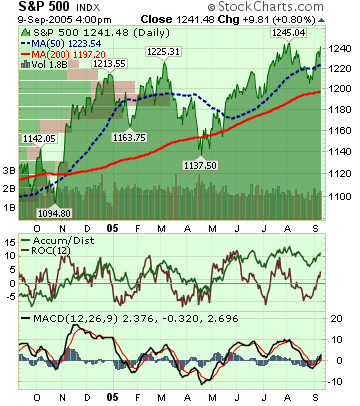
Click here for the Weekly Wrap by Briefing.com.
*5-day % Change
Click here for the Weekly Wrap by Briefing.com.
BOTTOM LINE: Overall, last week's market performance was very positive. The advance/decline line rose, almost every sector gained and volume was below average on the week. Measures of investor anxiety were lower. The AAII % Bulls rose for the week, but is still slightly below average levels. The average 30-year mortgage rate fell to 5.71% and is only 50 basis points above all-time lows set in June 2003 and down from 2005 highs of 6.04% set in April. The benchmark 10-year T-note yield rose 8 basis points on the week as economic data were generally more positive than had been anticipated and measures of inflation rose. These factors also boosted the US dollar and Gold. Earnings concerns resulted in the underperformance by transportation stocks. Tech stocks outperformed on the week as investors began to anticipate a strong fourth quarter. Finally, most commodity prices fell substantially as traders finally paid attention to mounting evidence of slowing global demand.
*5-day % Change
Weekly Scoreboard*
Indices
S&P 500 1,241.48 +1.63%
DJIA 10,678.56 +2.09%
NASDAQ 2,175.51 +1.28%
Russell 2000 678.05 +1.44%
DJ Wilshire 5000 12,407.05 +1.56%
S&P Equity Long/Short Index 1,066.63 +.72%
S&P Barra Growth 594.26 +1.77%
S&P Barra Value 642.86 +1.49%
Morgan Stanley Consumer 592.16 +2.04%
Morgan Stanley Cyclical 747.20 +1.34%
Morgan Stanley Technology 506.20 +2.18%
Transports 3,622.39 -1.32%
Utilities 421.05 +1.16%
S&P 500 Cum A/D Line 7,886.00 +1.35%
Bloomberg Crude Oil % Bulls 46.0 -9.48%
Put/Call .76 -32.74%
NYSE Arms .74 -39.84%
Volatility(VIX) 11.98 -8.90%
ISE Sentiment 194.00 +2.11%
AAII % Bulls 42.31 +33.22%
US Dollar 86.89 +.38%
CRB 323.32 -3.83%
Futures Spot Prices
Crude Oil 64.08 -7.73%
Unleaded Gasoline 195.97 -18.68%
Natural Gas 11.26 -4.95%
Heating Oil 189.65 -13.79%
Gold 453.40 +1.32%
Base Metals 127.09 -3.65%
Copper 160.65 -3.97%
10-year US Treasury Yield 4.12% +2.03%
Average 30-year Mortgage Rate 5.71% unch.
Leading Sectors
Restaurants +5.27%
Networking +4.66%
Steel +4.51%
Lagging Sectors
Oil Service +.13%
Broadcasting -1.18%
Oil Tankers -2.06%
One-Week High-Volume Gainers
One-Week High-Volume Losers
*5-Day % Change
S&P 500 1,241.48 +1.63%
DJIA 10,678.56 +2.09%
NASDAQ 2,175.51 +1.28%
Russell 2000 678.05 +1.44%
DJ Wilshire 5000 12,407.05 +1.56%
S&P Equity Long/Short Index 1,066.63 +.72%
S&P Barra Growth 594.26 +1.77%
S&P Barra Value 642.86 +1.49%
Morgan Stanley Consumer 592.16 +2.04%
Morgan Stanley Cyclical 747.20 +1.34%
Morgan Stanley Technology 506.20 +2.18%
Transports 3,622.39 -1.32%
Utilities 421.05 +1.16%
S&P 500 Cum A/D Line 7,886.00 +1.35%
Bloomberg Crude Oil % Bulls 46.0 -9.48%
Put/Call .76 -32.74%
NYSE Arms .74 -39.84%
Volatility(VIX) 11.98 -8.90%
ISE Sentiment 194.00 +2.11%
AAII % Bulls 42.31 +33.22%
US Dollar 86.89 +.38%
CRB 323.32 -3.83%
Futures Spot Prices
Crude Oil 64.08 -7.73%
Unleaded Gasoline 195.97 -18.68%
Natural Gas 11.26 -4.95%
Heating Oil 189.65 -13.79%
Gold 453.40 +1.32%
Base Metals 127.09 -3.65%
Copper 160.65 -3.97%
10-year US Treasury Yield 4.12% +2.03%
Average 30-year Mortgage Rate 5.71% unch.
Leading Sectors
Restaurants +5.27%
Networking +4.66%
Steel +4.51%
Lagging Sectors
Oil Service +.13%
Broadcasting -1.18%
Oil Tankers -2.06%
One-Week High-Volume Gainers
One-Week High-Volume Losers
*5-Day % Change
Friday, September 09, 2005
Stocks Modestly Higher as Long-Term Rates Decline and Energy Prices Fall
Indices
S&P 500 1,240.91 +.75%
DJIA 10,671.40 +.72%
NASDAQ 2,173.76 +.36%
Russell 2000 676.75 +.47%
DJ Wilshire 5000 12,403.50 +.73%
S&P Barra Growth 594.26 +.70%
S&P Barra Value 643.02 +.92%
Morgan Stanley Consumer 592.60 +.80%
Morgan Stanley Cyclical 747.22 +.77%
Morgan Stanley Technology 506.14 +.55%
Transports 3,618.78 -.89%
Utilities 421.73 +1.39%
Put/Call .77 -10.47%
NYSE Arms .63 -43.27%
Volatility(VIX) 12.09 -6.50%
ISE Sentiment 207.00 +32.69%
US Dollar 86.89 -.17%
CRB 323.20 -.47%
Futures Spot Prices
Crude Oil 64.00 -.76%
Unleaded Gasoline 197.50 -2.97%
Natural Gas 11.28 -.55%
Heating Oil 190.25 -1.40%
Gold 453.20 +.55%
Base Metals 127.09 -.59%
Copper 160.65 -.74%
10-year US Treasury Yield 4.12% -.56%
Leading Sectors %
Gold & Silver +2.66%
Energy +2.44%
Homebuilders +1.84%
Lagging Sectors
Disk Drives -.27%
Oil Tankers -.55%
Airlines -1.79%
S&P 500 1,240.91 +.75%
DJIA 10,671.40 +.72%
NASDAQ 2,173.76 +.36%
Russell 2000 676.75 +.47%
DJ Wilshire 5000 12,403.50 +.73%
S&P Barra Growth 594.26 +.70%
S&P Barra Value 643.02 +.92%
Morgan Stanley Consumer 592.60 +.80%
Morgan Stanley Cyclical 747.22 +.77%
Morgan Stanley Technology 506.14 +.55%
Transports 3,618.78 -.89%
Utilities 421.73 +1.39%
Put/Call .77 -10.47%
NYSE Arms .63 -43.27%
Volatility(VIX) 12.09 -6.50%
ISE Sentiment 207.00 +32.69%
US Dollar 86.89 -.17%
CRB 323.20 -.47%
Futures Spot Prices
Crude Oil 64.00 -.76%
Unleaded Gasoline 197.50 -2.97%
Natural Gas 11.28 -.55%
Heating Oil 190.25 -1.40%
Gold 453.20 +.55%
Base Metals 127.09 -.59%
Copper 160.65 -.74%
10-year US Treasury Yield 4.12% -.56%
Leading Sectors %
Gold & Silver +2.66%
Energy +2.44%
Homebuilders +1.84%
Lagging Sectors
Disk Drives -.27%
Oil Tankers -.55%
Airlines -1.79%
BOTTOM LINE: The Portfolio is higher mid-day on gains in my Oil Tanker shorts, Semiconductor longs and Internet longs. I have not traded today, thus leaving the Portfolio 100% net long. The tone of the market is modestly positive as the advance/decline line is higher, almost every sector is higher and volume is slightly below average. Measures of investor anxiety are lower. Today’s overall market action is slightly positive given declines in energy prices and long-term interest rates. Global demand for oil is not strong and it will turn negative as a result of Katrina. Oil is $3 a barrel lower than its highs before the hurricane. Import prices have declined over the last four months excluding energy. Moreover, prices of goods from China have fallen 1.3% over the last 12 months. Copper is breaking down. It is also below the highs set before the hurricane. Steel prices in the U.S. fell for the 11th straight month in August, notwithstanding the rally in the stocks. The 10-year Treasury-note yield is 4.12%, which is still near historic lows. Unit labor costs may temporarily rise more than the Fed would like as a result of Katrina, however labor costs will begin decelerating again in the first quarter of next year. The bottom line is the market is viewing Katrina as a demand-destroying event, not an inflationary one. I expect US stocks to trade mixed-to-lower from current levels into the close ahead of the 9/11 anniversary.
Today's Headlines
Bloomberg:
- The International Energy Agency cut its estimate for 2005 world oil demand growth for a third month as record-high fuel prices curb sales in China, Thailand and other developing countries in Asia.
- US consumers can expect to pay at least $400 more for heating oil this winter compared with last year after the shutdown of refineries caused by Katrina pushed prices to all-time highs.
- Governments of the North Atlantic Treaty Organization approved the use of ships and planes to help transport European aid to victims of Hurricane Katrina.
- PalmSource is being sold to Japan’s Access for as much as $324 million in cash.
- Oyster beds on the Louisiana coast, the largest US source of the shellfish, were nearly wiped out by Katrina, boosting costs for buyers such as the Oyster Bar in NY’s Grand Central Station.
- US Treasuries rose on expectations higher energy prices in the aftermath of Hurricane Katrina will slow the world’s largest economy.
- Homeland Security Secretary Michael Chertoff will replace FEMA head Michael Brown from his role leading the relief efforts following Hurricane Katrina.
Wall Street Journal:
- Japan’s Honda Motor debuts a new version of the Civic this month that it hopes will revive the model’s appeal to young, sporty buyers in the US.
- The hurricane catastrophe on the Gulf coast will probably cut US second-half economic growth and employment, according to the 56 economists polled in this month’s forecasting survey.
- Disruption caused by Hurricane Katrina may mean more US students turn to distance learning through Internet courses.
- Some Mississippi casino operators are offering their staff transfers to properties in other states in an attempt to hang onto personnel in the wake of Katrina and before reopening their venues.
- The US government requested a federal takeover of local law enforcement in New Orleans after Katrina and was rebuffed by the Louisiana governor’s office.
- Shares of Valero Energy have risen 25% since Katrina wrecked Gulf coast oil installations, pushing refining margins sky-high.
NY Times:
- Ford Motor yesterday agreed to sell its Hertz car-rental unit to a group of buyout firms for about $15 billion in cash and debt.
Market International:
- China has no plan to sell US dollar assets, citing an economist at a state-owned research institute.
- The International Energy Agency cut its estimate for 2005 world oil demand growth for a third month as record-high fuel prices curb sales in China, Thailand and other developing countries in Asia.
- US consumers can expect to pay at least $400 more for heating oil this winter compared with last year after the shutdown of refineries caused by Katrina pushed prices to all-time highs.
- Governments of the North Atlantic Treaty Organization approved the use of ships and planes to help transport European aid to victims of Hurricane Katrina.
- PalmSource is being sold to Japan’s Access for as much as $324 million in cash.
- Oyster beds on the Louisiana coast, the largest US source of the shellfish, were nearly wiped out by Katrina, boosting costs for buyers such as the Oyster Bar in NY’s Grand Central Station.
- US Treasuries rose on expectations higher energy prices in the aftermath of Hurricane Katrina will slow the world’s largest economy.
- Homeland Security Secretary Michael Chertoff will replace FEMA head Michael Brown from his role leading the relief efforts following Hurricane Katrina.
Wall Street Journal:
- Japan’s Honda Motor debuts a new version of the Civic this month that it hopes will revive the model’s appeal to young, sporty buyers in the US.
- The hurricane catastrophe on the Gulf coast will probably cut US second-half economic growth and employment, according to the 56 economists polled in this month’s forecasting survey.
- Disruption caused by Hurricane Katrina may mean more US students turn to distance learning through Internet courses.
- Some Mississippi casino operators are offering their staff transfers to properties in other states in an attempt to hang onto personnel in the wake of Katrina and before reopening their venues.
- The US government requested a federal takeover of local law enforcement in New Orleans after Katrina and was rebuffed by the Louisiana governor’s office.
- Shares of Valero Energy have risen 25% since Katrina wrecked Gulf coast oil installations, pushing refining margins sky-high.
NY Times:
- Ford Motor yesterday agreed to sell its Hertz car-rental unit to a group of buyout firms for about $15 billion in cash and debt.
Market International:
- China has no plan to sell US dollar assets, citing an economist at a state-owned research institute.
Subscribe to:
Comments (Atom)