Bloomberg:
- Crude oil fell below $60/bbl. to a six-month low after BP Plc(BP) started work to restore production at Alaska’s Prudhoe Bay, the largest US oil field, and Iran said it favors talks on the country’s nuclear program.
- BP Plc(BP) began work to resume production on a portion of the eastern side of the Prudhoe Bay oilfield in Alaska, which has been shut since early August because of leaks and corroded pipelines.
- Altria Group’s(MO) Philip Morris USA and other cigarette makers must face a class-action lawsuit on behalf of “light” cigarette smokers nationwide, a judge ruled.
- Goldman Sachs(GS) and Morgan Stanley(MS), the Wall Street giants that sell more of everything from stocks and bonds to risk-analysis software to the burgeoning hedge fund industry, may be the biggest winners after Amaranth Advisors LLC said it lost $6 billion on natural gas speculation.
- Fed Bank of Dallas President Fisher said the central bank will take “appropriate action” to reduce inflation should the slowing economy fail to do so.
- US Treasuries are rising again, pushing the 10-year T-note to a seven month high, as a continuing fall in commodity prices lessons inflation concerns.
Wall Street Journal:
- MasterCard Inc.(MC) and Visa USA are starting to fine merchants who don’t follow rules that seek to guard transactions from fraud artists.
- Four US airlines are battling for the right to fly a new daily route to China that has the potential to be highly profitable.
- Wal-Mart Stores(WMT) is confronting a cultural clash in cities such as Boston where critics see the retailer as the epitome of pedestrian suburban values.
- The US Treasury Dept. and IRS are to introduce regulations to stop transactions intended to avoid US taxes when involving foreign companies.
- US health saving accounts plans that require employees to pay as much as $5,250 a year in medical costs out of their own pockets before insurance applies have forced many employers to become medical experts.
- Venezuela’s President Chavez has created his own version of Dante’s inferno with its nine concentric circles of evil, Alvaro Vargas Llosa wrote. Poverty in Venezuela has risen from 43% in 1999 when Chavez took over to 53% in the most recent survey, citing Venezuela’s Instituto Nacional de Estadistica.
- Luxury fashion houses such as Dolce & Gabbana, Versace and Marc Jacobs are using secondary, lower-priced labels to help boost sales.
NY Times:
- In Iraq, the so-called generator man, who owns and operates the neighborhood power plant, has become probably the most vilified figure in Iraqi society after Saddam Hussein.
NY Daily News:
- The rate of crimes in the New York City subway system is the lowest in 37 years, averages seven felonies a day, citing Police Commissioner Raymond Kelly.
Washington Post:
- Iraq will need a US military presence for a “long time” to prevent “foreign interference” in its affairs, citing Iraqi President Jalal Talabani.
AP:
- The US Department of Homeland Security will announce a nearly fourfold boost in annual funding to safeguard New York and New Jersey’s port perimeters.
Washington Times:
- A Hollywood producer is suing former President Bill Clinton, saying he cheated him out of a multi-million-dollar Internet venture.
Advertising Age:
- Advertising rates for Howard Stern’s radio program on Sirius Satellite Radio(SIRI) have fallen by at least two-thirds from when he was on free radio.
El Universal:
- Venezuelan poverty leaves about 70% of the population without a bank account, citing a poll by Caracas-based research firm Datanalisis.
Monday, September 25, 2006
Existing Home Sales Exceed Estimates

- Existing Home Sales for August fell to 6.3M versus estimates of 6.2M and 6.33M in July.
BOTTOM LINE: Sales of previously owned home in the US exceeded estimates in August, Bloomberg reported. The median sales price fell 1.7% to $225,000 from a year earlier. The supply of months for sale rose to 7.5 months versus 7.3 months in July. Purchases fell 2.3% in the West and .8% in the South. Sales rose .7% in the Midwest and 1.9% in the Northeast. I continue to believe housing will begin stabilizing over the next few months after only modest price declines which would be considered a soft-landing. The overall negative effects of housing on the US economy are being mostly offset by other very positive factors.
Sunday, September 24, 2006
Monday Watch
Weekend Headlines
Bloomberg:
- The average US gasoline pump price fell 24 cents in the past two weeks to $2.42/gallon, the biggest decline in almost a year, as supplies stayed ahead of demand, Trilby Lundberg said, citing her survey of about 7,000 filling stations nationwide.
- Crude oil is falling to a 6-month low in NY as Iran’s President said his country is open to discussion on its nuclear program.
- The yen may fall to a 20-year low as individual investors in Japan join speculators on the Chicago Mercantile Exchange in selling the currency.
- Gilead Sciences(GILD) licensed eight Indian producers of generic drugs to make cheaper versions of the Viread AIDS medication, the company’s best-selling pill, for 95 countries where most people can’t afford treatment.
- European Central Bank President Jean-Claude Trichet said labor productivity is the biggest problem facing the economy of the dozen euro nations.
- US Treasury 10-year notes had their biggest weekly advance since April 2005 as traders raised bets the Fed will begin lowering interest rates.
- Honda Motor(HMC) will introduce a diesel car that meets California’s emission standards and a fuel cell-powered sports car within three years as it vies with Toyota Motor(TM) for buyers of fuel-efficient autos.
- Noble Group Ltd., which accounts for 10% of ethanol exports from Brazil, may start investing in production plants in the South American nation to benefit from forecasts of rising global demand.
- Mutual fund investors, captivated by oil’s 88% rise in two years, increased their energy holdings in 2006 just in time to lose $4.5 billion. That’s the damage US oil and gas funds recorded as crude plunged 23% from July highs, according to data compiled by Bloomberg. A total of $23.5 billion poured into energy mutual funds in the 12 months ended July 31, according to Financial Research Corp. in Boston. As well, about $67.4 billion is invested in 525 energy and commodity hedge funds, more than double the $30 billion at the start of the year, according to Energy Hedge Fund Center. There were 180 such funds in October 2004.
Wall Street Journal:
- The richest US taxpayers earned 19% of total income in 2004 versus 20.8% in 2000, citing IRS data on tax returns.
Barron’s:
- Morgan Keegan topped the list for best returns in the past year and past six months, while Charles Schwab(SCHW) had the best returns over the past three-and five-year periods, according to Barron’s semi-annual ranking of brokerages’ top share recommendations.
Forbes:
- Really, really cheap oil is coming.
NY Times:
- Ford Motor’s(F) chief sales analyst, George Pipas, expects the market for sport-utility vehicles to continue declining despite the recent drop in gas prices.
- New rules adopted in May 2005 reduced the waiting time for patients awaiting lung transplants in the US by granting organs to those who need them most.
- Congress may close the so-called Enron Corp. loophole, which allows unregulated over-the-counter trading of energy commodities, because of Amaranth Group’s loss of $6 billion on natural gas trades. The Oil and Gas Traders Oversight Act of 2006, which would require regulation of energy commodity trading, has unanimous consent to come up before the Senate.
Washington Post:
- A half-dozen bills before Congress would protect as much as 1 million acres of wilderness areas while allocating a portion to real estate developers and local communities as trade-offs.
Crain’s Chicago Business:
- UAL Corp.’s United Airlines(UAUA), the world’s second largest airline, hired Goldman Sachs(GS) to explore strategic options, including possible mergers with other carriers.
AP:
- Boyd Gaming Corp.(BYD) gave up its bid to develop a slot-machine casino in Limerick, Pennsylvania, because the township board of supervisors didn’t support the plan.
NY Post:
- Tribune Co.(TRB), owner of Newsday and the LA Times, chose Merrill Lynch to conduct any auction of the company or assets.
Star-Ledger:
- NY Waterway and Billybey Ferry Co. will reduce ferry fares from Jersey City, New Jersey, to Wall Street when they take over the route Oct. 2.
Seattle Post-Intelligencer:
- Microsoft Corp.(MSFT) has donated more than $2.5 billion to charities since 1983, including cash, software, employee contributions and company matching funds.
Financial Times:
- Hedge funds that have invested billions of dollars in reinsurance companies and catastrophe bonds are expected to receive high returns as a mild hurricane season looks more likely.
Economic Daily News:
- Taiwan Semiconductor Manufacturing(TSM) said the island’s customized chipmakers will improve sales within the next six months after their clients use up inventories, citing company Vice Chairman Tseng Fan-chen.
The Standard:
- China doesn’t need further tightening measures to cool the economy, citing Qiu Xiaohua, head of the government’s National Bureau of Statistics. The measures “are effective, we will continue with them and keep a close eye on their outcome,” Qui said.
Der Spiegel:
- DaimlerChrysler(DCX) is close to agreeing with Chery Automobile on a contract to buy cheap, small cars from the Chinese company that it will sell in the US.
The Business:
- Saudi Arabia plans to step up production to 13.5 million barrels of oil a day by 2011 to counter supply disruptions, citing new projections given to bankers in London. Previously, Saudi Arabia was aiming to stabilize its production at about 12 million barrels a day. Saudi Arabia is planning to invest $30 billion in “downstream” projects in coming years and officials are meeting bankers this week to discuss funding.
- BT Group Plc has joined forces with T-Mobile International AG as part of its effort to grow revenue by 50% a year from its combined fixed and mobile-phone service to businesses in the US.
Globe and Mail:
- Pakistan must rein in religious schools, called maddrassas, if neighboring Afghanistan is ever to know peace, Afghan President Hamid Karzai said. Such schools preach hatred for Afghanistan and the rest of the world, Karzai said.
Gulf News:
- Middle East oil producing states will spend $395 billion on energy infrastructure between 2007 and 2011, citing the Arab Petroleum Investment Corp., a Saudi Arabia-based agency that provides funding for oil and gas related projects in the Arab world.
Weekend Recommendations
Barron's:
- Made positive comments on (NJ) and (DE).
Citigroup:
- Reiterated Buy on (RHAT), target $33.
Morgan Stanley:
- Reiterated Overweight on (PCLN), target $40.
Night Trading
Asian indices are unch. to +.25% on average.
S&P 500 indicated +.08%
NASDAQ 100 indicated +.11%.
Morning Preview
US AM Market Call
NASDAQ 100 Pre-Market Indicator/Heat Map
Pre-market Commentary
Before the Bell CNBC Video(bottom right)
Global Commentary
Asian Indices
European Indices
Top 20 Business Stories
In Play
Bond Ticker
Daily Stock Events
Macro Calls
Rasmussen Consumer/Investor Daily Indices
CNBC Guest Schedule
Earnings of Note
Company/Estimate
- (JLG)/.41
- (WAG)/.41
Upcoming Splits
- None of note
Economic Releases
10:00 am EST
- Existing Home Sales for August are estimated to fall to 6.2M versus 6.33M in July.
Bloomberg:
- The average US gasoline pump price fell 24 cents in the past two weeks to $2.42/gallon, the biggest decline in almost a year, as supplies stayed ahead of demand, Trilby Lundberg said, citing her survey of about 7,000 filling stations nationwide.
- Crude oil is falling to a 6-month low in NY as Iran’s President said his country is open to discussion on its nuclear program.
- The yen may fall to a 20-year low as individual investors in Japan join speculators on the Chicago Mercantile Exchange in selling the currency.
- Gilead Sciences(GILD) licensed eight Indian producers of generic drugs to make cheaper versions of the Viread AIDS medication, the company’s best-selling pill, for 95 countries where most people can’t afford treatment.
- European Central Bank President Jean-Claude Trichet said labor productivity is the biggest problem facing the economy of the dozen euro nations.
- US Treasury 10-year notes had their biggest weekly advance since April 2005 as traders raised bets the Fed will begin lowering interest rates.
- Honda Motor(HMC) will introduce a diesel car that meets California’s emission standards and a fuel cell-powered sports car within three years as it vies with Toyota Motor(TM) for buyers of fuel-efficient autos.
- Noble Group Ltd., which accounts for 10% of ethanol exports from Brazil, may start investing in production plants in the South American nation to benefit from forecasts of rising global demand.
- Mutual fund investors, captivated by oil’s 88% rise in two years, increased their energy holdings in 2006 just in time to lose $4.5 billion. That’s the damage US oil and gas funds recorded as crude plunged 23% from July highs, according to data compiled by Bloomberg. A total of $23.5 billion poured into energy mutual funds in the 12 months ended July 31, according to Financial Research Corp. in Boston. As well, about $67.4 billion is invested in 525 energy and commodity hedge funds, more than double the $30 billion at the start of the year, according to Energy Hedge Fund Center. There were 180 such funds in October 2004.
Wall Street Journal:
- The richest US taxpayers earned 19% of total income in 2004 versus 20.8% in 2000, citing IRS data on tax returns.
Barron’s:
- Morgan Keegan topped the list for best returns in the past year and past six months, while Charles Schwab(SCHW) had the best returns over the past three-and five-year periods, according to Barron’s semi-annual ranking of brokerages’ top share recommendations.
Forbes:
- Really, really cheap oil is coming.
NY Times:
- Ford Motor’s(F) chief sales analyst, George Pipas, expects the market for sport-utility vehicles to continue declining despite the recent drop in gas prices.
- New rules adopted in May 2005 reduced the waiting time for patients awaiting lung transplants in the US by granting organs to those who need them most.
- Congress may close the so-called Enron Corp. loophole, which allows unregulated over-the-counter trading of energy commodities, because of Amaranth Group’s loss of $6 billion on natural gas trades. The Oil and Gas Traders Oversight Act of 2006, which would require regulation of energy commodity trading, has unanimous consent to come up before the Senate.
Washington Post:
- A half-dozen bills before Congress would protect as much as 1 million acres of wilderness areas while allocating a portion to real estate developers and local communities as trade-offs.
Crain’s Chicago Business:
- UAL Corp.’s United Airlines(UAUA), the world’s second largest airline, hired Goldman Sachs(GS) to explore strategic options, including possible mergers with other carriers.
AP:
- Boyd Gaming Corp.(BYD) gave up its bid to develop a slot-machine casino in Limerick, Pennsylvania, because the township board of supervisors didn’t support the plan.
NY Post:
- Tribune Co.(TRB), owner of Newsday and the LA Times, chose Merrill Lynch to conduct any auction of the company or assets.
Star-Ledger:
- NY Waterway and Billybey Ferry Co. will reduce ferry fares from Jersey City, New Jersey, to Wall Street when they take over the route Oct. 2.
Seattle Post-Intelligencer:
- Microsoft Corp.(MSFT) has donated more than $2.5 billion to charities since 1983, including cash, software, employee contributions and company matching funds.
Financial Times:
- Hedge funds that have invested billions of dollars in reinsurance companies and catastrophe bonds are expected to receive high returns as a mild hurricane season looks more likely.
Economic Daily News:
- Taiwan Semiconductor Manufacturing(TSM) said the island’s customized chipmakers will improve sales within the next six months after their clients use up inventories, citing company Vice Chairman Tseng Fan-chen.
The Standard:
- China doesn’t need further tightening measures to cool the economy, citing Qiu Xiaohua, head of the government’s National Bureau of Statistics. The measures “are effective, we will continue with them and keep a close eye on their outcome,” Qui said.
Der Spiegel:
- DaimlerChrysler(DCX) is close to agreeing with Chery Automobile on a contract to buy cheap, small cars from the Chinese company that it will sell in the US.
The Business:
- Saudi Arabia plans to step up production to 13.5 million barrels of oil a day by 2011 to counter supply disruptions, citing new projections given to bankers in London. Previously, Saudi Arabia was aiming to stabilize its production at about 12 million barrels a day. Saudi Arabia is planning to invest $30 billion in “downstream” projects in coming years and officials are meeting bankers this week to discuss funding.
- BT Group Plc has joined forces with T-Mobile International AG as part of its effort to grow revenue by 50% a year from its combined fixed and mobile-phone service to businesses in the US.
Globe and Mail:
- Pakistan must rein in religious schools, called maddrassas, if neighboring Afghanistan is ever to know peace, Afghan President Hamid Karzai said. Such schools preach hatred for Afghanistan and the rest of the world, Karzai said.
Gulf News:
- Middle East oil producing states will spend $395 billion on energy infrastructure between 2007 and 2011, citing the Arab Petroleum Investment Corp., a Saudi Arabia-based agency that provides funding for oil and gas related projects in the Arab world.
Weekend Recommendations
Barron's:
- Made positive comments on (NJ) and (DE).
Citigroup:
- Reiterated Buy on (RHAT), target $33.
Morgan Stanley:
- Reiterated Overweight on (PCLN), target $40.
Night Trading
Asian indices are unch. to +.25% on average.
S&P 500 indicated +.08%
NASDAQ 100 indicated +.11%.
Morning Preview
US AM Market Call
NASDAQ 100 Pre-Market Indicator/Heat Map
Pre-market Commentary
Before the Bell CNBC Video(bottom right)
Global Commentary
Asian Indices
European Indices
Top 20 Business Stories
In Play
Bond Ticker
Daily Stock Events
Macro Calls
Rasmussen Consumer/Investor Daily Indices
CNBC Guest Schedule
Earnings of Note
Company/Estimate
- (JLG)/.41
- (WAG)/.41
Upcoming Splits
- None of note
Economic Releases
10:00 am EST
- Existing Home Sales for August are estimated to fall to 6.2M versus 6.33M in July.
BOTTOM LINE: Asian Indices are mostly higher, boosted by technology shares in the region. I expect US stocks to open modestly lower and to rally into the afternoon, finishing modestly higher. The Portfolio is 75% net long heading into the week.
Weekly Outlook
Click here for The Week Ahead by Reuters
There are some economic reports of note and several significant corporate earnings reports scheduled for release this week.
Economic reports for the week include:
Mon. - Existing Home Sales
Tues. - Consumer Confidence
Wed. - Durable Goods Orders, New Home Sales
Thur. - Final 2Q GDP, Final 2Q GDP Price Index, Final 2Q Personal Consumption, Final 2Q PCE, Initial Jobless Claims
Fri. - Personal Income, Personal Spending, PCE Core, Univ. of Mich. Consumer Confidence
Some of the more noteworthy companies that release quarterly earnings this week are:
Mon. - JLG Industries(JLG), Walgreen(WAG)
Tues. - Dress Barn(DBRN), HB Fuller(FUL), Jabil Circuit(JBL), Lennar Corp.(LEN), Paychex(PAYX), Red Hat(RHAT), Stride Rite(SRR), Worthington Industries(WOR)
Wed. - Actuant(ATU), McCormick & Co.(MKC)
Thur. - American Greeting(AM), Family Dollar(FDO), Texas Industries(TXI)
Fri. - Global Payments(GPN)
Other events that have market-moving potential this week include:
Mon. - UBS Global Life Sciences Conference
Tue. - Merrill Lynch Global Power & Gas Conference, UBS Global Life Sciences Conference, Thomas Weisel Consumer Conference, Prudential Electrical Equip. & Consumer Electrical Conference
Wed. - UBS Global Life Sciences Conference, Merrill Lynch Global Power & Gas Conference, Prudential Electrical Equip. & Consumer Electrical Conference
Thur. - Prudential Electrical Equip. & Consumer Electrical Conference, UBS Global Life Sciences Conference
Fri. - Prudential Electrical Equip. & Consumer Electrical Conference, St. Louis’ Fed President speaks of data dependence
There are some economic reports of note and several significant corporate earnings reports scheduled for release this week.
Economic reports for the week include:
Mon. - Existing Home Sales
Tues. - Consumer Confidence
Wed. - Durable Goods Orders, New Home Sales
Thur. - Final 2Q GDP, Final 2Q GDP Price Index, Final 2Q Personal Consumption, Final 2Q PCE, Initial Jobless Claims
Fri. - Personal Income, Personal Spending, PCE Core, Univ. of Mich. Consumer Confidence
Some of the more noteworthy companies that release quarterly earnings this week are:
Mon. - JLG Industries(JLG), Walgreen(WAG)
Tues. - Dress Barn(DBRN), HB Fuller(FUL), Jabil Circuit(JBL), Lennar Corp.(LEN), Paychex(PAYX), Red Hat(RHAT), Stride Rite(SRR), Worthington Industries(WOR)
Wed. - Actuant(ATU), McCormick & Co.(MKC)
Thur. - American Greeting(AM), Family Dollar(FDO), Texas Industries(TXI)
Fri. - Global Payments(GPN)
Other events that have market-moving potential this week include:
Mon. - UBS Global Life Sciences Conference
Tue. - Merrill Lynch Global Power & Gas Conference, UBS Global Life Sciences Conference, Thomas Weisel Consumer Conference, Prudential Electrical Equip. & Consumer Electrical Conference
Wed. - UBS Global Life Sciences Conference, Merrill Lynch Global Power & Gas Conference, Prudential Electrical Equip. & Consumer Electrical Conference
Thur. - Prudential Electrical Equip. & Consumer Electrical Conference, UBS Global Life Sciences Conference
Fri. - Prudential Electrical Equip. & Consumer Electrical Conference, St. Louis’ Fed President speaks of data dependence
BOTTOM LINE: I expect US stocks to finish the week modestly higher on lower energy prices, short-covering, bargain hunting, mostly positive economic reports and less pessimism. My trading indicators are still giving bullish signals and the Portfolio is 75% net long heading into the week.
Saturday, September 23, 2006
Market Week in Review
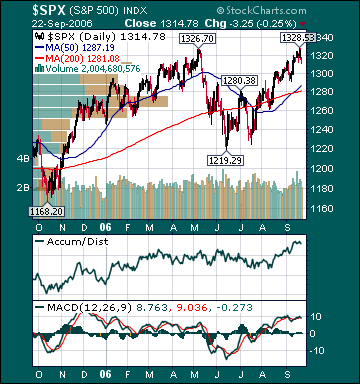
S&P 500 1,314.78 -.39%*
Click here for the Weekly Wrap by Briefing.com.
*5-day % Change
Click here for the Weekly Wrap by Briefing.com.
BOTTOM LINE: Overall, last week's market performance was mildly bearish. The advance/decline line fell, sector performance was mixed and volume was above average on the week. Measures of investor anxiety were mixed. The AAII percentage of Bulls fell to 47.75% this week from 47.95% the prior week. This reading is still slightly above average levels. The AAII percentage of Bears fell to 34.23% this week from 38.36% the prior week. This reading is still above average levels. The 10-week moving average of the percent bears is currently 39.6%. The 10-week moving-average of percent Bears was 43.0% at the major bear market lows during 2002. The only other times it was higher than these levels, since record keeping began in 1987, were the significant market bottom during the 1990 recession/Gulf War and in October 1992. The steadfastly high bearish percentage, considering the DJIA is only 2.1% from an all-time high, is still providing a wall of worry. I continue to believe the “irrational pessimism” aimed towards most US stocks has never been this great in history given the positive macro backdrop.
The average 30-year mortgage rate fell another 3 basis points to 6.40%, which is 40 basis points below July highs. I still believe housing is in the process of slowing to more healthy sustainable levels. Mortgage rates have likely begun an intermediate-term move lower, which should help stabilize housing over the next few months. The Case-Shiller housing futures are still projecting a 5% decline in the average home price over the next 9 months. Considering the average house has appreciated over 50% during the last few years, this would be considered a “soft landing.” The overall negative effects of housing on the US economy are currently being exaggerated, in my opinion. Housing has been slowing substantially for 13 months and has been mostly offset by other very positive aspects of the economy.
The benchmark 10-year T-note yield plunged 20 basis points on the week on diminishing inflation concerns and economic growth worries. In my opinion, investors overreacted to the negative Philly Fed reading. Consumer spending is much more important to the health of the US economy. Spending is poised to remain strong on plunging energy prices, falling long-term rates, a rising stock market, healthy job market, decelerating inflation and more optimism. The CRB Commodities Index, the main source of inflation fears, has now declined 8.4% over the last 12 months and is down 17.7% from May highs, approaching bear market territory. I believe inflation fears have peaked for the year as economic growth moderates to around average levels, unit labor costs remain subdued and the mania for commodities continues to reverse course.
The EIA reported this week that gasoline supplies rose less than expectations even as refinery utilization rose. Unleaded Gasoline futures dropped substantially again and are now 49.3% below September 2005 highs even as refinery utilization remains below normal as a result of the hurricanes last year, some Gulf of Mexico oil production remains shut-in and fears over future production disruptions persist. Gasoline demand is estimated to rise .8% this year versus a 20-year average of 1.7% demand growth. According to TradeSports.com, the percent chance of a US and/or Israeli strike on Iran this year has fallen to 10% from 36% late last year. The elevated level of gas prices related to crude oil production disruption speculation is further dampening fuel demand, which is sending gas prices back to more reasonable levels.
US oil inventories have only been higher during one other period over the last 7 years. Since December 2003, global oil demand is only up .7%, while global supplies have increased 4.8%, according to the Energy Intelligence Group. Moreover, worldwide inventories are poised to begin increasing at an accelerated rate over the next year. I continue to believe oil is priced at extremely elevated levels on fear and record speculation by investment funds, not fundamentals. The Amaranth Advisors hedge fund blow-up is a prime example of the extent to which many investment funds have been speculating on ever higher commodity prices. I suspect a number of other funds will experience similar fates over the coming months, which will further pressure energy prices as these funds unwind their leveraged positions.
Oil has clearly broken its uptrend, notwithstanding that this is the seasonally strong period for the commodity. A major top in oil is likely already in place. However, a Gulf hurricane could lead to a bounce higher in price over the next few weeks accelerating demand destruction, resulting in a complete technical breakdown in crude. As the fear premium in oil dissipates back to more reasonable levels, global growth slows and supplies continue to rise, crude oil should head meaningfully lower from current levels over the intermediate-term.
Natural gas inventories rose more than expectations this week, sending prices for the commodity plunging further. Supplies are now 12.5% above the 5-year average, a record high level for this time of year, even as some daily Gulf of Mexico production remains shut-in. Natural gas prices have collapsed 70.7% since December 2005 highs. It is very likely US natural gas storage will become full during October, creating the distinct possibility of a “no-bid” situation for the physical commodity. Colorado State recently reduced its forecast from three to two major hurricanes for this season versus seven last year. The peak of hurricane season was September 10. Natural gas made new cycle lows again this week despite the fact that the commodity is in its seasonally strong period.
Gold rose slightly on the week on US dollar weakness. The US dollar fell on worries over slowing economic growth. I continue to believe there is very little chance of another Fed rate hike anytime soon. An eventual cut is more likely at this point as inflation continues to decelerate.
Technology stocks outperformed for the week on more buyout activity and strong earnings reports. Energy-related stocks underperformed substantially again as the mania for these shares continues to subside in the face of falling prices and declining inflation worries. S&P 500 profit growth for the second quarter came in a strong 16.3% versus a long-term historical average of 7%, according to Thomson Financial. This is the 16th straight quarter of double-digit profit growth, the best streak since recording keeping began in 1936. Moreover, another double-digit gain is likely in the third quarter. Despite a 76.5% total return for the S&P 500 since the October 2002 bottom, its forward p/e has contracted relentlessly and now stands at a very reasonable 15.1. The 20-year average p/e for the S&P 500 is 24.4. The S&P 500 is now up 6.8% and the Russell 2000 Index is up 7.6% year-to-date. The DJIA is only 2.1% away from its all-time high reached on January 14, 2000. I expect the Dow to breach this level convincingly during the fourth quarter.
Current stock prices are still providing longer-term investors very attractive opportunities in many equities that have been punished indiscriminately. In my entire investment career, I have never seen the best “growth” companies in the world priced as cheaply as they are now relative to the broad market. By contrast, “value” stocks are quite expensive in many cases. A recent CSFB report confirmed this view. The report concluded that on a price-to-cash flow basis growth stocks are now cheaper than value stocks for the first time since at least 1977. Almost the entire decline in the S&P 500’s p/e, since the bubble burst in 2000, is a function of growth stock multiple contraction. The p/e on value stocks is back near high levels. I still expect the most overvalued economically sensitive and emerging market stocks to continue underperforming over the intermediate-term as the manias for those shares subside and global growth slows to more average rates. I believe a chain reaction of events has begun that will result in a substantial increase in demand for US stocks.
In my opinion, the market is still factoring in way too much bad news at current levels. One of the characteristics of the current “negativity bubble” is that most potential positives are undermined, downplayed or completely ignored, while almost every potential negative is exaggerated and promptly priced in to stock prices. This “irrational pessimism” by investors is resulting in a dramatic decrease in the supply of stock as companies buy back shares, IPOs are pulled and secondary stock offerings are canceled.
Over the coming months, an end to the Fed rate hikes, lower commodity prices, seasonal strength, the November election, decelerating inflation readings, lower long-term rates, increased consumer/investor confidence, rising demand for US stocks and the realization that economic growth is only slowing to around average levels should provide the catalysts for another substantial push higher in the major averages through year-end as p/e multiples begin to expand. I expect the S&P 500 to return a total of at least 15% for the year. The ECRI Weekly Leading Index fell this week and is forecasting healthy US economic activity.
*5-day % Change
Subscribe to:
Posts (Atom)