Style Outperformer:
Sector Outperformers:
- 1) Gold & Silver +.42% 2) Gaming +.41% 3) Oil Tankers +.39%
Stocks Rising on Unusual Volume:
- REXX, VHC, JCP, VCLK, RAX, EDU and CZR
Stocks With Unusual Call Option Activity:
- 1) IP 2) CNX 3) VLCK 4) BTU 5) NOV
Stocks With Most Positive News Mentions:
- 1) UTX 2) JCOM 3) ADVS 4) HWCC 5) RFIL
Charts:
Weekend Headlines
Bloomberg:
- Europe Risks Debt-Crisis Contagion as Cypriots Resist Bank Tax.
Europe braced for renewed turmoil as outrage in Cyprus
over an unprecedented levy on bank deposits threatened to derail the
nation’s bailout. The euro tumbled. Cypriot President Nicos
Anastasiades, who bowed to demands by euro-area finance ministers to
raise 5.8 billion euros ($7.6 billion) by taking a piece of every bank
account in Cyprus, appealed to lawmakers in Nicosia the ratify the levy
today. The vote was delayed from yesterday over the opposition of the
European Central Bank amid talks to restructure the levy. While Cyprus
accounts for less than half a percent of the 17-nation euro economy, the
raid on bank accounts risks triggering new convulsions in the financial
crisis that began in 2009 in Greece. The tax is “a worrying
precedent with potentially systemic consequences if depositors in other
periphery countries fear a similar treatment in the future,” Joachim
Fels, chief economist at Morgan Stanley in London, wrote in a client
note. Scenes of Cypriots lining up at cash machines raised the specter
of capital flight elsewhere and threatened to disrupt a market calm
since the ECB’s pledge in September to backstop troubled nations’ debt. With no
government in Italy, Spain in the throes of a political scandal and
Greece struggling to meet the terms of its own bailout, more turmoil
could hamper efforts to end the crisis.
- Cyprus
Bailout Is 'Disaster' for EU Single Market, Bowles Says. Levy on
deposits agreed under Cyprus bailout deal means circumventing EU deposit
guarantee laws, Sharon Bowles, head of the European Parliament's
Economic and Monetary Affairs Committee, said. "It robs smaller
investors of the protection they were promised," Bowles said today. "The
lesson here is that the EU's single market rules will be flouted when
the Eurozne, ECB and IMF say so," she said.
- Cypriot Bank Levy Is ‘Ominous’ for Bondholders, Barclays Says. The decision to impose losses on
Cypriot depositors is the latest erosion of bondholder
protection at European banks and an “ominous” sign of how
bailouts are being handled, Barclays Plc (BARC) said. Investors need to be better aware of national resolution
frameworks, with Switzerland, Britain, the Netherlands and
Germany being the riskiest for bondholders, Barclays, Britain’s
second-largest bank by assets, said in a report. “The imposition of a levy on depositors in Cyprus is a
material development that furthers the erosion of bondholder
protection at European banks,” London-based Barclays said in
the report. “We believe the expropriation of SNS Reaal
subordinated bonds, the imposition of losses on Anglo Irish
senior bonds and the haircuts of depositors in Cyprus form an
ominous trend.”
- Euro Drops Versus Yen, Dollar as Cyprus Turmoil Roils Markets. The
euro dropped to its lowest
level this year against the dollar after an unprecedented levy on bank
deposits in Cyprus threatened to derail the nation’s bailout and spark a
new round in Europe’s debt crisis. “The concern is that this bailout
plan was forced upon deposit holders, taxing them and therefore an
involuntary support for the bailout,” said Imre Speizer, a strategist at
Westpac Banking Corp. (WBC) in Auckland. “If this is a template for
future bailouts then that’s worrying for any of the larger countries if
they have to go down this route. It isn’t affecting only the euro,
it’s affecting risk appetite in general.” The euro slid to as low as
$1.2889, the least since Dec. 10, before trading at $1.2905 as of 11:33
a.m. in Tokyo, down
1.3 percent from the end of last week.
- Banks Raise Cross-Border Lending by Least in 13 Years, BIS Says. Global banks’ cross-border lending
increased at the slowest rate in 13 years in the third quarter,
restrained by a contraction in loans to financial firms in the
euro-area, the Bank for International Settlements said. Foreign banks are reducing their lending to European banks
on concern that the region’s sovereign debt crisis could be
exacerbated by political uncertainty in Italy, the area’s third-
largest economy. Banks are also reducing lending as they try to
meet the stricter capital requirements set by the Basel
Committee on Banking Supervision.
- China’s Stocks Fall to Two-Month Low as JPMorgan Lowers Rating. China’s
stocks retreated, dragging the benchmark index to a two-month low, as
brokerages and automakers slumped and JPMorgan & Chase Co. reduced
its recommendation on the nation’s shares to underweight. Citic
Securities Co. and Haitong Securities Co. dropped at least 2.7 percent.
Former Bank of China Ltd. Chairman Xiao Gang will replace Guo Shuqing as
head of the securities regulator, according to a person with direct
knowledge of the matter. SAIC Motor Corp. (600104), China’s largest
carmaker, tumbled 5.3 percent after the nation’s quality watchdog
ordered joint-venture partner Volkswagen AG to recall some vehicles.
“The departure of Guo is perceived as negative for the market as he’s
reform-minded and pushed forward innovative measures for the brokerage
sector and the stock market,” said Wu Kan, a Shanghai-based fund manager
at Dazhong Insurance Co., which oversees $285 million. “Investors
remain concerned about the possibility of slowing growth and monetary
tightening.” The Shanghai Composite Index (SHCOMP) declined 1 percent to
2,255.42 at 10:42 a.m. local time, poised for the lowest closesince
Jan.
11.
- Moody's Sees Defaults as PBOC Warns on Local Risks:
China Credit. Moody's Investor Services said China's local-government
financing vehicles face greater risk of default, as regulators warn 20%
of their loans are risky. A rally in LGFV bonds may reverse,
particularly should delinquencies emerge, Christine Kuo, a Moody's
analyst wrote.
- Nomura: China Will Tighten Policies to Cut Crisis Risk. China will probably tighten
policies this year to contain the growing risks of a
“systemic” financial crisis, according to Nomura Holdings Inc. China is displaying the same three symptoms that Japan, the
U.S. and parts of Europe showed before their respective
financial crises, economists Zhang Zhiwei and Wendy Chen wrote
in a note dated yesterday. These signs are a rapid build-up of
leverage, elevated property prices and a decline in potential
economic growth, they said. “Our base case is that the government will tighten
policies,” Zhang, Hong Kong-based chief China economist, and
Chen wrote. “If a loose policy stance is maintained and these
risks are not brought under control, strong growth of above 8
percent in 2013 is possible, but that would heighten the risks
of high inflation and a financial crisis in 2014.”
- Li Rejects U.S. Hacking Allegations Against China as Groundless. Premier Li Keqiang said the U.S.
should stop making “groundless accusations” against China
regarding cybersecurity and focus on taking “practical” action
over the issue. Hacking is a “worldwide problem and in fact China itself
is a main victim of such attacks,” Li said at his first press
briefing since his appointment by the National People’s Congress
March 15. “China does not support -- in fact it is opposed to -
- hacking attacks,” he said.
- Australia Faces ‘Massive Hit’ to Government Revenue, Swan Says. “One of the big challenges we face is a massive hit to
government revenues,” Swan said in a weekly economic note
yesterday. Revenue downgrades “will inevitably continue to
impact beyond the current year.” Labor Prime Minister Julia Gillard’s
bid to overcome the opposition Liberal-National coalition’s lead in
opinion polls is being damaged by weaker growth, lower prices for
Australia’s resources, and a strong local currency that’s curbing tax
receipts. Gillard, the nation’s first female leader, was forced in December to abandon a pledge to return the budget to a
surplus this year.
- Tepco Faces Suit by U.S. Troops Over Radiation. Tokyo Electric Power Co.’s bill for its Fukushima nuclear disaster may
swell as more U.S. military personnel charge the utility lied about
radiation levels they faced while assisting in relief efforts after
Japan’s 2011 earthquake and tsunami disaster.
- Latin America Faces Slowing Growth as Commodities Fall, IDB Says. Latin America and the Caribbean
face weaker economic growth over the next five years as
commodity prices fall and governments struggle with fiscal
deficits, the Inter-American Development Bank said. Annual growth for Latin America and the Caribbean is
forecast to be 3.9 percent through 2017, down from 4.8 percent
during the five years before the 2007 global recession, the
Washington-based lender said in a report today. Out of 21 major
economies in the region that were reviewed for the study, only
Colombia, Trinidad & Tobago and Belize were in better fiscal
shape than before the financial crisis. “Weaker fiscal balances are a cause for concern under
current circumstances,” according to the report. “The space
for monetary policy action has shrunk and sustained lower growth
expectations place a limit on what monetary policy can
achieve.”
- Bullish Bets Jump Most Since July as Gold Rebounds: Commodities. Hedge funds and other large speculators raised net-long positions across 18 U.S. futures and options in the week ended
March 12 by 30 percent to 528,680 contracts, the biggest gain
since July and up from a four-year low the previous week, U.S.
Commodity Futures Trading Commission data show. Money managers
raised bullish bets on corn by 39 percent, cotton holdings were
the highest since 2010, and gold wagers increased 9 percent.
- Rebar Trades Near Lowest Level in Three Months on Supply Concern. Steel reinforcement-bar futures
traded near the lowest level in three months as Chinese
inventory is piling up while mills continue to increase output.
Rebar for delivery in October on the Shanghai Futures
Exchange fell as much as 2 percent to 3,784 yuan ($609) a metric
ton and was at 3,849 at 10:15 a.m. local time.
- Industrial Metals Fall on Cyprus; Copper Touches 4-Month Low. Copper declined for a second day to
a four-month low as an unprecedented levy on bank deposits in
Cyprus threatens to plunge Europe back into crisis, curbing
demand for metals. Aluminum, nickel, tin, lead and zinc dropped.
Copper for delivery in three months slumped as much as 2.7
percent to $7,545.75 a metric ton, the lowest level since Nov. 9,
on the London Metal Exchange and traded at $7,617 by 10:39 a.m.
in Tokyo.
- Rubber Slumps on Turmoil in Europe, High China Stockpiles.
Rubber declined amid high
stockpiles in China and as Europe braced for renewed turmoil over bank
deposits in Cyprus, which strengthened the Japanese currency and reduced
investor appetite for yen-based contracts. The contract for delivery in August on the Tokyo Commodity
Exchange retreated as much as 3.5 percent to 272.9 yen a
kilogram ($2,879 a metric ton), before trading at 273.9 at 10:47
a.m. Futures fell 5.1 percent last week and lost 9.5 percent
this year.
- Obama Meetings Didn’t Ease Budget Standoff, Boehner Says. The fight between Democrats and
Republicans over how to address the nation’s fiscal health
continues even after a week of meetings between President Barack Obama
and Republicans on Capitol Hill, House Speaker John Boehner said. “It’s always a good thing to engage in more
conversation,” Boehner, an Ohio Republican, said in an
interview broadcast today on ABC’s “This Week” program. “But
when you get down to the bottom line, the president believes
that we have to have more taxes from the American people, we’re
not going to get very far.”
- Fed’s Fisher Says Too-Big-to-Fail Banks Should Be Shrunk. Federal
Reserve Bank of Dallas President Richard Fisher said the government
should break up the biggest U.S. banks rather than allow them to hold a
“too-big- to-fail” advantage over smaller firms. The 12 largest
financial institutions hold almost 70 percent of the assets in the
nation’s banking system and profit from an unfair implicit guarantee
that the government would bail them out, Fisher said today in a
speech at the Conservative Political Action Conference in National
Harbor, Maryland. The biggest banks enjoy a “significant” subsidy,
enabling them “to grow larger and riskier,” he said. “These institutions
operate under a privileged status,” Fisher said. “They represent not
only a threat to financial stability, but to fair and open
competition.” Fisher said in a phone interview with Bloomberg News that
his proposal “will not lead to the denial of credit for U.S.
corporations.” The cost from big banks “far exceeds the benefits,” and
the U.S. doesn’t need “to have the largest banks in the world to
compete,” Fisher said after his speech. “The point is to have healthy banks,” he said. “The point is that the taxpayer is not subjected again to the kind of
losses or economic disruptions that they face from having
concentrated institutions.” All banks should be subject to a bankruptcy process, Fisher
said in his speech. Customers and creditors of non-bank
affiliates should sign disclosures accepting “that there is no
government guarantee -- ever -- backstopping their investment,”
he said. “Addressing institutional size is vital to maintaining a
credible threat of failure,” Fisher said. “Without fear of
failure, these banks and their counterparties can take excessive
risks.”
- Iraq to Invest $130 Billion in Upstream Oil Sector Over 5 Years. Iraq
plans to spend $130 billion on the country’s upstream sector over the
next five years to help raise production capacity to 9 million barrels a
day, Oil
Minister Abdul Kareem al-Luaibi said. The country will allocate $18
billion to raise natural gas
output and $25 billion to expand refinery capacity, al-Luaibi
said at a conference in Basrah today. Iraq forecasts $600
billion in revenue from the oil expansion, he said.
- McCarthy Says House Should Subpoena Documents on Drones. The U.S. House should subpoena the
Obama administration if it fails to provide the rules and
justifications for its secretive drone program, according to
Representative Kevin McCarthy, the chamber’s No. 3 Republican. “This is a transparency issue,” McCarthy, of California,
said in an interview with Bloomberg’s Television’s “Political
Capital with Al Hunt” airing this weekend. So far, President Barack Obama’s administration has
provided Congress with only part of its rationale for using
drones to target and kill U.S. citizens identified as
terrorists.
Wall Street Journal:
- Anti-Euro Party Mobilizes in Germany. Merkel's Ruling Coalition Faces Test as Economists, Business Leaders Offer Conservative Voters an 'Alternative'. A prominent group of anti-euro German economists and business leaders
has formed a political party to challenge Germany's support for
euro-zone bailouts, a move that could test the ruling center-right
coalition's hold on conservative votes in the fall general election. With just six months until the election, the new party, which calls
itself Alternative for Germany, is unlikely to gain enough traction to
win seats in Parliament, analysts say. Yet even if the party comes in
below the 5% threshold needed to win representation, it could still
attract enough conservative votes to prevent a return of the current
coalition government, a combination of Angela Merkel's Christian
Democrats, their Bavarian sister party, and the pro-business Free
Democrats.
- 'Wash Trades' Scrutinized. Issue Is Whether High-Speed Firms Illegally Buy, Sell Futures in Same Deals. U.S. regulators are investigating whether high-frequency traders are
routinely distorting stock and futures markets by illegally acting as
buyer and seller in the same transactions, according to people familiar
with the probes. Such transactions, known as wash trades, are banned by U.S. law
because they can feed false information into the market and be used to
manipulate prices. Intentionally taking both sides of a trade can
minimize financial risk for the trading firm while potentially creating a
false impression of higher volume in the market.
- Treasury Scrutinizes a Shortage of Notes. The U.S. Treasury Department is probing whether traders in the $11
trillion Treasury market hoarded securities to drive up the price of
10-year notes, one of the world's most-used benchmarks. Regulators are concerned that the market function smoothly and
without abnormal price activity, said people familiar with the inquiry.
Anyone holding $2 billion or more of 10-year notes that mature February
15, 2023 was asked by the Treasury Friday to contact the Federal Reserve
Bank of New York by March 21 to address their large positions,
according to a statement. Holding large positions in Treasury bonds
isn't illegal.
- Inside a Warier Fed, Watch the New Guy. Wall Street is watching Jeremy Stein. Still not a year into his tenure on the Federal Reserve's board of
governors, the 52-year-old has grabbed the attention of investors,
traders and his own Fed colleagues by publicly airing concerns about overheating in some sectors of the credit markets.
Fed Chairman Ben Bernanke and Vice Chairwoman Janet Yellen have
referred to Mr. Stein in recent speeches, acknowledging his concerns but
playing down the immediate risks.
- My Unrecognizable Democratic Party by Ted Van Dyk. The stakes are too high, please get serious about governing before it's too late. As a lifelong Democrat, I have a mental picture these days of my
president, smiling broadly, at the wheel of a speeding convertible. His
passengers are Democratic elected officials and candidates. Ahead of
them, concealed by a bend in the road, is a concrete barrier.
They didn't have to take that route.
CNBC:
- Cyprus Bailout 'Disaster' Risks New Euro Crisis. Even
as Cyprus's President Nicos Anastasiades addressed the nation on Sunday
night, saying savers would be compensated by shares in banks guaranteed
by future natural gas revenues, he was said to be working to
renegotiate terms of the highly criticized bailout deal. Over the weekend, analysts warned the decision by the euro zone to force
bank depositors in Cyprus to contribute towards a bailout—a first in
the euro zone debt crisis—could hurt other peripheral nations, the euro
and the global stock market rally.
- Ethanol Surplus May Lift Gas Prices. A glut of ethanol in the gasoline supply is threatening to push up
prices at the pump and may have exacerbated the growing cost gap between
regular gasoline and premium, some oil experts say.
Business Insider:
- ZERVOS: 'This Is A Nuclear War On Savings And Wealth'. To tax the bank deposits of savers sends an ominous message to the
entire global investment community. All of us should really take a
moment to consider what the governments of Europe have done. To be
clear, they initiated a surprise assault on the precautionary savings of
their own people. Such a move should send shock waves across the entire
population of the developed world. This was not a Bernanke style slow
moving financial repression against risk free savings that is meant to
stir up animal spirits and force risk taking. This is a nuclear war on savings and wealth - something that will likely crush animal spirits.
Chicago Tribune:
Reuters:
- ECB's Weidmann says Italy cannot count on aid. Italy cannot count on the European Central Bank (ECB) buying up its bonds if its borrowing costs rise as a result of its politicians discussing
rowing back on reforms, ECB Bank policymaker Jens Weidmann warned in a
German magazine. The anti-establishment politician Beppe Grillo
has said he wants a referendum on Italy's use of the euro, while former
Prime Minister Silvio Berlusconi has criticised what he sees as German
economic "diktat" in the currency bloc. "If
important political actors in Italy discuss turning back on reforms or
Italy leaving the currency union, and as a result yields for Italian
sovereign bonds rise, this cannot and must not be a reason for the central bank to intervene," Weidmann told Focus magazine in an interview. He
said in the magazine interview the euro zone crisis was not over yet,
and would only be once structural problems such as lack of
competitiveness and high indebtedness had been resolved. "The impression
everything is back to usual just because the situation on the financial
markets has eased is deceptive and problematic," he said. Weidmann
added that the idea of reducing the debt loads of countries through
higher inflation was very dangerous. "If you allow inflation once,
then you can no longer tame it," he said. Weidmann said he saw the
independence of central banks endangered by increasing pressure from
politicians. "This trend of more political influence is not restricted only to the euro area, it is a worldwide phenomenon."
- Cyprus discussing changes in bank tax levy-source. Cyprus was in talks with
international lenders on Sunday to possibly change the size of
proposed levys on bank deposits demanded as a condition for a
bailout, a source close to the consultations said. Cyprus was
discussing with lenders the possibility of changing the levy to 3.0
percent for deposits below 100,000 euros, and to 12.5 percent for those
above that, the source said on condition of anonymity. Euro zone leaders
and Cyprus agreed on Saturday that depositors should be taxed up to 10
percent - 6.7 percent on
amounts below 100,000 euros and 9.9 percent on figures above
that - to raise 5.8 billion euros and be eligible for an
international bailout.
- JPMorgan's(JPM) Highbridge raises $5 billion credit fund. Highbridge Capital Management
LLC, a hedge fund manager owned by JPMorgan Chase & Co,
has raised a $5 billion mezzanine debt fund, a spokesman said on
Sunday, the latest alternative asset firm seeking to seize on
corporate credit opportunities.
- BIS concerned markets getting hooked on stimulus.
The Bank for International
Settlements raised concern that buoyant financial markets are getting
too dependent on monetary and fiscal stimulus, discouraging governments
from pushing through reforms. Central banks in the United States,
Europe and Japan have calmed financial markets with lower interest rates
and asset purchase programmes, buying governments time to implement
reforms that make their economies more competitive. And while stock
markets rallied, volatility diminished and corporate bond spreads
tightened over the past six months, the outlook of the real economy had
not improved, mainly because of
monetary and fiscal accommodative policies, the BIS said.
- IMF says talks constructive on possible Egypt aid deal. The International Monetary Fund
said on Sunday it would continue talks with Egypt aimed at
agreeing possible financial aid after meeting with government
officials seeking a $4.8 billion loan to relieve a currency and
budget crisis.
- Malls must move beyond shopping to survive in Internet era. As growing
numbers of shoppers move online, European mall owners are looking to
pull in customers by including services that can't be replicated on the
Web like hospital care and government offices. Malls must become more like full-service community centres
to survive in the face of a growing list of failed retailers
like HMV and Blockbuster, property experts at the annual MIPIM
trade fair in Cannes, France, told Reuters.
Der Spiegel:
- European banking union probably lacks legal basis in EU contracts, according to German parliamentary lawyers, citing an internal document.
WirtschaftsWoche:
- Ireland Hopes for ESM Help If Banks Need More Capital. Ireland's government plans to ask for funds from the European Stability Mechanism should its banks need additional funding, citing people within the government. A stress test in 2H may show Irish banks need more capital because of a rising no. of bad mortgages, citing central bankers.
SkyTG24:
- Democratic Party leader Pier Luigi Bersani said he won't seek an
alliance with Silvio Berlusconi's People of Liberty party, or PDL,
according to an interview.
WantChinaTimes:
- China to tighten screws on local government financing platforms. The China Banking Regulatory Commission, the country's banking
regulator, will prohibit local government financing platforms from
increasing their loan volumes and exceeding the amount of their
outstanding loans above 2011 levels, reports Want Daily, our
Chinese-language sister newspaper.
Tehran Times:
- Iranian commanders authorized to give immediate response to hostile actions. Brigadier General Massoud Jazayeri of the Islamic Revolution Guards
Corps said on Saturday that Iranian commanders had been given the
authority to give immediate response to any hostile action by the
enemy. Jazayeri made the remarks in response to threats of military action
against Iran over its nuclear program issued by a number of Israeli
officials, according to Sepahnews. “The era of threat, intimidation, and the childish game of carrot and
stick has come to an end, and if avaricious regimes and the hegemonic
powers do not have a proper understanding of the current situation in
the world and region, they will be faced with numerous and unforeseeable
problems,” he said. Elsewhere in his remarks, Jazayeri said, “Mr. Obama, do not make a
mistake. All our options are also on the table. Return to your country
before getting more bogged down in the region’s quagmire.”
Weekend Recommendations
Barron's:
- Bullish commentary on (PTRY), (PAY), (GG) and (NEM).
- Bearish commentary on (GSM).
Night Trading
- Asian indices are -1.75% to -.75% on average.
- Asia Ex-Japan Investment Grade CDS Index 107.0 +5.5 basis points.
- Asia Pacific Sovereign CDS Index 80.5 +.25 basis point.
- NASDAQ 100 futures -1.20%.
Morning Preview Links
Earnings of Note
Company/Estimate
Economic Releases
10:00 am EST
- The NAHB Housing Market Index for March is estimated to rise to 47 versus 46 in February.
Upcoming Splits
Other Potential Market Movers
- The Eurozone Trade Balance data, RBA minutes, Sidoti Emerging Growth Conference and the (GB) investor day could also impact trading today.
BOTTOM LINE: Asian indices are lower, weighed down by financial and technology shares in the region. I expect US stocks to open lower and to maintain losses into the afternoon. The Portfolio is 50% net long heading into the week.
U.S. Week Ahead by Reuters (video).
Wall St. Week Ahead by Reuters.
Stocks to Watch Monday by MarketWatch.
Weekly Economic Calendar by Briefing.com.
BOTTOM LINE: I expect US stocks to finish the week modestly lower on rising global growth fears, greater Mideast unrest, increasing Asia tensions, rising Eurozone
debt angst, profit-taking, technical selling and more shorting. My
intermediate-term trading indicators are giving neutral signals and the
Portfolio is 50% net long heading into the week.
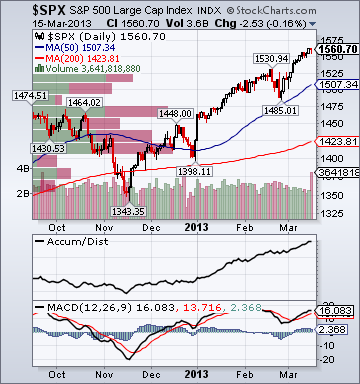
S&P 500 1,560.70 +.61%*
The Weekly Wrap by Briefing.com.
*5-Day Change
Indices
- Russell 2000 952.48 +1.06%
- Value Line Geometric(broad market) 407.93 +1.04%
- Russell 1000 Growth 710.49 +.27%
- Russell 1000 Value 798.75 +.94%
- Morgan Stanley Consumer 951.01 +.84%
- Morgan Stanley Cyclical 1,178.99 +1.39%
- Morgan Stanley Technology 741.11 +.25%
- Transports 6,272.67 +2.10%
- Bloomberg European Bank/Financial Services 96.52 -.62%
- MSCI Emerging Markets 43.04 -2.14%
- Lyxor L/S Equity Long Bias 1,138.39 +.26%
- Lyxor L/S Equity Variable Bias 847.02 -.10%
Sentiment/Internals
- NYSE Cumulative A/D Line 179,291 +.4%
- Bloomberg New Highs-Lows Index 911 +289
- Bloomberg Crude Oil % Bulls 34.48 -1.88%
- CFTC Oil Net Speculative Position 228,195 -3.20%
- CFTC Oil Total Open Interest 1,720,024 +.56%
- Total Put/Call .85 -5.56%
- ISE Sentiment 129.0 +14.16%
- Volatility(VIX) 11.30 -10.25%
- S&P 500 Implied Correlation 55.49 +.09%
- G7 Currency Volatility (VXY) 9.03 -2.90%
- Smart Money Flow Index 11,488.19 +1.19%
- Money Mkt Mutual Fund Assets $2.652 Trillion +.20%
Futures Spot Prices
- Reformulated Gasoline 316.38 -1.44%
- Heating Oil 293.90 -1.08%
- Bloomberg Base Metals Index 207.68 +.90%
- US No. 1 Heavy Melt Scrap Steel 352.67 USD/Ton unch.
- China Iron Ore Spot 134.60 USD/Ton -8.0%
- UBS-Bloomberg Agriculture 1,545.72 +.52%
Economy
- ECRI Weekly Leading Economic Index Growth Rate 6.3% -10 basis points
- Philly Fed ADS Real-Time Business Conditions Index -.1831 +8.99%
- S&P 500 Blended Forward 12 Months Mean EPS Estimate 114.24 +.21%
- Citi US Economic Surprise Index 27.0 +6.9 points
- Fed Fund Futures imply 56.0% chance of no change, 44.0% chance of 25 basis point cut on 3/20
- US Dollar Index 82.26 -.55%
- Yield Curve 174.0 -5 basis points
- 10-Year US Treasury Yield 1.99% -5 basis points
- Federal Reserve's Balance Sheet $3.147 Trillion +1.84%
- U.S. Sovereign Debt Credit Default Swap 38.04 -2.49%
- Illinois Municipal Debt Credit Default Swap 134.0 -2.19%
- Western Europe Sovereign Debt Credit Default Swap Index 97.45 +1.1%
- Emerging Markets Sovereign Debt CDS Index 171.34 +1.02%
- Israel Sovereign Debt Credit Default Swap 129.91 +6.63%
- Iraq Sovereign Debt Credit Default Swap 449.06 +5.10%
- China Blended Corporate Spread Index 393.0 +1 basis point
- 10-Year TIPS Spread 2.57% unch.
- TED Spread 19.75 +.25 basis point
- 2-Year Swap Spread 13.5 -1.0 basis point
- 3-Month EUR/USD Cross-Currency Basis Swap -16.50 unch.
- N. America Investment Grade Credit Default Swap Index 78.48 -3.72%
- European Financial Sector Credit Default Swap Index 142.88 +2.96%
- Emerging Markets Credit Default Swap Index 239.70 +.30%
- CMBS AAA Super Senior 10-Year Treasury Spread to Swaps 119.0 -11.0 basis points
- M1 Money Supply $2.473 Trillion +.49%
- Commercial Paper Outstanding 1,018.0 -.3%
- 4-Week Moving Average of Jobless Claims 346,800 -2,000
- Continuing Claims Unemployment Rate 2.4% unch.
- Average 30-Year Mortgage Rate 3.63% +11 basis points
- Weekly Mortgage Applications 823.70 -4.7%
- Bloomberg Consumer Comfort -31.6 +.8 point
- Weekly Retail Sales +2.7% +10 basis points
- Nationwide Gas $3.70/gallon -.01/gallon
- Baltic Dry Index 880.0 +5.51%
- China (Export) Containerized Freight Index 1,110.77 unch.
- Oil Tanker Rate(Arabian Gulf to U.S. Gulf Coast) 17.50 unch.
- Rail Freight Carloads 235,174 -5.64%
Best Performing Style
Worst Performing Style
Leading Sectors
Lagging Sectors
Weekly High-Volume Stock Gainers (22)
- EGL, IMMR, CSII, MW, P, BIOS, AMBA, GNMK, PCRX, FSYS, BONT, ADNC, NFP, DYN, WAGE, WAIR, ADVS, PRIM, SQI, HPTX, HTWR and ICON
Weekly High-Volume Stock Losers (8)
- GOV, STAN, DKS, ESC, SHOS, ANGO, SLCA and VHC
Weekly Charts
ETFs
Stocks
*5-Day Change
Broad Market Tone:
- Advance/Decline Line: Lower
- Sector Performance: Most Sectors Declining
- Market Leading Stocks: Underperforming
Equity Investor Angst:
- ISE Sentiment Index 129.0 +37.33%
- Total Put/Call .85 +19.72%
Credit Investor Angst:
- North American Investment Grade CDS Index 78.92 +.75%
- European Financial Sector CDS Index 142.87 +1.38%
- Western Europe Sovereign Debt CDS Index 98.95 -.28%
- Emerging Market CDS Index 239.62 +.59%
- 2-Year Swap Spread 13.5 -.25 bp
- 3-Month EUR/USD Cross-Currency Basis Swap -16.5 unch.
Economic Gauges:
- 3-Month T-Bill Yield .08% -1 bp
- China Import Iron Ore Spot $134.60/Metric Tonne +1.28%
- Citi US Economic Surprise Index 27.0 -2.3 points
- 10-Year TIPS Spread 2.57 -2 bps
Overseas Futures:
- Nikkei Futures: Indicating -103 open in Japan
- DAX Futures: Indicating -5 open in Germany
Portfolio:
- Slightly Lower: On losses in my retail/tech/medical sector longs
- Disclosed Trades: Covered some of my (IWM)/(QQQ) hedges, then added them back
- Market Exposure: 50% Net Long

