Sunday, October 08, 2006

Weekly Outlook

Click here for The Week Ahead by Reuters

There are some economic reports of note and several significant corporate earnings reports scheduled for release this week.

Economic reports for the week include:

Mon. - None of note

Tues. - Wholesale Inventories

Wed. - Sept. 20 FOMC Minutes

Thur. - Trade Balance, Initial Jobless Claims, Fed’s Beige Book

Fri. - Import Price Index, Advance Retail Sales, Univ. of Mich. Consumer Confidence, Business Inventories

Some of the more noteworthy companies that release quarterly earnings this week are:

Mon. - Cheesecake Factory(CAKE)

Tues. - Alcoa(AA), Chattem(CHTT), Genentech(DNA)

Wed. - Gannett Co.(GCI), Lam Research(LRCX), M&T Bank(MTB), Monsanto(MON), Progressive Corp.(PGR), Ruby Tuesday(RI)

Thur. - Apollo Group(APOL), Fastenal Group(FAST), Genzyme Corp.(GENZ), Harley-Davidson(HDI), MGIC Investment(MTG), Polaris Industries(PII), Winnebago Industries(WGO)

Fri. - General Electric(GE), JB Hunt Transportation(JBHT), Regions Financial(RF)

Other events that have market-moving potential this week include:

Mon. - None of note

Tue. - (SPLS) Analyst and Investor Conference, (CVS) Sept. Sales release, (CIEND) Analyst Day

Wed. - Fed’s Bies speaking, Fed’s Lacker speaking

Thur. - (WEN) Analyst Meeting, Fed’s Beige Book, Fed’s Moskow speaking

Fri. - None of note

BOTTOM LINE: I expect US stocks to finish the week modestly higher on lower energy prices, short-covering, investment manager performance anxiety, bargain hunting, mostly positive economic reports and less pessimism. My trading indicators are still giving bullish signals and the Portfolio is 100% net long heading into the week.
Saturday, October 07, 2006

Market Week in Review

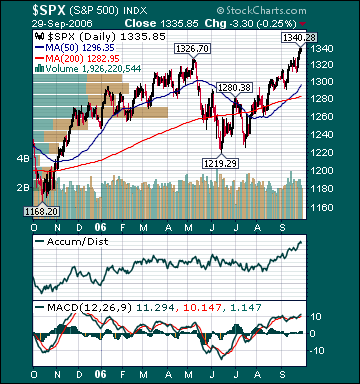
S&P 500 1,349.58 +1.03%*

Photobucket - Video and Image Hosting

Click here for the Weekly Wrap by Briefing.com.

BOTTOM LINE: Overall, last week's market performance was bullish as the Dow Jones Industrial Average made a new all-time high. The advance/decline line rose, most sectors gained and volume was above average on the week. Measures of investor anxiety were mostly higher. The AAII % Bulls plunged to 37.78% this week from 51.32% the prior week. This reading is now below average levels. The AAII % Bears soared to 46.67% this week from 32.89% the prior week. This reading is now approaching elevated levels. The 10-week moving average of the % Bears is currently 36.61%. The 10-week moving-average of the % Bears was 43.0% at the major bear market lows during 2002.

Soaring bearish sentiment and plunging bullish sentiment is absolutely mind-boggling considering the recent rally and the fact that the DJIA just took out its January 14, 2000 record high. There is overwhelming evidence that investor sentiment regarding U.S. stocks has never been this poor in history with the DJIA registering all-time highs. As well, there are many other indicators registering high levels of investor skepticism regarding recent stock market gains. This bodes very well for another substantial move higher in the major averages as the bears remain stunningly complacent, thus providing a high wall of worry for stocks to climb.

I believe this week's sharp deterioration in investor sentiment is a direct result of the strong belief by the herd that the U.S. is in a long-term trading range or secular bear environment. In my opinion, the bears' abuse of George Soros' Theory of Reflexivity(the theory basically states that the future outcome of an events can be altered by changing current perceptions regarding such an event) during the last few years has left most investors substantially underexposed to U.S. equities, specifically growth stocks, and many active traders leaning heavily the wrong way. Short interest on the NYSE and Nasdaq is at all-time highs. The ISE Sentiment Index has bounced around depressed levels for months. Domestic stock mutual funds are still seeing outflows.

The average 30-year mortgage rate fell another basis point to 6.3%, which is 50 basis points below July highs. I still believe housing is in the process of slowing, but will stabilize at relatively high levels over the coming months. Former Fed Chairman Alan Greenspan said this week he believes the “worst may well be over” for the housing slowdown. Mortgage applications surged 11.9% this week, the most since June 2005. The Case-Shiller housing futures are still projecting a 5% decline in the average home price over the next 9 months. Considering the average house has appreciated over 50% during the last few years, this would be considered a “soft landing.” The overall negative effects of housing on the US economy are currently being exaggerated by the bears, in my opinion. Housing has been slowing substantially for 14 months and has been mostly offset by many other very positive aspects of the economy. Americans’ median net worth is still very close to or at record high levels, unemployment is low, interest rates are low, stocks are rising and most measures of income growth are almost twice the inflation rate, just to name a few.

The benchmark 10-year T-note yield rose 6 basis points on the week on profit taking and diminishing economic growth concerns. Overall, September retail sales rose more than estimates and excluding Wal-Mart(WMT), gained a vigorous 6.0%. In my opinion, investors’ continuing fears over an economic “hard landing” are misplaced. Consumer spending is very important to the health of the US economy. Spending is poised to remain strong on plunging energy prices, low long-term interest rates, a rising stock market, healthy job market, decelerating inflation and more optimism. The CRB Commodities Index, the main source of inflation fears, has now declined 7.3% over the last 12 months and is down 17.8% from May highs, approaching bear market territory. The average commodity hedge fund is down 13.8% for the year. I believe inflation fears have peaked for this cycle as global economic growth moderates to around average levels, unit labor costs remain subdued and the mania for commodities continues to reverse course.

The EIA reported this week that gasoline supplies rose slightly less than expectations as refinery utilization fell substantially. U.S. gasoline supplies are still at the highest level since 1991 for this time of the year. Unleaded Gasoline futures fell again for the week and are 48.3% below September 2005 highs even as refinery utilization remains below normal as a result of the hurricanes last year, some Gulf of Mexico oil production remains shut-in and fears over future production disruptions persist. Gasoline demand is estimated to rise .8% this year versus a 20-year average of 1.7% demand growth. Moreover, distillate stocks are 18% above the five-year average for this time of the year as we head into the winter heating season. According to TradeSports.com, the percent chance of a US and/or Israeli strike on Iran this year has fallen to 6.6% from 36% late last year. The still elevated level of gas prices related to crude oil production disruption speculation by investment funds is further dampening fuel demand, which will send gas prices still lower.

US oil inventories have only been higher during one other period over the last 7 years. Since December 2003, global oil demand is only up .7%, while global supplies have increased 4.8%, according to the Energy Intelligence Group. Moreover, worldwide inventories are poised to begin increasing at an accelerated rate over the next year. I continue to believe oil is priced at extremely elevated levels on fear and record speculation by investment funds, not fundamentals. The Amaranth Advisors hedge fund blow-up is a prime example of the extent to which many investment funds have been speculating on ever higher energy prices through futures contracts, thus driving the price of the underlying commodity to absurd levels. Amaranth, a multi-strategy hedge fund, lost about $6.5 billion of its $9.5 billion under management in less than two months speculating mostly on higher natural gas prices. I suspect a number of other funds will experience similar fates over the coming months, which will further pressure energy prices as these funds unwind their leveraged positions to meet investor redemptions.

Oil has clearly broken its uptrend, notwithstanding that this is the seasonally strong period for the commodity. A major top in oil is likely already in place. However, further OPEC production cuts could lead to a temporary bounce higher in price over the next couple of weeks, accelerating demand destruction, resulting in a complete technical breakdown in crude. Demand destruction is already pervasive globally. Moreover, many Americans already feel as though they are helping fund terrorism or hurting the environment every time they fill up their gas tanks. I do not believe we will ever again see the demand for gas-guzzling vehicles that we saw in recent years, even if gas prices continue to plunge. An OPEC production cut with oil at still very high levels and weakening global growth would only further deepen resentment towards the cartel and result in even greater long-term demand destruction. Finally, as the fear premium in oil dissipates back to more reasonable levels, global growth slows and supplies continue to rise, crude oil should continue heading meaningfully lower over the intermediate-term, notwithstanding OPEC production cuts.

Natural gas inventories rose less than expectations this week, resulting in a short-covering rally in the commodity. Supplies are still 12.1% above the 5-year average, a record high level for this time of year, even as some daily Gulf of Mexico production remains shut-in. Natural gas prices have collapsed 59.3% since December 2005 highs. It is very likely US natural gas storage will become full sometime this month, creating the distinct possibility of a “no-bid” situation for the physical commodity. Colorado State recently reduced its forecast from two to zero major hurricanes for this season versus seven last year. The peak of hurricane season was September 10. Natural gas prices are still in their seasonally strong period despite recent losses.

Gold fell on the week on US dollar strength and diminishing inflation worries. The US dollar rose on more economic optimism. I continue to believe there is very little chance of another Fed rate hike anytime soon. An eventual cut is more likely at this point as inflation continues to decelerate.

Restaurant stocks outperformed for the week on rising optimism over consumer spending on the decline in energy prices, low unemployment and rising stock prices. Energy stocks continued their recent substantial underperformance as the mania for these shares continues to unwind. S&P 500 profit growth for the second quarter came in a strong 16.3% versus a long-term historical average of 7%, according to Thomson Financial. This is the 16th straight quarter of double-digit profit growth, the best streak since recording keeping began in 1936. Moreover, another double-digit gain is likely in the third quarter. Earnings pre-announcements are running below average levels so far. Despite a 81.3% total return for the S&P 500 since the October 2002 bottom, its forward p/e has contracted relentlessly and now stands at a very reasonable 15.5. The 20-year average p/e for the S&P 500 is 24.4. The S&P 500 is now up 9.7% and the Russell 2000 Index is up 10.9% year-to-date. The DJIA made a new all-time high this week, breaking above its January 14, 2000 record close. I expect the Dow to break convincingly above 12,000 before year-end.

Current stock prices are still providing longer-term investors very attractive opportunities, in my opinion. In my entire investment career, I have never seen the best “growth” companies in the world priced as cheaply as they are now relative to the broad market. By contrast, “value” stocks are quite expensive in many cases. A recent CSFB report confirmed this view. The report concluded that on a price-to-cash flow basis growth stocks are now cheaper than value stocks for the first time since at least 1977. Almost the entire decline in the S&P 500’s p/e, since the bubble burst in 2000, is attributable to growth stock multiple contraction. I still expect the most overvalued economically sensitive and emerging market stocks to continue underperforming over the intermediate-term as the manias for those shares subside and global growth slows to more average rates. I continue to believe a chain reaction of events has begun that will result in a substantial increase in demand for US stocks.

In my opinion, the market is still factoring in way too much bad news at current levels, notwithstanding recent gains. One of the characteristics of the current “negativity bubble” is that most potential positives are undermined, downplayed or completely ignored, while almost every potential negative is exaggerated and promptly priced in to stock prices. Furthermore, this “irrational pessimism” by investors has resulted in a dramatic decrease in the supply of stock as companies bought back shares, IPOs were pulled and secondary stock offerings canceled. Commodity and emerging market funds, which have received huge capital infusions this year, will likely see significant outflows at year-end. I continue to believe there is massive bull firepower available at a time when the supply of stock is contracting.

Over the coming months, an end to the Fed rate hikes, lower commodity prices, seasonal strength, the November election, decelerating inflation readings, lower long-term rates, increased consumer/investor confidence, short-covering, investment manager performance anxiety, rising demand for US stocks and the realization that economic growth is only slowing to around average levels should provide the catalysts for another substantial push higher in the major averages through year-end as p/e multiples expand further. I still expect the S&P 500 to return a total of at least 15% for the year. The ECRI Weekly Leading Index rose this week and is forecasting healthy US economic activity.


*5-day % Change

Friday, October 06, 2006

Weekly Scoreboard*

Indices
S&P 500 1,349.58 +1.03%
DJIA 11,850.21 +1.47%
NASDAQ 2,299.99 +1.84%
Russell 2000 739.81 +1.96%
Wilshire 5000 13,467.92 +1.09%
S&P Barra Growth 626.66 +1.08%
S&P Barra Value 720.79 +.97%
Morgan Stanley Consumer 652.88 -.09%
Morgan Stanley Cyclical 837.57 +2.19%
Morgan Stanley Technology 537.67 +1.21%
Transports 4,569.83 +2.61%
Utilities 429.14 +.17%
MSCI Emerging Markets 98.90 +2.20%
S&P 500 Cum A/D Line 8,064.0 +4.0%
Bloomberg Crude Oil % Bulls 44.0 +8.7%
CFTC Oil Large Speculative Longs 159,235 -4.0%
Put/Call .96 +15.66%
NYSE Arms 1.06 +23.26%
Volatility(VIX) 11.56 -3.51%
ISE Sentiment 110.0 +37.50%
AAII % Bulls 37.78 -26.38%
AAII % Bears 46.67 +41.90%
US Dollar 86.51 +.56%
CRB 300.20 -1.76%
ECRI Weekly Leading Index 136.40 +.96%

Futures Spot Prices
Crude Oil 59.76 -5.08%
Unleaded Gasoline 150.42 -3.83%
Natural Gas 6.42 +14.24%
Heating Oil 169.40 -3.33%
Gold 577.90 -4.14%
Base Metals 230.79 -1.10%
Copper 339.10 -1.14%
10-year US Treasury Yield 4.69% +1.3%
Average 30-year Mortgage Rate 6.30% -.16%

Leading Sectors
Restaurants +5.32%
Gaming +4.72%
Biotech +3.16%
Internet +3.13%
I-Banks +3.10%

Lagging Sectors
Hospitals -1.29%
Energy -1.57%
Oil Service -3.26%
Gold & Silver -3.29%
Oil Tankers -3.50%

One-Week High-Volume Gainers
One-Week High-Volume Losers

*5-Day % Change

Stocks Slightly Lower into Final Hour on Profit-Taking and Higher Long-Term Rates

BOTTOM LINE: The Portfolio is higher into the final hour on gains in my Internet longs, Semi longs and Retail longs. I have not traded today, thus leaving the Portfolio 100% net long. The tone of the market is slightly negative as the advance/decline line is about even, most sectors are falling and volume is below average. The Wall Street Journal is confirming that Google (GOOG) is in talks to acquire YouTube for $1.6 billion. However, the talks are still at a sensitive stage. I think this would make an excellent acquisition for Google. This price tag seems high, but over the long term it would be well worth it, in my opinion. Google remains my largest long position. I expect US stocks to trade modestly higher into the close from current levels on short-covering, less pessimism, performance anxiety and bargain-hunting.

Today's Headlines

Bloomberg:
- Natural gas is falling again in NY after US inventories soared to a record last week.
- Heating oil futures are falling as inventories are 18% above the 5-year average for this time of the year and forecasts call for warm weather in the Northeast.
- Crude oil fell more than $1/bbl. on speculation that members of OPEC won’t follow through with production cuts.
- Gold is set to post a weekly decline as falling oil prices reduced the appeal of the precious metal as a hedge against inflation.
- The US dollar posted the biggest gain since July against the yen and euro after a government report showed the US jobless rate unexpectedly fell in September.
- Jerome York, an aide to billionaire investor Kirk Kerkorian, resigned form GM’s board after the automaker failed to support Kerkorian’s proposal for an alliance with Renault SA and Nissan Motor.
- Crown Castle(CCI), the second-biggest owner of US cellular-telephone towers, agreed to buy Global Signal(GSL) for about $3.93 billion to become the dominant provider in LA, Chicago and Dallas.
- US Treasuries are falling, pushing 10-year yields up the most since July, after the government said the nation’s jobless rate dropped in September while the economy added more jobs in prior months than reported earlier.
- Amaranth Advisors, LLC, the hedge-fund manager that’s liquidating after losing $6.5 billion betting on natural gas, plans to cut about 60% of its workforce within a week and help place them at other firms.
- The cost of transporting oil abroad supertankers may fall by year-end as OPEC members reduce production, leaving a glut of vessels.

Wall Street Journal:
- The end of Hong Kong’s “laissez-faire capitalist” economy policies will slow the territory’s growth and end its role as a model for Asian countries, economist Milton Friedman said.
- MySpace.com, the social networking site, has attracted older users.
- Hedge funds searching for investment opportunities are turning their attention to sub-Saharan Africa.
- JC Penney(JCP) is seeking to emulate department-store rival Kohl’s(KSS) by opening more freestanding stores, which customers are increasingly favoring over regional malls.

NY Times:
- Andrew Cuomo, Democratic candidate for NY’s Attorney General, made a 19% return when he invested more than half of his $1.2 million in campaign funds in the hedge fund of one of his supporters two years ago, citing campaign spokeswoman Wendy Katz. The hedge fund Cuomo invested in, Gregg Hymowitz’s EnTrust Partners, waived its minimum asset requirement and investment amount when it allowed the Cuomo campaign to invest in its fund.

Boersen:
- Dong Energy A/S of Denmark has applied for an exploration permit to search for oil and natural gas off the country’s northwest coast, citing Jan Terje, the company’s head of exploration.

Job Market Even Stonger Than Previously Thought, Wages Rise 4% Over Last Year, Payroll Growth Decelerates

- The Change in Non-farm Payrolls for September was 51K versus estimates of 120K and an upwardly revised 188K in August.
- The Change in Manufacturing Payrolls for September was -19K versus estimates of -5K and an upwardly revised -7K in August.
- The Unemployment Rate for September fell to 4.6% versus estimates of 4.7% and 4.7% in August.
-
BOTTOM LINE: The US economy created 51,000 jobs in September as unemployment fell back to a five-year low, Bloomberg reported. Job growth during the last year was revised 45% higher. 810,000 more jobs were created over the last 12 months than previously thought. This was the largest upward revision since at least 1991 when the labor market began benchmarking numbers. Wage growth over the last year matched a five-year high. The substantial upward revision to job growth over the last year is sending Treasuries lower and the US dollar higher. This shows the economy was even stronger than most realized earlier in the year. I continue to believe the job market will remain healthy over the intermediate-term as companies gain confidence in the sustainability of the current business cycle, optimism continues to grow, consumer spending remains strong, gas prices continue to fall and housing stabilizes at relatively high levels.