Sunday, January 21, 2007

Weekly Outlook

Click here for The Week Ahead by Reuters

There are a few economic reports of note and some significant corporate earnings reports scheduled for release this week.

Economic reports for the week include:

Mon. - Leading Indicators

Tues. - Richmond Fed Manufacturing Index

Wed. - MBA Mortgage Applications, EIA Inventory Data

Thur. - Initial Jobless Claims, Existing Home Sales

Fri. - Durable Goods Orders, New Home Sales

Some of the more noteworthy companies that release quarterly earnings this week are:

Mon. - American Express(AXP), CSX Corp.(CSX), Eaton Corp.(ETN), Pfizer Inc.(PFE), Texas Instruments(TXN)

Tues. - Adtran Inc.(ADTN), Advanced Micro Devices(AMD), AK Steel(AKS), Avaya Inc.(AV), Bank of America(BAC), Brinker Intl.(EAT), Burlington Northern(BNI), Centex Corp.(CTX), Coach Inc.(COH), DR Horton(DHI), EMC Corp.(EMC), Integrated Device Technology, Johnson & Johnson(JNJ), Microchip Tech(MCHP), QLogic Corp.(QLGC), Seagate Technologies(STX), UAL Corp.(UAUA), United Technologies(UTX), Wachovia Corp.(WB), Yahoo!(YHOO)

Wed. - Abbott Labs(ABT), Allegheny Technologies(ATI), AmerisourceBergen(ABC), Check Point Software(CHKP), ConocoPhillips(COP), Corning Inc.(GLW), eBay Inc.(EBAY), Ethan Allen(ETH), F5 Networks(FFIV), First Data(FDC), General Dynamics(GD), Hershey(HSY), Hutchinson Tech(HTCH), McDonald’s Corp.(MCD), NetFlix(NFLX), Novellus Systems(NVLS), Parametric Tech(PMTC), Qualcomm Inc.(QCOM), Ryland Group(RYL), Symantec Corp.(SYMC), Tidewater(TDW), Trident Microsystems(TRID), Varian Medical(VAR)

Thur. - Agere Systems(AGR), Altera Corp.(ALTR), Amgen Inc.(AMGN), AT&T(T), Baxter Intl(BAX), Beazer Homes(BZH), Bebe Stores(BEBE), Becton Dickinson(BDX), BJ Services(BJS), Bristol-Myers(BMY), Callaway Golf(ELY), Cardinal Health(CAH), Dow Jones(DJ), Federated Investors(FII), Ford Motor(F), Franklin Resources(BEN), ImClone Systems(IMCL), Intl. Rectifier(IRF), Kimberly-Clark(KMB), Lear Corp.(LEA), Legg Mason(LM), Lockheed Martin(LMT), Massey Energy(MEE), Maxim Integrated(MXIM), MBIA Inc.(MBI), McKesson Corp.(MCK), Microsoft Corp.(MSFT), Northrop Grumman(NOC), Peabody Energy(BTU), Quest Diagnostics(DGX), St Jude Medical(STJ), Stryker Corp.(SYK), Sybase Inc.(SY), Union Pacific(UNP), Western Digital(WDC), Zoll Medical(ZOLL)

Fri. - Avid Tech(AVID), Caterpillar Inc.(CAT), CDW Corp.(CDWC), Dolby Labs(DLB), Fortune Brands(FO), Halliburton(HAL), Honeywell Intl(HON), Southern Copper(PCU), T Rowe Price Group(TROW)

Other events that have market-moving potential this week include:

Mon. - AG Edwards Retailing Conference, (TGT) Sales Update, (PFE) Analyst Meeting, Fed’s Yellen speaking

Tue. - AG Edwards Retailing Conference, State of the Union Address, (KMI) Analyst Meeting, (XTO) Analyst Conference

Wed. - None of note

Thur. - Bank of America Out of the Box REIT Summit

Fri. - None of note

BOTTOM LINE: I expect US stocks to finish the week mixed as mostly positive economic data, buyout speculation, stable long-term rates, mostly positive earnings reports and constructive Fed comments offsets profit-taking and shorting. My trading indicators are giving mostly bullish signals and the Portfolio is 75% net long heading into the week.
Saturday, January 20, 2007

Market Week in Review

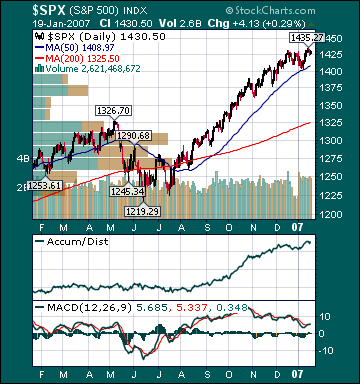
S&P 500 1,430.50 +.47%*

Photobucket - Video and Image Hosting

Click here for the Weekly Wrap by Briefing.com.

BOTTOM LINE: Overall, last week's market performance was neutral. The advance/decline line rose, sector performance was mixed and volume was heavy on the week. Measures of investor anxiety were mixed. However, the AAII percentage of Bulls rose to 57.58% this week from 44.44% the prior week. This reading is now at above average levels. The AAII percentage of Bears fell to 27.27% this week from 34.26% the prior week. This reading is now around average levels. The 10-week moving average of the percentage of Bears is currently 36.9%, an above-average level. The 10-week moving average of the percentage of Bears peaked at 43.0% at the major bear market low during 2002. Moreover, the 50-week moving average of the percentage of Bears is 36.9%, a very high level seen during only two other periods in U.S. history.

I continue to believe that steadfastly high bearish sentiment in many quarters is mind-boggling, considering the S&P 500's 18.2% rise in less than seven months, one of the best August/September/October runs in U.S. history, the US economy is accelerating, the fact that the Dow made another all-time high recently and that we are in the early stages of what is historically a very strong period for U.S. stocks after a midterm election. Despite recent gains, the forward P/E on the S&P 500 is a very reasonable 15.9 due to the historic run of double-digit profit growth increases, which are poised to continue in the fourth quarter. Bears still remain stunningly complacent, in my opinion. As I have said many times over the last few months, every pullback is seen as a major top and every move higher is just another shorting/selling opportunity. Even most bulls have raised cash of late, anticipating a meaningful correction after the recent surge.

As well, there are many other indicators registering high levels of investor skepticism regarding recent stock market gains. Bloomberg reported this week that only 46.2% of analysts have made "buy" calls on their stocks this month. The percentage of "buys" has now declined for six consecutive months. This is the lowest percentage of “buys” since Bloomberg began tracking them in 1997. The 50-day moving average of the ISE Sentiment Index just crossed above the 200-day moving average for the first time since November 2005 recently and is already rolling over again. The ISE Sentiment Index plunged to a very depressed 78.0 on Wednesday. Nasdaq and NYSE short interests are very close to record highs. Moreover, public short interest continues to soar to record levels, and U.S. stock mutual funds have seen outflows for most of the last year, according to AMG Data Services. 90%, or $140 billion, of all mutual fund inflows went to international funds last year. The percentage of U.S. mutual fund assets invested in domestic stocks fell to 78% last year, the lowest since at least 1984, as the mania for emerging market stocks intensified with parabolic moves in most commodity prices. Moreover, U.S. equity funds were on track to receive $14.7 billion of new cash inflows for 2006, the lowest in 17 years for a period in which the S&P 500 gained, according to ICI. Finally, investment blogger bullish sentiment is hovering just above record lows at 25.7% Bulls. There is still a high wall of worry for stocks to climb substantially from current levels as the public remains very skeptical of this bull market.

I continue to believe this is a direct result of the strong belief by the herd that the U.S. is in a long-term trading range or secular bear environment. There is still overwhelming evidence that investment sentiment by the general public regarding U.S. stocks has never been this poor in history, with the Dow registering all-time highs almost weekly. I still expect the herd to finally embrace the current bull market this year, which should result in another substantial move higher in the major averages as the S&P 500 breaks out to an all-time high to join the Dow and Russell 2000. Only in a "negativity bubble" could Wall Street strategists' consensus predictions of a 7% gain for the S&P 500 this year be characterized as "very bullish" by the many bearish pundits. As well, many of the so-called bullish U.S. investors are only "really bullish" on commodity stocks and U.S. companies with substantial emerging markets exposure, not the broad U.S. stock market. Finally, how many investors are bullish on "growth" stocks? There are relatively few true "growth" investors left after six-years of underperformance.

Based on the action during the first few weeks of this year, I suspect even more cash has piled up on the sidelines and some of that cash will be deployed into true growth companies as their outperformance gains steam throughout the year. I continue to believe the coming bullish shift in long-term sentiment with respect to U.S. stocks will result in the "mother of all short-covering rallies."

The average 30-year mortgage rate rose 2 basis points to 6.23%, which is 57 basis points below July 2006 highs. I still believe housing is in the process of stabilizing at relatively high levels. The Fed’s Hoenig, Lacker and Bies all made positive comments this week regarding the prospects for the US housing market. Mortgage applications fell -.6% after soaring 16.6% the prior week, the largest gain since June 2005, and continue to trend higher with the decline in mortgage rates and healthy job market. The Mortgage Bankers Association said last month that the US housing market will “fully regain its footing” by the middle of this year. Moreover, the California Building Industry Association recently gave an upbeat forecast for housing, saying production would be near last year’s brisk levels.

Housing inventories have been trending lower and homebuilding equities have been moving higher. The Housing Index(HGX) has risen 26.6% from July lows. The Case-Schiller housing futures have improved substantially and are now projecting a 1.7% decline in the average home price by May, up from projections of a 5.2% decline a few months ago. Considering the median house has appreciated over 50% during the last few years with record high US home ownership, this would be considered a “soft landing.” The overall negative effects of housing on the US economy and the potential for significant price drops are still being exaggerated by the many stock market bears in hopes of dissuading buyers from stepping up, in my opinion. Housing and home equity extractions had been slowing substantially for almost 2 years and the negative effects were mostly offset by many other very positive aspects of the US economy.

Home values are more important than stock prices to the average American, but the median home has barely declined in value after a historic run-up, while the S&P 500 has risen 15.6% over the last year and 93.1% since the Oct. 4, 2002 low. Americans’ median net worth is still very close to or at record high levels as a result, a fact that is generally unrecognized or minimized by the record number of stock market participants that feel it is in their financial and/or political interests to paint a bleak picture of America.

Moreover, energy prices are down significantly, consumer spending remains healthy, unemployment is low by historic standards, interest rates are low, inflation is below average rates, stocks are surging and wages are rising. The economy has created 840,000 jobs in the last five months. Challenger, Gray & Christmas reported recently that December job cuts plunged 49.3% from year-ago levels. As well, the Monster Employment Index is just off record highs. Finally, the unemployment rate is a historically low 4.5%, down from 5.1% in September 2005, notwithstanding fewer real estate-related jobs and significant auto production cutbacks.

The Consumer Price Index for December rose 2.5% year-over-year, down from a 4.7% increase in September of 2005. This is meaningfully below the long-term average of around 3%. Moreover, the CPI has only been lower during 4 other periods since the mid-1960s. Many other measures of inflation have recently shown substantial deceleration. The Producer Price Index for December rose a historically low 1.1% year-over-year. Most measures of Americans’ income growth are now almost twice the rate of inflation. Americans’ Average Hourly Earnings rose 4.2% in December, substantially above the 3.2% 20-year average. The recent plunge in many commodities should eventually result in the complete debunking of the problematic inflation myth that so many have perpetuated endlessly over the last couple of years.

The benchmark 10-year T-note yield was unch. for the week as positive economic data offset diminishing inflation concerns. In my opinion, investors’ continuing fears over an economic “hard landing” are misplaced. The ISM Manufacturing Index improved in December and is now registering expansion. Moreover, the ISM’s semi-annual forecast was released recently and gave an upbeat assessment of expected manufacturing activity this year. The ISM Non-Manufacturing Index, which is a gauge of the vast majority of U.S. economic activity, came in at a healthy 57.1 for December. Manufacturing accounts for roughly 12% of US economic growth, while consumer spending accounts for about 70% of growth. Consumer spending is poised to accelerate to above-average levels over the coming months.

U.S. GDP growth came in at a sluggish 1.1% and 0.7% during the first two quarters of 1995. During May 1995, the ISM Manufacturing Index fell below 50, which signals a contraction in activity. It stayed below 50, reaching a low of 45.5, until August 1996. During that period, the S&P 500 soared 31% as the P/E multiple expanded from 16.0 to 17.2. This was well before the stock market bubble began to inflate. As well, manufacturing was more important to overall US economic growth at that time. Stocks can and will rise as P/E multiples expand, even with more average economic and earnings growth. The S&P 500's P/E has contracted for three straight years. A recent Morgan Stanley report concluded that the S&P 500's P/E has only contracted for four consecutive years twice since 1905. The report said that each point of multiple expansion is equivalent to a 6.6% gain in the S&P 500. As I have said many times before, P/E multiple expansion is the bears' worst nightmare.

Weekly retail sales rose a slightly below average 2.7% for the week. However, retail sales are poised to accelerate. The Department of Energy is projecting nationwide average gas prices to fall to $1.95 per gallon over the coming weeks, with oil around current levels. Moreover, jobless claims have been trending lower of late, housing has improved, wages are rising, stocks are mostly higher, and inflation is below long-term average rates. Both main consumer confidence readings are now very near cycle highs, and many consumers are chomping at the bit to buy new spring clothing after such a warm fall muted holiday clothing sales. I expect new cycle highs for both measures of consumer sentiment over the next few months.

Just take a look at commodity charts, gauges of commodity sentiment and inflows into commodity-related funds over the last couple of years. There has been a mania for commodities. That mania is now in the stages of unwinding. The CRB Commodities Index, the main source of inflation fears, is now in bear market territory, declining 15.8% over the last 12 months and down 20.5% from May highs despite a historic flood of capital into commodity funds and numerous potential upside catalysts. Oil has declined $26/bbl from July highs. Last year, oil rose $2.05/bbl. on the first trading day of the year and $7.40/bbl. through the first three weeks of trading as commodity funds, flush with new capital, drove futures prices higher. I suspect, given the average commodity hedge fund fell around double-digits last year as the CRB Index dropped 7.4%, that many energy-related funds saw outflows at year-end. Oil has declined 14.9% or $9/bbl. already this year. The commodity mania has pumped air into the current US “negativity bubble.” In my opinion, that is why it is so easy for most to believe that housing was in a bubble, but then act shocked when commodities plunge. I continue to believe inflation fears have peaked for this cycle as global economic growth slows to average levels, unit labor costs remain subdued and the mania for commodities continues to reverse course.

The EIA reported this week that gasoline supplies rose substantially more than expectations again even as refinery utilization fell significantly. U.S. gasoline supplies are at high levels for this time of the year, notwithstanding declining refinery utilization. Gasoline futures rose slightly for the week and have plunged 51.7% from September 2005 highs even as some Gulf of Mexico oil production remains shut-in and fears over future production disruptions persist. The still very elevated level of gas prices, related to crude oil production disruption speculation by investment funds, will further dampen global fuel demand, sending gas prices still lower over the intermediate-term.

The 10-week moving-average of US oil inventories is still approaching 8-year highs. Since December 2003, global oil demand is only up 2%, despite booming global growth, while global supplies have increased 6%, according to the Energy Intelligence Group. OPEC said recently that global crude oil supply would exceed demand by 100 million barrels by the second quarter of this year. Moreover, worldwide oil inventories are poised to begin increasing at an accelerated rate over the next year. One of the main reasons I believe OPEC has been slow to actually meet their pledged cuts has been the fear of losing market share to non-OPEC countries. Moreover, OPEC actually needs lower prices to prevent any further long-term demand destruction. I continue to believe oil is priced at elevated levels on record speculation by investment funds, not fundamentals.

The Amaranth Advisors hedge fund blow-up is a prime example of the extent to which many investment funds have been speculating on ever higher energy prices through futures contracts, thus driving the price of the underlying commodity to absurd levels. Amaranth, a multi-strategy hedge fund, lost about $6.5 billion of its $9.5 billion under management in less than two months speculating mostly on higher natural gas prices even as they plunged. I continue to believe a number of other funds will experience similar fates over the coming months after managers “pressed their bets” in hopes of making up for recent poor performance, which will further pressure energy prices as these funds unwind their leveraged long positions to meet rising investor redemptions. Moreover, the same rampant speculation that has driven the commodity mania will work against energy as downside speculation increases and likely drives down prices even further than the fundamentals would otherwise dictate.

Recently, Cambridge Energy Research, one of the most respected energy research firms in the world, put out a report that drills gaping holes in the belief by most investors of imminent "peak oil" production. Cambridge said that its analysis indicates that the remaining global oil base is actually 3.74 trillion barrels, three times greater than "peak oil" theory proponents say and that the "peak oil" theory is based on faulty analysis. I suspect the contango that still exists in energy futures, which encourages hoarding, will begin to reverse over the coming months as more investors come to the realization that the "peak oil" theory is hugely flawed, global storage fills, and Chinese/US demand slows.

A major top in oil is already in place as global crude oil storage capacity utilization is running around 98%. Recent OPEC production cuts are resulting in a complete technical breakdown in crude futures. Spare production capacity, which had been one of the main sources of angst among the many oil bulls, rises with each OPEC cut. As well, demand destruction is already pervasive globally and will only intensify over the coming years as many more alternative energy projects come to the fore. Moreover, many Americans feel as though they are helping fund terrorism or hurting the environment every time they fill up their gas tanks. I do not believe we will ever again see the demand for gas-guzzling vehicles that we saw in recent years, even if gas prices plunge further from current levels, as I expect. If OPEC actually implements all their announced production cuts, with oil still at very high levels and weakening global growth, it will only further deepens resentment towards the cartel and result in even greater long-term demand destruction. Finally, as the fear premium in oil dissipates back to more reasonable levels, global growth slows and supplies continue to rise, crude oil should continue heading meaningfully lower over the intermediate-term, notwithstanding OPEC production cuts. Oil has already begun another significant downturn and I suspect crude will eventually fall to levels that most investors deemed unimaginable just a few months ago during the next significant global economic downturn.

Natural gas inventories fell slightly more than expectations this week. Prices for the commodity rose as historic investment fund speculation continues despite the fact that supplies are now 20.0% above the 5-year average and at all-time high levels for this time of year, even as some daily Gulf of Mexico production remains shut-in. Natural gas prices have collapsed 56.0% since December 2005 highs. Notwithstanding this decline, natural gas anywhere near current prices is ridiculous with absolute inventories poised to hit new records this year. The long-term average price of natural gas is $4.63 with inventories much lower than current levels.

Gold rose on the week on short-covering even as demand from India, the world’s largest buyer of the metal, continues to moderate and inflation is poised to decelerate further on the decline in other commodities. Gold, natural gas, oil and copper still look both fundamentally and technically weak. The US dollar declined on profit-taking after recent gains. The monthly budget statement for December was significantly better-than-expected once again. The US budget deficit is now 1.5% of GDP, well below the 40-year average of 2.3% of GDP. I continue to believe there is very little chance of another Fed rate hike anytime soon despite the current modest acceleration in economic activity. An eventual rate cut is more likely this year as inflation continues to decelerate substantially. A Fed rate cut should actually boost the dollar as currency speculators anticipate faster US economic growth. Moreover, last month’s net long-term TIC flows report showed foreign investors’ demand for US securities remains strong despite last year’s dollar weakness.

Oil Service stocks outperformed significantly for the week on short-covering and speculation that oil has finished its decline. Semis underperformed substantially on near-term pricing concerns and speculation that upcoming catalysts would fail to boost demand. S&P 500 profit growth for the third quarter came in around 20% versus a long-term historical average of 7%, according to Thomson Financial. This marks the 17th straight quarter of double-digit profit growth, the best streak since recording keeping began in 1936. Moreover, another double-digit gain is likely for the fourth quarter. Just a few months ago many investors expected profit growth to fall to the low single digits. Despite a 93.1% total return(which is equivalent to a 16.6% average annual return) for the S&P 500 since the October 2002 bottom, its forward p/e has contracted relentlessly and now stands at a very reasonable 15.9. The 20-year average p/e for the S&P 500 is 23.0.

Current stock prices are still providing longer-term investors very attractive opportunities, in my opinion. In my entire investment career, I have never seen the best “growth” companies in the world priced as cheaply as they are now relative to the broad market. By contrast, “value” stocks are quite expensive in many cases. A CSFB report late last year confirmed this view. The report concluded that on a price-to-cash flow basis growth stocks are cheaper than value stocks for the first time since at least 1977. The entire decline in the S&P 500’s p/e, since the bubble burst in 2000, is attributable to growth stock multiple contraction. I still expect the most overvalued economically sensitive and emerging market stocks to continue underperforming over the intermediate-term as the manias for those shares subside as global growth slows to more average rates.

The emerging markets’ mania, which has mainly been the by-product of the commodity mania, is likely nearing an end, as well. I am keeping a close eye on the Vietnam Stock Index(VNINDEX), which has recently dwarfed the Nasdaq’s meteoric rise in the late 90s, rocketing 230% higher over the last 12 months. Moreover, it is already 36.1% higher this year. The bursting of this bubble in Vietnam, which I suspect will begin very soon, may well signal the end of the mania for emerging market stocks. I continue to believe a chain reaction of events has already begun that will result in a substantial increase in demand for US stocks.

In my opinion, the US stock market is still factoring in way too much bad news at current levels, notwithstanding recent gains. One of the characteristics of the current “negativity bubble” is that most potential positives are undermined, downplayed or completely ignored, while almost every potential negative is exaggerated, trumpeted and promptly priced in to stock prices. Furthermore, this “irrational pessimism” by investors is resulting in a dramatic decrease in the supply of stock as companies buy back shares, IPOs are pulled and secondary stock offerings are canceled. Booming merger and acquisition activity is also greatly constricting the supply of stock. Many commodity funds, which have received a historic flood of capital inflows over the last few years are likely now seeing redemptions as the CRB Index is in bear market territory. Some of this capital will likely find its way back to US stocks. As well, money market funds are brimming with cash. There is massive bull firepower available on the sidelines for US equities at a time when the supply of stock has contracted.

Considering the overwhelming majority of investment funds failed to meet the S&P 500's 15.8% return last year, I suspect most portfolio managers have a very low threshold of pain this year for falling substantially behind their benchmark once again. Rising optimism for a Fed rate cut, a stronger US dollar, lower commodity prices, seasonal strength, decelerating inflation readings, a pick-up in consumer spending, lower long-term rates, increased consumer/investor confidence, short-covering, investment manager performance anxiety, rising demand for US stocks and the realization that economic growth is poised to accelerate back to around average levels in the second half of the year should provide the catalysts for another substantial push higher in the major averages this year as p/e multiples expand substantially. A recent Citigroup report said that the total value of U.S. shares dropped last year, despite rising stock prices, by the most in 22 years. Last year, supply contracted, but demand for U.S. equities was muted. While overall US public sentiment is still depressed given the macro backdrop, I am seeing some signs that irrational pessimism is lifting a bit. This should make the many bears very nervous as keeping the public excessively pessimistic on U.S. stocks has been one of their main weapons.

In my opinion, this is why the bearish attacks on Apple Inc.(AAPL) have been so vigorous of late despite its stunning business execution, notwithstanding the fact that most of the bears aren’t even short the stock. Apple is a great American “growth” story that has the potential to help turn the bearish general public bullish on US stocks. The hordes of newly minted short-sellers, since the bubble burst in 2000, can’t allow that. Their business models depend on the herd maintaining the belief that US stocks are in a secular decline. I suspect accelerating demand for U.S. stocks, combined with shrinking supply, will make for a lethally bullish combination this year. Finally, the ECRI Weekly Leading Index fell slightly this week, but is still near cycle highs and is forecasting a modest acceleration in US economic activity.


*5-day % Change

Friday, January 19, 2007

Weekly Scoreboard*

Indices
S&P 500 1,430.50 +.47%
DJIA 12,565.53 +.40%
NASDAQ 2,451.31 -1.35%
Russell 2000 785.16 -.42%
Wilshire 5000 14,348.14 +.40%
Russell 1000 Growth 565.17 -.05%
Russell 1000 Value +.97%
Morgan Stanley Consumer 711.69 +1.03%
Morgan Stanley Cyclical 921.96 +2.22%
Morgan Stanley Technology 563.29 -3.07%
Transports 4,859.30 +3.54%
Utilities 448.12 -.02%
MSCI Emerging Markets 112.39 +2.75%
S&P 500 Cumulative A/D Line 11,225 +3.0%
Bloomberg Crude Oil % Bulls 43.0 +42.3%
CFTC Oil Large Speculative Longs 176,223 +7.0%
Put/Call .82 +15.5%
NYSE Arms .95 +3.3%
Volatility(VIX) 10.40 -4.32%
ISE Sentiment 139.0 unch.
AAII % Bulls 57.58 +29.57%
AAII % Bears 27.27 -20.4%
US Dollar 84.88 -.46%
CRB 290.48 +1.54%
ECRI Weekly Leading Index 140.80 -.64%

Futures Spot Prices
Crude Oil 51.95 -.15%
Reformulated Gasoline 139.80 +.39%
Natural Gas 6.95 +10.53%
Heating Oil 151.59 +2.19%
Gold 635.80 +3.92%
Base Metals 220.82 -2.75%
Copper 253.40 -4.35%
10-year US Treasury Yield 4.77% unch.
Average 30-year Mortgage Rate 6.23% +.32%

Leading Sectors
Oil Service +5.1%
Homebuilders +3.3%
Drugs +2.9%
REITs +2.57%
Hospitals +2.15%

Lagging Sectors
Gaming -.51%
Tobacco -.72%
Alternative Energy -1.83%
Computer Networking -4.0%
Semis -5.3%

One-Week High-Volume Gainers
One-Week High-Volume Losers

*5-Day % Change

Stocks Mostly Higher into Final Hour on Rising Economic Optimism

BOTTOM LINE: The Portfolio is slightly higher into the final hour on gains in my Internet longs, Telecom longs and Airline longs. I covered some of my (EEM) short and some of my (IWM)/(QQQQ) hedges today, thus leaving the Portfolio 75% net long. The tone of the market is positive as the advance/decline line is higher, sector performance is mostly positive and volume is above average. While holiday retail sales came in slightly above most forecasts, spending was still modestly below average levels. The Department of Energy is projecting nationwide average gas prices to fall to $1.95 per gallon over the coming weeks, with oil around current levels. Moreover, jobless claims have been trending lower of late, housing has improved, wages are rising, stocks are mostly higher, and inflation is below long-term average rates. Both main consumer confidence readings are very near cycle highs, and many consumers are chomping at the bit to buy new spring clothing after such a warm winter muted winter shopping. I expect retail sales to accelerate back to above-average levels over the coming months. I expect US stocks to trade mixed into the close from current levels as more economic optimism and short-covering offsets higher energy prices and long-term rates.

Today's Headlines

Bloomberg:
- US ethanol prices dropped to the lowest in almost three months, following a plunge in crude oil that’s led to cheaper costs for gasoline.
- Corn futures in Chicago are falling today on speculation that high prices will prompt a bigger jump in plantings than previously expected.
- The European Union’s mandatory targets for using renewable fuels will herald opportunities for “entrepreneurial” farmers, said European Commission President Jose Barroso.
- The 17% drop in oil this month has caused benchmark NY gasoline futures, which are based on wholesale prices, to tumble 14%. Gas station prices usually lag behind futures by four to eight weeks. A corresponding drop for retail gasoline would lower the nationwide average to about $1.95/gallon.
- Schlumberger Ltd., the world’s largest oilfield-services provider, said fourth-quarter profit soared 71% and forecast “significant growth” in 2007 as oil and gas producers work harder to find and tap new deposits.
- General Electric(GE) said fourth-quarter earnings rose 12% on commercial loans, sales of equipment for power plants and a rebound in the NBC Universal media unit.
- Fortress Investment Group LLC, a NY-based hedge fund and private-equity firm, may raise as much as $634.3 million in the first IPO by a US manager of alternative assets.
- Supplements of folic acid, a vitamin found in yeast, organ meats and green, leafy vegetables, improve memory and cognitive functions that decline in old age.
- Crude oil is bouncing $1/bbl. on short-covering, but is set for its fifth weekly decline, after US stockpiles surged and the IEA trimmed forecasts for global demand.

Wall Street Journal:
- Oil companies that have been among investors’ favorites lately, such as Canada’s Suncor Energy(SU), will be hurt if the oil-price slide continues.
- Some hedge-fund investors are worrying that worldwide commodity-trading funds have peaked after strong 2006 returns. The number of hedge funds trading commodities futures has risen 67% in just the last year, with assets growing 71% during that period, citing David Mooney, a fund manager with UK-based New Finance Capital.

NY Times:
- Iran’s supreme leader Ayatollah Ali Khamenei may no longer support President Mahmoud Ahmadinejad. Two newspapers, including the Khamenei-owned Jomhouri-Eslami, have called on the president to stay out of the country’s nuclear plan.
- General Electric Co., E.I. du Pont de Nemours and Co., Alcoa Inc. and Caterpillar are among 10 large US companies that will call on Jan. 22 for a cap on US emissions of carbon dioxide and reductions of 10% to 30% over 15 years.
- Wall Street investment firms control as much as half of US futures contracts for commodities such as cattle, corn, wheat and oil, stakes that are helping drive up prices at the supermarket and gas pump.

AP:
- Men face a 77% higher risk than women of dying in a road accident, according to Carnegie Mellon Univ. research.

al-Hayat:
- Iran is ready for talks with the US, Iraqi President Jalal Talabani said. Iranian officials told Talabani during a November visit to Tehran that they were ready to reach an understanding beneficial to both Iran and the US on issues ranging from Afghanistan to Lebanon.

JANA:
- Libya sold its crude oil this week at an average price of $49.63/bbl.

Consumer Confidence Surges to 36-month High

- Preliminary Univ. of Mich. Consumer Confidence for January rose to 98.0 versus estimates of 92.2 and a reading of 91.7 in December.
BOTTOM LINE: American consumers gained confidence in January, boosting sentiment to the highest level since January 2004, as falling energy prices and steady wage gains made them feel better, Bloomberg said. The Expectations component of the index rose to 88.7, the highest since December 2004, versus 81.2 the prior month. The Current Conditions component, which is a gauge of Americans’ perceptions of their financial situation and whether or not it’s a good time to buy big-ticket items, surged to 112.5 from 108.1 the prior month. The average price of a gallon of gas was $2.20 on Jan. 17, 13 cents lower than at the end of December. Gas is 28% lower than last year’s high of $3.04/gallon in August. I continue to believe every measure of consumer sentiment will make new cycle highs over the coming months as energy prices fall further, long-term rates remain low, inflation decelerates further, wages continue to outpace inflation, stocks rise more, housing stabilizes at high levels and the job market remains healthy.