S&P 500 1,643.38 +.78%*
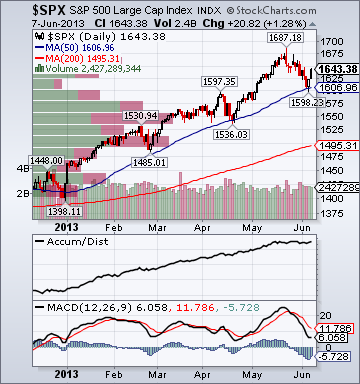
The Weekly Wrap by Briefing.com.
*5-Day Change
Indices
- Russell 2000 987.62 +.35%
- S&P 500 High Beta 25.57 +.28%
- Value Line Geometric(broad market) 426.04 +.25%
- Russell 1000 Growth 748.66 +.54%
- Russell 1000 Value 836.34 +.79%
- Morgan Stanley Consumer 1,006.46 +1.39%
- Morgan Stanley Cyclical 1,212.85 -.52%
- Morgan Stanley Technology 764.04 +.36%
- Transports 6,343.79 +.85%
- Bloomberg European Bank/Financial Services 96.08 -2.25%
- MSCI Emerging Markets 40.74 -2.68%
- HFRX Equity Hedge 1,106.96 -1.32%
- HFRX Equity Market Neutral 946.39 +.17%
Sentiment/Internals
- NYSE Cumulative A/D Line 186,505 -1.81%
- Bloomberg New Highs-Lows Index -111 -227
- Bloomberg Crude Oil % Bulls 35.29 +48.2%
- CFTC Oil Net Speculative Position 255,834 -.51%
- CFTC Oil Total Open Interest 1,740,663 -.23%
- Total Put/Call 1.12 -5.08%
- ISE Sentiment 77.0 -20.62%
- Volatility(VIX) 15.14 -7.11%
- S&P 500 Implied Correlation 52.67 -4.5%
- G7 Currency Volatility (VXY) 10.39 +1.8%
- Emerging Markets Currency Volatility (EM-VXY) 9.67 -.92%
- Smart Money Flow Index 11,779.63 -2.63%
- Money Mkt Mutual Fund Assets $2.613 Trillion unch.
Futures Spot Prices
- Reformulated Gasoline 287.15 +4.64%
- Heating Oil 289.31 +4.15%
- Bloomberg Base Metals Index 196.50 +1.32%
- US No. 1 Heavy Melt Scrap Steel 327.0 USD/Ton -6.4%
- China Iron Ore Spot 110.90 USD/Ton +.45%
- UBS-Bloomberg Agriculture 1,509.32 +.23%
Economy
- ECRI Weekly Leading Economic Index Growth Rate 6.3% -30 basis points
- Philly Fed ADS Real-Time Business Conditions Index -.1595 +10.49%
- S&P 500 Blended Forward 12 Months Mean EPS Estimate 116.16 +.22%
- Citi US Economic Surprise Index -32.30 -17.9 points
- Citi Emerging Markets Economic Surprise Index -45.10 +2.0 points
- Fed Fund Futures imply 44.0% chance of no change, 56.0% chance of 25 basis point cut on 6/19
- US Dollar Index 81.69 -1.88%
- Euro/Yen Carry Return Index 134.33 -1.34%
- Yield Curve 187.0 +4 basis points
- 10-Year US Treasury Yield 2.17% +4 basis points
- Federal Reserve's Balance Sheet $3.357 Trillion +.46%
- U.S. Sovereign Debt Credit Default Swap 28.0 +.90%
- Illinois Municipal Debt Credit Default Swap 155.0 +26.01%
- Western Europe Sovereign Debt Credit Default Swap Index 87.0 +5.46%
- Emerging Markets Sovereign Debt CDS Index 220.03 +10.29%
- Israel Sovereign Debt Credit Default Swap 120.75 +.62%
- China Blended Corporate Spread Index 386.0 +20 basis points
- 10-Year TIPS Spread 2.15% -4 basis points
- TED Spread 23.50 -1.5 basis points
- 2-Year Swap Spread 17.25 +1.0 basis point
- 3-Month EUR/USD Cross-Currency Basis Swap -12.5 +1.75 basis points
- N. America Investment Grade Credit Default Swap Index 79.40 +2.52%
- European Financial Sector Credit Default Swap Index 152.30 +3.82%
- Emerging Markets Credit Default Swap Index 299.93 +7.45%
- CMBS AAA Super Senior 10-Year Treasury Spread to Swaps 102.50 +2.5 basis points
- M1 Money Supply $2.533 Trillion +.34%
- Commercial Paper Outstanding 1,030.60 -1.6%
- 4-Week Moving Average of Jobless Claims 352,500 +5,200
- Continuing Claims Unemployment Rate 2.3% unch.
- Average 30-Year Mortgage Rate 3.91% +10 basis points
- Weekly Mortgage Applications 638.70 -11.46%
- Bloomberg Consumer Comfort -29.7 unch.
- Weekly Retail Sales +2.70% +10 basis points
- Nationwide Gas $3.63/gallon +.02/gallon
- Baltic Dry Index 806.0 -.62%
- China (Export) Containerized Freight Index 1,035.04 unch.
- Oil Tanker Rate(Arabian Gulf to U.S. Gulf Coast) 22.50 -10.0%
- Rail Freight Carloads 221,806 -10.64%
Best Performing Style
Worst Performing Style
Leading Sectors
Lagging Sectors
Weekly High-Volume Stock Gainers (20)
- CLVS, ET, NRCIB, HSII, CIEN, MKTG, TSRO, GIII, JMBA, TTS, MFRM, AGYS, DFRG, CBRL, LGND, QDEL, NCS, FIX, CLP and THR
Weekly High-Volume Stock Losers (10)
- ADC, CYNO, RST, RHP, OLP, SHOS, VRA, UBNT, PAY and INFI
Weekly Charts
ETFs
Stocks
*5-Day Change
Today's Market Take:
Broad Market Tone:
- Advance/Decline Line: Higher
- Sector Performance: Most Sectors Rising
- Market Leading Stocks: Performing In Line
Equity Investor Angst:
- ISE Sentiment Index 78.0 -21.21%
- Total Put/Call 1.16 -4.13%
Credit Investor Angst:
- North American Investment Grade CDS Index 81.11 -3.31%
- European Financial Sector CDS Index 152.23 -7.51%
- Western Europe Sovereign Debt CDS Index 87.0 +3.0%
- Emerging Market CDS Index 299.99 -1.7%
- 2-Year Swap Spread 17.25 unch.
- 3-Month EUR/USD Cross-Currency Basis Swap -12.5 +.25 bp
Economic Gauges:
- 3-Month T-Bill Yield .04% -1 bp
- China Import Iron Ore Spot $110.90/Metric Tonne -2.63%
- Citi US Economic Surprise Index -32.30 -3.3 points
- 10-Year TIPS Spread 2.14 +1 bp
Overseas Futures:
- Nikkei Futures: Indicating +383 open in Japan
- DAX Futures: Indicating -8 open in Germany
Portfolio:
- Higher: On gains in my biotech/medical/retail/tech sector longs and emerging markets shorts
- Disclosed Trades: Covered some of my (IWM)/(QQQ) hedges, then added them back
- Market Exposure: 50% Net Long
Bloomberg:
- Debt Risk Heads for Third Weekly Rise as Yields Surge in Europe.
The cost of insuring European
corporate bonds is heading for its third weekly increase as
yields surge amid concern central banks will curb their efforts
to boost economic growth. The Markit iTraxx Europe Index of
credit-default swaps on 125 companies with investment-grade ratings rose
eight basis points this week, and was at 111 basis points at 10:51 a.m.
in London, the longest stretch of weekly gains since March. Average
yields on the debt rose nine basis points to a two-month high of
1.99 percent, according to Bank of America Merrill Lynch’s Euro
Corporate index. Average yields on junk-rated notes climbed 23 basis points
this week to 5.46 percent, the highest in a month, Bank of
America Merrill Lynch index data show. The spread over
government debt widened 27 basis points to 511, the most since
April 18. The Markit iTraxx Crossover Index of default swaps on 50
companies with high-yield credit ratings reached a two-month
high of 471 basis points yesterday, after jumping 49 basis points this week.
An increase signals deterioration in perceptions of credit quality. The
Markit iTraxx Financial Index linked to senior debt of 25 banks and
insurers rose 16 basis points to 163 while the
subordinated index climbed 22 basis points to 233.
- EU Says Countries Must Shoulder Responsibility for Ailing Banks. Euro-area states should only be able
to seek direct help for their banking systems from the currency
zone’s firewall fund if their national solvency is at risk, the
European Commission said in a draft report. Otherwise, the European Stability Mechanism should lend
funds to the affected nation, which would then be responsible
for channelling the money to overhaul its lenders as was the
case for Spain, according to the document obtained by Bloomberg
News. Direct ESM aid is part of the European Union’s strategy to
shore up its banking system through common supervision and
standards for dealing with failing banks.
- European Stocks Advance on U.S. Non-Farm Payroll Report. European stocks advanced, rebounding
after the Stoxx Europe 600 Index fell to its lowest level in more than six weeks yesterday, as a U.S. report showed employers
added more workers last month than forecast. The Stoxx 600 climbed 1.3 percent to 295.4 at the close of
trading.
- China’s Stocks Drop for Seventh Day Before Data. China’s
stocks fell, capping the benchmark gauge’s first weekly decline in six
weeks, as money-market rates jumped and economists forecast a report
tomorrow will show export growth slowed last month. China Petroleum
& Chemical Corp. (386), the nation’s biggest refiner, slid 1.6
percent after the government said it will cut gasoline prices.
Industrial Bank Co. dropped 1.7 percent, adding to an 8.1 percent slump
this week. China Coal Energy Co. (601898) led declines among coal
producers. China’s exports may have grown 7.4 percent, half of April’s
14.7 percent, based on the median
estimate of 38 economists. The government will release industrial
output, retail sales, and inflation data on June 9. The Shanghai
Composite Index (SHCOMP) fell for a seventh day, losing 1.4 percent to
2,210.90 at the close. It slid 3.9 percent this
week, the first decline since the week ended April 26, amid
concerns about slowing economic growth and tighter liquidity.
- Brazil to Experience Tremors from Fed QE Program Tapering. End of
quantitative easing program in the US could cause tremors for the world
and Brazil, columnist Claudia Safatle reports, citing people from
Brazil's economic team. Rising interest rates and depreciation of the
real add important risk factors to the continuity of economic recovery,
raising doubts about 2014 growth. GDP to grow about 2% in 2013; next
year, growth will be similar or worse, depending on monetary tightening
cycle and declines in currency. There may be some overshooting and
overreaction, an official said.
- Brazilian Real’s Rout Deepens as S&P Cuts Credit Rating Outlook. Brazil’s real fell to a four-year low
after Standard & Poor’s cut the government’s credit-rating
outlook to negative amid an economic slump that’s threatening to
drive up the country’s debt levels. The real sank 0.8 percent to 2.1467 per dollar at 10:23
a.m. in Sao Paulo after earlier reaching 2.1533, the lowest on a
closing basis since May 2009. Swap rates due January 2016 rose
11 basis points, or 0.11 percentage point, to 9.79 percent. The
Ibovespa benchmark stock gauge slumped 0.5 percent.
- Commodity Investments Drop the Most in 11 Months as Gold Tumbles. Commodity investments fell $27
billion in April, the most in 11 months, on record sales of gold exchange-traded products, Barclays Plc (BARC) said. Assets under management dropped to $385 billion from $412 billion in March, the biggest decline since May 2012, London-based Barclays said in a report e-mailed today. Net redemptions
in gold were a record 182 metric tons worth $8.7 billion in
April followed by another 99 tons in May, it said.
The Standard & Poor’s GSCI Total Return Index of 24 raw
materials fell 4.7 percent in April, the biggest drop since May
2012. The gauge is down 3.1 percent this year.
- Gold, Silver Tumble Most in Three Weeks on Stimulus Bets. Gold
tumbled the most since mid-April after employment in the U.S. increased
more than forecast in May, boosting concern that the Federal Reserve
may scale back monetary stimulus. Silver fell more than 4 percent.
- Greenspan Calls for Tapering of Federal Reserve Asset Purchases. Alan
Greenspan, former chairman of the Federal Reserve, said the central
bank needs to begin cutting back on its unprecedented asset purchases
and move toward stopping them altogether. “The sooner we come to grips
with this excessive level of assets on the balance sheet of the Federal
Reserve, which everyone agrees is excessive, the better,” Greenspan said on CNBC television today. “The issue is not only a question of when we taper down, but when do we turn? And I think that the markets may not give us all of the leeway we would like to do that.”
Greenspan, 87, said while slowing bond purchases must be an initial
step, a lower rate of asset purchases will still add to the Fed’s
balance sheet, which has reached a record $3.4 trillion. Asked if he thinks the economy is strong enough to drop the
policy, known as quantitative easing, to zero, Greenspan said
“we’ve got to do it even if we don’t think it’s strong
enough.”
- Mortgage-Bond Yields Approach 14-Month High After Jobs Report. Yields on Fannie Mae and Freddie Mac
mortgage bonds that guide U.S. home-loan rates approached a 14-month high as May employment data failed to allay concern that
the Federal Reserve will pare back its unprecedented stimulus. Fannie
Mae’s current-coupon 30-year securities rose 0.03 percentage point to
2.96 percent as of 11 a.m. in New York, according to data compiled by
Bloomberg. Yields reached 3 percent on June 4, the highest level since
April 2012, climbing from a record-low 1.68 percent in September when the Fed said it would start buying $40 billion of home-loan debt a month to
begin its third round of bond purchases.
- Obama Surveillance Defies Campaign Civil Liberty Pledge.
The news that Barack Obama continued the Bush administration’s domestic
telephone surveillance program is sparking new doubts about a president
who campaigned as a champion of civil liberties and greater
transparency. “It’s remarkable that the man who rode his way to the
presidency by suggesting George Bush’s anti-terrorism policies violated
the Constitution is emulating those
policies himself,” said Ari Fleischer, the former president’s press
secretary. “It’s as if George Bush had gotten a fourth term.”
Wall Street Journal:
- Fed on Track to Ease Up on Bond Buying Later This Year by Jon Hilsenrath. Federal Reserve officials are likely to signal at their June policy
meeting that they're on track to begin pulling back their
$85-billion-a-month bond-buying program later this year, as long as the
economy doesn't disappoint. A good-but-not-great jobs report Friday ensured officials wouldn't
want to act right away and would instead want to see more data before
taking a delicate step toward winding down the program. Fed Chairman Ben Bernanke signaled last month that the central bank
could start pulling back the program "in the next few meetings," a view
echoed by other officials in recent weeks. The Fed's next meeting is June 18-19, and after that at the end of July and in mid-September.
- Rehn Hits Back at IMF Over Greece.
European Union Economics Chief Olli Rehn had harsh words for the
International Monetary Fund Friday as he responded to a report by the
IMF criticizing the European Commission over the Greek bailout. "I don't think it's fair and just that the IMF is trying to wash its
hands and throwing the dirty water on European shoulders," Mr. Rehn said
using unusually tough language.
- Rapid Increase in Brazil Credit Poses Concerns For Households-IMF. The rapid growth of credit in Brazil poses some concerns for
households, but not so much for the financial sector, the International
Monetary Fund said Thursday. Although the overall level of debt in Brazil remains relatively low by
international standards, the IMF expressed concern about the levels of
household debt, and high debt-service burdens in particular, given the
high interest rates and short loan maturities. Mortgages continue to
be
only a small share of the total consumer-credit portfolio, it said.
"With average debt service-to-income estimated above 20%, there are
indications that some households are already under financial distress,"
the report said. Recent data on delinquency rates and bounced checks suggest at least
some households may have reached or exceeded the limit of their
debt-carrying capacity, the IMF said.
Fox News:
- Obama: Phone, Internet data collection not 'Big Brother'. President Obama, speaking publicly for the first time about his
administration's mass collection of phone and Internet data, said Friday
that the programs have made a difference in tracking terrorists and are
not tantamount to "Big Brother." Obama addressed the mounting controversy about the programs during
remarks in California, ahead of a highly anticipated meeting with
Chinese President Xi Jinping. As the administration moves to declassify
some of the details about those programs, Obama assured that his
administration is trying to strike the right "balance." "In the abstract, you can complain about Big Brother and how this is a
potential program run amok, but when you actually look at the details,
then I think we've struck the right balance," Obama said. Obama acknowledged that the U.S. government is collecting reams of
phone records, including phone numbers and the duration of calls, but
said this does not include listening to calls or gathering the names of
callers.
- Mark Levin On NSA Tracking: "We Have The Elements Of A Police State Here". (video)
- Misfired email tipped off DC officials to IRS scandal in 2010, earlier than previously known.
CNBC:
Zero Hedge:
Business Insider:
Reuters:
- Bundesbank dampens optimism over German economy. Germany's
central bank said the economy would slow considerably after a strong
second quarter, cutting its 2013 growth forecast by 0.1 percentage
points to 0.3 percent and its estimate for 2014 growth to 1.5 percent
from 1.9 percent. The Bundesbank's 2013 prediction brought it into
line with the International Monetary Fund, which halved its forecast for
Germany on Monday.
- TREASURIES-U.S. bonds slump on revived bets of less Fed buying.
- Tumble in key interest rate highlights bank finance woes. A key overnight interest rate went negative
twice last week, in a rare stumble that renewed attention on the
distortions created by the Federal Reserve's asset-buying
stimulus program.
The overnight general
collateral repo rate, or GC rate, effectively determines the interest
earned on overnight secured loans to banks. A negative rate means
lenders pay for the privilege of
loaning money - an unsustainable position that has highlighted
severe dysfunction in the so-called repo market. The GC rate fell to negative three basis points (bp) last
Wednesday, and dropped two more bp the following day - its first
tumble into negative ground since the 2011 eurozone crisis. That drop has renewed concerns that the repo market is
clogged, with a shortage of the collateral it needs to function
smoothly.
Telegraph:
Foglio:
- Berlusconi
Says Euro-Area Cohesion at Risk Over Growth. Former Italian PM says in
interview with Il Foglio that Italy must confront German Chancellor
Merkel and obtain EU growth policies. If response of Germany and EU
allies is insufficient, nations must find own growth solutions "undoing
the mechanisms of the euro area," Berlusconi said.
Echoing fears that
European policymakers remain in a state of cognitive dissonance –
recognizing the need for root-and-branch overhaul of peripheral banks,
but backtracking on joint liability plans – Christopher Flowers, the
legendary FIG investor who now runs the £2.3 billion ($3.5 billion)
private equity group JC Flowers, sounded the alarm over the negative
sovereign-bank feedback loop.
In a shot across the bows of market bulls, who cite the return of
capital flows to weaker eurozone states, Flowers issued a stark warning:
"There is a scenario where we have a Lehman-type event: we wake up some
Thursday and a big country is in trouble.
"And the ECB will have to decide to support banks x, y, z. And then the
ECB will, in fact, decide to own bank x, y, z.
While we want you to share, we ask you use the functions on-site rather than copy/paste. See T's & C's for details. http://www.euromoney.com/Article/3211790/CurrentIssue/88924/Restructuring-Flowers-slams-Europe-over-inaction.html?copyrightInfo=true
Style Underperformer:
Sector Underperformers:
- 1) Gold & Silver -3.60% 2) REITs -.85% 3) Steel -.81%
Stocks Falling on Unusual Volume:
- IRM, TIVO, EQIX, LAMR, TMO, CPRT, SHOS, OIS, BOFI, CHMT, LQDT, WLT, ARMH, USM, QCOM, DLR, NX, HME, CLP, ZTS, AMT, LYB, AEM and SYNA
Stocks With Unusual Put Option Activity:
- 1) LYV 2) IRM 3) BID 4) IYT 5) YUM
Stocks With Most Negative News Mentions:
- 1) RYL 2) KBH 3) SLV 4) ANR 5) VNQ
Charts:
Style Outperformer:
Sector Outperformers:
- Restaurants +1.85% 2) Biotech +1.68% 3) HMOs +1.66%
Stocks Rising on Unusual Volume:
- CA, NRG, ELN, THO, GME, UNXL, PPC and QCOR
Stocks With Unusual Call Option Activity:
- 1) CA 2) HRB 3) CTRX 4) TIVO 5) KKD
Stocks With Most Positive News Mentions:
- 1) PSMT 2) LMT 3) VRA 4) VALE 5) GPS
Charts:

