Monday, October 10, 2005
Monday Watch

Weekend Headlines
Bloomberg:
- Fluor Corp., the biggest US construction and engineering company, won a $1 billion contract to expand natural gas processing facilities in the United Arab Emirates.
- An alleged terrorist plot reported to national officials was planned for on or around Sunday and might have involved a team of terrorists attacking New York’s subways with explosives hidden in briefcases or strollers, citing a Homeland Security memo.
- Wal-Mart Stores said October sales in the US are rising within its forecast range, led by the nation’s western region.
- Delphi filed for bankruptcy protection for its US operations after failing to win concessions from unions and financial aid from former parent GM.
- US natural gas prices may fall as mild weather reduces demand, a Bloomberg survey showed.
Financial Times:
- Nokia Oyj, the world’s biggest mobile phone maker, expects “good” demand next year, defying analysts’ predictions for slower growth, citing an interview with CEO Ollila.
- German Chancellor Gerhard Schroeder will “leave the national political stage” to make way for opposition leader Angela Merkel in a deal likely to be announced on Monday, Oct. 10.
Washington Post:
- The Arabic-language news channel al-Jazeera, which has been accused of aiding terrorists, hired veteran BBC journalist David Frost as it gets ready to start a network that will broadcast in English.
- Sleeping less than seven hours a night may raise the risk of obesity, according to a report that adds to research linking a lack of rest to higher rates of cancer and diabetes.
NY Times:
- Mortgage brokers in the US, a profession that barely existed 25 years ago, will make $33 billion this year.
- The resilience of the US economy is explained by its ability to constantly recalibrate itself and adjust its supply side to demand, thus fostering economic stability.
- CVS Corp. CEO Ryan said that the drugstore chain will benefit when patents on some popular medicines, including Zoloft and Zithromax, expire this year and next.
- Home photo-printing is failing to catch on with consumers because the process is more expensive than ordering prints from retailers, including Wal-Mart Stores and Snapfish.com.
- The strain of bird flue that is currently in Asia won’t likely become a pandemic affecting humans this year, citing scientists.
- Divining the right mix of government and private activity is key to disaster response, drawing examples from the response of the US government to a hurricane that hit Galveston, Texas, in 1900, and to a 1906 earthquake and fire that leveled San Francisco.
- A ruling in a class-action lawsuit in June by a US District Court judge in Corpus Christi, Texas, has sent a shock wave through the world of plaintiffs’ lawyers.
- Flight Safety Technologies is testing a laser system to detect turbulence behind plane engines that may help air-traffic controllers prevent crashes and raise runway capacity 20%.
LA Times:
- California Governor Schwarzenegger signed a bill requiring tobacco companies to sell only “fire safe” cigarettes in the state beginning in 2007.
- The number of Cubans trying to reach the US by boat across the Florida Straits is the highest in more than a decade.
Detroit News:
- GM is raising health-care costs for tens of thousands of white-collar employees and retirees, a move that may save millions.
San Francisco Chronicle:
- Convention bookings in San Francisco reached a record during the fiscal year ended June 30, with 925 groups scheduling meetings for an estimated economic benefit of $1.4 billion.
Mail on Sunday:
- Ericsson AB will buy Marconi, a UK telecommunications equipment maker in an agreed transaction that may value Marconi at as much as $2.3 billion.
Il Sole/24 Ore:
- The European Central Bank is not planning to raise interest rates as it continues to monitor the effects of rising oil prices on the European economic recovery.
Oil & Gas Journal:
- Even with the effects of the hurricanes natural gas storage now stands 40 bcf above the 5-year average.
Weekend Recommendations
Barron's:
- Had positive comments on WMT, MXO and SYT.
Goldman Sachs:
- Reiterated Outperform on SYK and CFC.
Night Trading
Asian indices are -.25% to +1.0% on average.
S&P 500 indicated +.20%.
NASDAQ 100 indicated +.26%.
Morning Preview
US AM Market Call
NASDAQ 100 Pre-Market Indicator/Heat Map
Pre-market Commentary
Before the Bell CNBC Video(bottom right)
Global Commentary
Asian Indices
European Indices
Top 20 Business Stories
In Play
Bond Ticker
Daily Stock Events
Macro Calls
Rasmussen Consumer/Investor Daily Indices
CNBC Guest Schedule
Earnings of Note
Company/Estimate
AA/.29
DNA/.30
Upcoming Splits
- None of note
Economic Releases
- None of note
Bloomberg:
- Fluor Corp., the biggest US construction and engineering company, won a $1 billion contract to expand natural gas processing facilities in the United Arab Emirates.
- An alleged terrorist plot reported to national officials was planned for on or around Sunday and might have involved a team of terrorists attacking New York’s subways with explosives hidden in briefcases or strollers, citing a Homeland Security memo.
- Wal-Mart Stores said October sales in the US are rising within its forecast range, led by the nation’s western region.
- Delphi filed for bankruptcy protection for its US operations after failing to win concessions from unions and financial aid from former parent GM.
- US natural gas prices may fall as mild weather reduces demand, a Bloomberg survey showed.
Financial Times:
- Nokia Oyj, the world’s biggest mobile phone maker, expects “good” demand next year, defying analysts’ predictions for slower growth, citing an interview with CEO Ollila.
- German Chancellor Gerhard Schroeder will “leave the national political stage” to make way for opposition leader Angela Merkel in a deal likely to be announced on Monday, Oct. 10.
Washington Post:
- The Arabic-language news channel al-Jazeera, which has been accused of aiding terrorists, hired veteran BBC journalist David Frost as it gets ready to start a network that will broadcast in English.
- Sleeping less than seven hours a night may raise the risk of obesity, according to a report that adds to research linking a lack of rest to higher rates of cancer and diabetes.
NY Times:
- Mortgage brokers in the US, a profession that barely existed 25 years ago, will make $33 billion this year.
- The resilience of the US economy is explained by its ability to constantly recalibrate itself and adjust its supply side to demand, thus fostering economic stability.
- CVS Corp. CEO Ryan said that the drugstore chain will benefit when patents on some popular medicines, including Zoloft and Zithromax, expire this year and next.
- Home photo-printing is failing to catch on with consumers because the process is more expensive than ordering prints from retailers, including Wal-Mart Stores and Snapfish.com.
- The strain of bird flue that is currently in Asia won’t likely become a pandemic affecting humans this year, citing scientists.
- Divining the right mix of government and private activity is key to disaster response, drawing examples from the response of the US government to a hurricane that hit Galveston, Texas, in 1900, and to a 1906 earthquake and fire that leveled San Francisco.
- A ruling in a class-action lawsuit in June by a US District Court judge in Corpus Christi, Texas, has sent a shock wave through the world of plaintiffs’ lawyers.
- Flight Safety Technologies is testing a laser system to detect turbulence behind plane engines that may help air-traffic controllers prevent crashes and raise runway capacity 20%.
LA Times:
- California Governor Schwarzenegger signed a bill requiring tobacco companies to sell only “fire safe” cigarettes in the state beginning in 2007.
- The number of Cubans trying to reach the US by boat across the Florida Straits is the highest in more than a decade.
Detroit News:
- GM is raising health-care costs for tens of thousands of white-collar employees and retirees, a move that may save millions.
San Francisco Chronicle:
- Convention bookings in San Francisco reached a record during the fiscal year ended June 30, with 925 groups scheduling meetings for an estimated economic benefit of $1.4 billion.
Mail on Sunday:
- Ericsson AB will buy Marconi, a UK telecommunications equipment maker in an agreed transaction that may value Marconi at as much as $2.3 billion.
Il Sole/24 Ore:
- The European Central Bank is not planning to raise interest rates as it continues to monitor the effects of rising oil prices on the European economic recovery.
Oil & Gas Journal:
- Even with the effects of the hurricanes natural gas storage now stands 40 bcf above the 5-year average.
Weekend Recommendations
Barron's:
- Had positive comments on WMT, MXO and SYT.
Goldman Sachs:
- Reiterated Outperform on SYK and CFC.
Night Trading
Asian indices are -.25% to +1.0% on average.
S&P 500 indicated +.20%.
NASDAQ 100 indicated +.26%.
Morning Preview
US AM Market Call
NASDAQ 100 Pre-Market Indicator/Heat Map
Pre-market Commentary
Before the Bell CNBC Video(bottom right)
Global Commentary
Asian Indices
European Indices
Top 20 Business Stories
In Play
Bond Ticker
Daily Stock Events
Macro Calls
Rasmussen Consumer/Investor Daily Indices
CNBC Guest Schedule
Earnings of Note
Company/Estimate
AA/.29
DNA/.30
Upcoming Splits
- None of note
Economic Releases
- None of note
BOTTOM LINE: Asian Indices are mostly higher, spurred by gains in exporters in the region after last week’s better-than-expected US employment report. I expect US stocks to open modestly higher on gains in Asia and a bounce after last week’s losses. The Portfolio is 50% net long heading into the week.
Sunday, October 09, 2005
Weekly Outlook
There are some important economic reports and a few significant corporate earnings reports scheduled for release this week.
Economic reports for the week include:
Mon. - None of note
Tues. - Minutes of Sept. 20 FOMC Meeting
Wed. - None of note
Thur. - Trade Balance, Import Price Index, Initial Jobless Claims
Fri. - Consumer Price Index, Advance Retail Sales, Industrial Production, Univ. of Mich. Consumer Confidence, Business Inventories
A few of the more noteworthy companies that release quarterly earnings this week are:
Mon. - Alcoa Inc.(AA), Genentech(DNA)
Tues. - Advanced Micro Devices(AMD), Apple Computer(AAPL), Merrill Lynch(MER)
Wed. - Harley-Davidson(HDI), Lam Research(LRCX), Monsanto Co.(MON)
Thur. - Genzyme(GENZ), Progressive Corp.(PGR), Tribune Co.(TRB)
Fri. - Arch Coal(ACI), Boston Scientific(BSX), First Data(FDC), General Electric(GE), JB Hunt Transportation(JBHT), Peabody Energy(BTU), Saks Inc.(SKS), UnitedHealth Group(UNH)
Other events that have market-moving potential this week include:
Mon. - US Bond Market Closed for Columbus Day, Banc of America Real Estate Conference
Tue. - Bear Stearns Retail Outing, Banc of America Real Estate Conference
Wed. - Banc of America Real Estate Conference, Fed Chairman Greenspan speaks, Fed’s Olson speaks
Thur. - None of note
Fri. - None of note
Economic reports for the week include:
Mon. - None of note
Tues. - Minutes of Sept. 20 FOMC Meeting
Wed. - None of note
Thur. - Trade Balance, Import Price Index, Initial Jobless Claims
Fri. - Consumer Price Index, Advance Retail Sales, Industrial Production, Univ. of Mich. Consumer Confidence, Business Inventories
A few of the more noteworthy companies that release quarterly earnings this week are:
Mon. - Alcoa Inc.(AA), Genentech(DNA)
Tues. - Advanced Micro Devices(AMD), Apple Computer(AAPL), Merrill Lynch(MER)
Wed. - Harley-Davidson(HDI), Lam Research(LRCX), Monsanto Co.(MON)
Thur. - Genzyme(GENZ), Progressive Corp.(PGR), Tribune Co.(TRB)
Fri. - Arch Coal(ACI), Boston Scientific(BSX), First Data(FDC), General Electric(GE), JB Hunt Transportation(JBHT), Peabody Energy(BTU), Saks Inc.(SKS), UnitedHealth Group(UNH)
Other events that have market-moving potential this week include:
Mon. - US Bond Market Closed for Columbus Day, Banc of America Real Estate Conference
Tue. - Bear Stearns Retail Outing, Banc of America Real Estate Conference
Wed. - Banc of America Real Estate Conference, Fed Chairman Greenspan speaks, Fed’s Olson speaks
Thur. - None of note
Fri. - None of note
BOTTOM LINE: I expect US stocks to finish the week modestly higher on a bounce after recent losses. While last weeks lows may hold from an intermediate-term standpoint, I expect stocks to trade range-bound until closer to month’s end or early November as earnings worries increase. Subsequently, I expect a strong year-end rally to begin, led by the technology, retail, biotech, I-Banking, restaurant, gaming and airline sectors as earnings exceed lowered expectations, inflation fears subside and the energy price downtrend persists. Continued weakness in energy-related stocks should be more than offset by strength in most other market sectors. My trading indicators are giving bearish signals and the Portfolio is 50% net long heading into the week.
Economic Week in Review
ECRI Weekly Leading Index 135.10 -.30%
Construction Spending for August rose .4% versus estimates of a .4% gain and a .3% rise in July. US construction spending rose in August to a record, led by a jump in highway projects, and may climb for the rest of the year as rebuilding after Hurricane Katrina accelerates, Bloomberg said. Spending on residential construction rose .2%, non-residential construction spending rose .7% and government-funded construction rose .5%. “Activity will doubtless rise strongly in the fourth quarter and beyond as post-Katrina rebuilding gets under way,” said Ian Shepherdson, chief US economist at High Frequency Economics.
ISM Manufacturing for September rose to 59.4, the highest since August 2004, versus estimates of 52.0 and a reading of 53.6 in August. ISM Prices Paid for September rose to 78.0 versus estimates of 73.0 and a reading of 62.5 in August. US manufacturing unexpectedly accelerated in September, suggesting the recovery from two Gulf Coast hurricanes will be rapid, Bloomberg reported. The new orders component of the index rose to 63.8 from 56.4 in August. The employment component of the index rose to 53.1 from 52.6 in August. “The jump in new orders suggest that business was very good in September, and when business is good companies will feel better even though they’re facing higher input costs,” said Stephen Stanley, chief economist at RBS Greenwich Capital.
Factory Orders for August rose 2.5% versus estimates of a 2.0% gain and a 2.5% decline in July. Orders placed with US factories rose 2.5% in August, the third increase in four months, signaling manufacturing was gaining strength ahead of Hurricanes Katrina and Rita, Bloomberg reported. Bookings for commercial aircraft surged 9.2% following a 21% decrease in July. Orders for capital goods excluding aircraft, a barometer for future business investment, gained 3.1% after a 3.9% decline in July. The inventory-to-shipments ratio fell to 1.18 months, the lowest level since December, versus 1.2 months the prior month. Unfilled orders rose 1.6% and have now risen 10% over the last 12 months. “Manufacturing was going strong before Katrina hit and the ISM report told us Katrina didn’t have much effect on activity across the nation,” said Michael Moran, chief economist at Daiwa Securities. “With backlogs building, we should expect output and employment to remain sold,” said Joel Naroff, president of Naroff Economic Advisors.
Total Vehicle Sales for September fell to 16.4M versus estimates of 16.0M and 16.8M in August. Domestic Vehicle Sales for September fell to 13.0M versus estimates of 12.8M and 13.3M in August. General Motors and Ford Motor said US sales of cars and trucks plunged in September as the lure of employee discounts faded, while the largest Asian automakers gained at least 10%, Bloomberg reported. Gasoline prices damped sales of sport-utility vehicles such as the Ford Explorer, which plunged 58% last month. “You have gasoline prices at $3/gallon and it’s pushing the shift to smaller, more fuel-efficient vehicles,” said Kevin Tynan, an Argus Research analyst. Asian automakers captured 38.2% of the US market, their best showing in any September. Toyota said it was helped by soaring sales of the gasoline-electric Prius cars, hybrid Highlander and Lexus RX 400h SUVs. Nissan saw a surge in sales of its compact Sentra cars and mid-sized Altima sedans and Murano SUVs, the company’s most fuel-efficient models in their respective categories.
ISM Non-Manufacturing for September fell to 53.3 versus estimates of 60.0 and a reading of 65.0 in August. US service industries expanded at the slowest pace in more than two years in September as Hurricanes Katrina and Rita shut down Gulf Coast businesses and pushed costs for materials and supplies to a record, Bloomberg reported. The Prices Paid component of the index rose to 81.4 from 67.1. The employment gauge fell to 54.9 from 59.6. The New Orders component of the index fell to 56.6 from 65.8. “Service companies are clearly looking at the low readings on consumer confidence and are scaling back their expectations for growth this year,” said Chris Rupkey, senior financial economist at Bank of Tokyo-Mitsubishi.
The Change in Non-farm Payrolls for September was -35K versus estimates of -150K and an upwardly revised 211K in August. The Unemployment Rate for September rose to 5.1% versus estimates of 5.0% and 4.9% in August. The Change in Manufacturing Payrolls for September was -27K versus estimates of -33K and an upwardly revised -9K in August. Average Hourly Earnings for September rose .2% versus estimates of a .2% increase and a .1% gain in August. Hurricane Katrina pushed the US unemployment rate up to 5.1% in September as the economy lost 35,000 jobs, fewer than expected and evidence that the storm wasn’t strong enough to derail the expansion, Bloomberg reported. The hurricanes Katrina and Rita may have eliminated up to 480,000 jobs temporarily, according to the latest estimates from the Congressional Budget Office. “This is a pretty good payroll number for September. The market dodged a bullet with this report,” said John Silvia, chief economist at Wachovia Corp. “It’s a very resilient economy that’s likely to be doing extremely well in a few months,” said Kurt Karl, chief US economist at Swiss Reinsurance.
Wholesale Inventories for August rose .5% versus estimates of a .4% increase and a .1% gain in July. Stockpiles at US wholesalers rose in August by the most in four months as companies rebuilt inventories to meet growing demand before the two hurricanes ripped into the Gulf Coast, Bloomberg reported. The inventory-to-sales ratio fell to 1.17 months. “Both sales and inventories advanced noticeably, underscoring the point that the economy was in quite good shape prior to the hurricanes,” said Stephen Stanley, chief economist at RBS Greenwich Capital.
Consumer Credit for August fell to $4.9B versus estimates of $5.0B and an upwardly revised $6.5B in July. Borrowing by US consumers rose at a modestly slower pace in August as American coped with rising interest rates and high gas prices, Bloomberg reported. Auto loans and other non-revolving debt rose $2.6 billion in August after rising $4.7 billion a month earlier. “The national statistics do not yet tell the story that the consumer is in debt up to his eyeballs,” said Chris Rupkey.
Construction Spending for August rose .4% versus estimates of a .4% gain and a .3% rise in July. US construction spending rose in August to a record, led by a jump in highway projects, and may climb for the rest of the year as rebuilding after Hurricane Katrina accelerates, Bloomberg said. Spending on residential construction rose .2%, non-residential construction spending rose .7% and government-funded construction rose .5%. “Activity will doubtless rise strongly in the fourth quarter and beyond as post-Katrina rebuilding gets under way,” said Ian Shepherdson, chief US economist at High Frequency Economics.
ISM Manufacturing for September rose to 59.4, the highest since August 2004, versus estimates of 52.0 and a reading of 53.6 in August. ISM Prices Paid for September rose to 78.0 versus estimates of 73.0 and a reading of 62.5 in August. US manufacturing unexpectedly accelerated in September, suggesting the recovery from two Gulf Coast hurricanes will be rapid, Bloomberg reported. The new orders component of the index rose to 63.8 from 56.4 in August. The employment component of the index rose to 53.1 from 52.6 in August. “The jump in new orders suggest that business was very good in September, and when business is good companies will feel better even though they’re facing higher input costs,” said Stephen Stanley, chief economist at RBS Greenwich Capital.
Factory Orders for August rose 2.5% versus estimates of a 2.0% gain and a 2.5% decline in July. Orders placed with US factories rose 2.5% in August, the third increase in four months, signaling manufacturing was gaining strength ahead of Hurricanes Katrina and Rita, Bloomberg reported. Bookings for commercial aircraft surged 9.2% following a 21% decrease in July. Orders for capital goods excluding aircraft, a barometer for future business investment, gained 3.1% after a 3.9% decline in July. The inventory-to-shipments ratio fell to 1.18 months, the lowest level since December, versus 1.2 months the prior month. Unfilled orders rose 1.6% and have now risen 10% over the last 12 months. “Manufacturing was going strong before Katrina hit and the ISM report told us Katrina didn’t have much effect on activity across the nation,” said Michael Moran, chief economist at Daiwa Securities. “With backlogs building, we should expect output and employment to remain sold,” said Joel Naroff, president of Naroff Economic Advisors.
Total Vehicle Sales for September fell to 16.4M versus estimates of 16.0M and 16.8M in August. Domestic Vehicle Sales for September fell to 13.0M versus estimates of 12.8M and 13.3M in August. General Motors and Ford Motor said US sales of cars and trucks plunged in September as the lure of employee discounts faded, while the largest Asian automakers gained at least 10%, Bloomberg reported. Gasoline prices damped sales of sport-utility vehicles such as the Ford Explorer, which plunged 58% last month. “You have gasoline prices at $3/gallon and it’s pushing the shift to smaller, more fuel-efficient vehicles,” said Kevin Tynan, an Argus Research analyst. Asian automakers captured 38.2% of the US market, their best showing in any September. Toyota said it was helped by soaring sales of the gasoline-electric Prius cars, hybrid Highlander and Lexus RX 400h SUVs. Nissan saw a surge in sales of its compact Sentra cars and mid-sized Altima sedans and Murano SUVs, the company’s most fuel-efficient models in their respective categories.
ISM Non-Manufacturing for September fell to 53.3 versus estimates of 60.0 and a reading of 65.0 in August. US service industries expanded at the slowest pace in more than two years in September as Hurricanes Katrina and Rita shut down Gulf Coast businesses and pushed costs for materials and supplies to a record, Bloomberg reported. The Prices Paid component of the index rose to 81.4 from 67.1. The employment gauge fell to 54.9 from 59.6. The New Orders component of the index fell to 56.6 from 65.8. “Service companies are clearly looking at the low readings on consumer confidence and are scaling back their expectations for growth this year,” said Chris Rupkey, senior financial economist at Bank of Tokyo-Mitsubishi.
The Change in Non-farm Payrolls for September was -35K versus estimates of -150K and an upwardly revised 211K in August. The Unemployment Rate for September rose to 5.1% versus estimates of 5.0% and 4.9% in August. The Change in Manufacturing Payrolls for September was -27K versus estimates of -33K and an upwardly revised -9K in August. Average Hourly Earnings for September rose .2% versus estimates of a .2% increase and a .1% gain in August. Hurricane Katrina pushed the US unemployment rate up to 5.1% in September as the economy lost 35,000 jobs, fewer than expected and evidence that the storm wasn’t strong enough to derail the expansion, Bloomberg reported. The hurricanes Katrina and Rita may have eliminated up to 480,000 jobs temporarily, according to the latest estimates from the Congressional Budget Office. “This is a pretty good payroll number for September. The market dodged a bullet with this report,” said John Silvia, chief economist at Wachovia Corp. “It’s a very resilient economy that’s likely to be doing extremely well in a few months,” said Kurt Karl, chief US economist at Swiss Reinsurance.
Wholesale Inventories for August rose .5% versus estimates of a .4% increase and a .1% gain in July. Stockpiles at US wholesalers rose in August by the most in four months as companies rebuilt inventories to meet growing demand before the two hurricanes ripped into the Gulf Coast, Bloomberg reported. The inventory-to-sales ratio fell to 1.17 months. “Both sales and inventories advanced noticeably, underscoring the point that the economy was in quite good shape prior to the hurricanes,” said Stephen Stanley, chief economist at RBS Greenwich Capital.
Consumer Credit for August fell to $4.9B versus estimates of $5.0B and an upwardly revised $6.5B in July. Borrowing by US consumers rose at a modestly slower pace in August as American coped with rising interest rates and high gas prices, Bloomberg reported. Auto loans and other non-revolving debt rose $2.6 billion in August after rising $4.7 billion a month earlier. “The national statistics do not yet tell the story that the consumer is in debt up to his eyeballs,” said Chris Rupkey.
BOTTOM LINE: Overall, last week's economic data were modestly positive as most releases exceeded expectations. Construction will remain very strong and continue adding to economic growth for the foreseeable future as the effects of the highway bill and hurricane rebuilding take hold. Measures of manufacturing were accelerating before the hurricanes and have continued to maintain strength as evidenced by the strong surge in the ISM report and better-than-expected Factory Orders. Manufacturing will continue to boost economic growth through year-end as inventories are rebuilt after a mid-year slump. I expect prices paid indices to begin decelerating again towards year-end and fall throughout most of next year. Vehicle Sales were due for a slowdown after recent record activity related to employee discount promotions. However, I expect sales to remain relatively healthy as more Americans switch to fuel-efficient vehicles. The ISM Non-manufacturing Index will likely bounce back next month as consumer spending has remained healthy despite the effects of the hurricanes. Job growth should rebound sharply over the coming months, but not back to pre-hurricane levels. Considering the vigorous spending on autos and homes this year, it is not surprising to see consumer credit growth decelerate temporarily. However, Consumer Credit should also accelerate into year-end.
I continue to believe the US economy’s resilience is remarkable given the recent headwinds of record energy prices and massive hurricane-related dislocations. I see very little evidence of a significant economic slowdown. US growth has likely slowed to below average rates(below 3.1%) from very high levels before the hurricanes(above 4.5%). However, growth should accelerate back to at least average levels(around 3%) into year-end as energy prices continue to decline, inflation fears subside, corporate spending accelerates, job growth rebounds, incomes continue to grow faster than inflation, consumer confidence rebounds and hurricane rebuilding takes hold. These positives should mostly offset higher interest rates and a slowing housing market. With US growth at average rates, housing slowing to more healthy sustainable levels and measures of inflation decelerating, the Fed will likely “pause” during the first quarter of next year.
I disagree with those market participants that view the decline in energy prices as a significant weakening of the US economy. Global rig counts are at the highest level in almost 20 years. Global supply of oil is currently exceeding demand by at least 2 million barrels/day. Back in 2000 when the gap was at this point, oil was $25/bbl. I am seeing overwhelming evidence around the world of demand destruction, as a result of high prices, which will further widen this spread. In my opinion, oil has been trading at record highs on fear of a fourth quarter supply shortfall rather than fundamentals. T.Boone Pickens, the well-known energy hedge fund manager, has repeatedly stated that we would see demand exceed supply during the fourth quarter of this year. Demand for oil has been decelerating since last November. As we move closer to year-end, with demand for oil now falling rather than decelerating, the fear premium should be removed. I continue to expect oil to reach $35-$40/bbl. over the intermediate-term. Natural Gas is also trading at record prices on fear as evidenced by the supply build last week even with almost 70% of Gulf of Mexico production shut-in. I expect natural gas prices to follow oil meaningfully lower over the coming months. Finally, the ECRI Weekly Leading Index fell .30% to 135.10 and is still forecasting healthy US economic growth.
Saturday, October 08, 2005
Market Week in Review
S&P 500 1,195.90 -2.68%
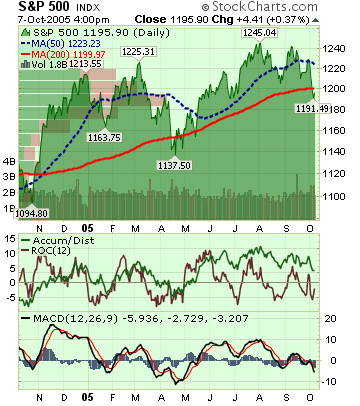
Click here for the Weekly Wrap by Briefing.com.
*5-day % Change
Click here for the Weekly Wrap by Briefing.com.
BOTTOM LINE: Overall, last week's market performance was negative considering the substantial fall in energy prices, better-than-expected economic data and stable long-term rates. The advance/decline line fell, almost every sector declined and volume was above average on the week. Measures of investor anxiety were mostly higher. However, the AAII % Bulls rose sharply for the week and is now slightly above average levels. In my opinion, while measures of investor fear are elevated from an intermediate-term standpoint, they are still registering too much complacency in the short-term for a sustainable rally to occur. While stocks may have put in a bottom this week, another short period of weakness is likely which should set the stage for a strong year-end rally. The average 30-year mortgage rate rose to 5.98%, but is still only 77 basis points above all-time lows set in June 2003 and down from 2005 highs of 6.04% set in April. The benchmark 10-year T-note yield rose 2 basis points on the week as economic data surprised on the upside and multiple Fed members spoke of the need to stop inflation before it becomes a problem. In my opinion, it is very reckless for the Fed to speak incessantly about inflation considering it is only near average levels by historic standards and a large component of inflation is expectations. The US dollar fell after European central bankers spoke of the need to raise rates for the first time this cycle. Gold rose on strong demand from China, a weaker dollar and inflation worries. Unleaded Gas futures have now plunged almost 40% since September highs even as refinery utilization remains at only 69.8%. Moreover, natural gas saw another inventory build this week even as 64% of daily Gulf of Mexico production remains shut-in. I continue to believe global energy demand destruction, which began a number of months ago, has accelerated meaningfully over the last few weeks and will send energy prices substantially lower over the intermediate-term.
*5-day % Change
Subscribe to:
Comments (Atom)