Weekend Headlines
Bloomberg:
- Japan Posts Record Annual Trade Deficit as Import Bill Soars.
Japan reported a record annual trade deficit last year as energy
shipments and weakness in the yen pumped up the nation’s import bill. The
shortfall was 11.5 trillion yen ($113 billion), almost double the
previous year’s 6.9 trillion yen, a finance ministry report showed in
Tokyo today. Imports rose 25 percent in December from a year earlier
and exports gained 15 percent, leaving a monthly deficit of 1.3
trillion yen. A record 18 straight monthly deficits show how nuclear
plant shutdowns, higher import costs, and limited gains in
export volumes are dragging on Prime Minister Shinzo Abe’s
efforts to sustain momentum in the world’s third-biggest
economy.
- Default-Swap Bets at 14-Month High on Trust Flops: China Credit.
Credit traders have taken out the most protection on China's debt in 14
months just as the world's second-biggest economy faces a default test
in its $1.7 trillion market for trust products. The net notional amount
of credit-default swaps outstanding on Chinese sovereign bonds totaled
$9.125 billion on Jan. 17, the most since November 2012, according to
figures published by Depository Trust & Clearing Corp.
December's 12% jump to $9.066 billion was the biggest monthly gain since
October 2011. The cost of the contracts surged 25 basis points since
Dec. 31, poised for the largest monthly increase since a record cash
crunch in June. Local-government financing vehicles set coupons of more
than 9% in two debt sales last week, levels not seen since at least
2012, according to Nomura Holdings. "If the market sees serious credit
risks, local governments' financing channels will be closed," Xu Gao,
chief economist at Everbright in Beijing, said in a phone interview.
"The consequence is not what top leaders can accept and would lead to a
hard landing of the economy."
- Emerging-Market VIX Surges Most in Two Years on Selloff.
Equity volatility from India to Brazil and Turkey jumped the most in
two years as turmoil spread across global markets amid a selloff in
developing-country currencies and growing concern over China’s economy. The
Chicago Board Options Exchange Emerging Markets ETF Volatility Index
rose 40 percent to 28.26 last week, the biggest increase since September
2011, according to data compiled by Bloomberg.
- Yen Touches 7-Week High as Emerging-Market Rout Fuels Haven Rush. The yen touched a seven-week high
versus the dollar after a selloff in emerging-market assets
boosted its appeal as a haven. Japan’s currency held its biggest
weekly gain since August against its U.S. peer after Treasury yields
posted a fourth weekly decline, damping the relative allure of the
greenback.
The Federal Reserve starts a two-day policy meeting tomorrow.
Argentina led a slump in emerging-market currencies last week as
the country devalued its peso.
- Chinese Stocks Sink to Five-Month Low as Economic Concern Mounts.
Chinese stocks fell, with a gauge of mainland companies traded in Hong
Kong headed for a five-month low, amid concern an economic slowdown will
hurt earnings. China Coal Energy Co. (601898), the nation’s
second-largest coal producer, tumbled 5.2 percent in Hong Kong after
saying 2013 profit probably fell as much as 65 percent. Anhui Conch
Cement Co., the nation’s biggest coal producer, sank 5.3 percent. Gains
in all eight companies trading for the first time in Shenzhen triggered
trading halts. The Hang Seng China Enterprises Index (HSCEI) lost 2.5
percent to 9,766.60 at 10:01 a.m. in Hong Kong, taking its decline this
year to 9.8 percent. The Shanghai Composite Index (SHCOMP) slid 0.9
percent to 2,036.30.
- Asian Stocks Head for Biggest 3-Day Drop in Seven Months.
Asian stocks declined, with the region’s benchmark index heading for
its steepest three-day loss since June, as concern that the global
economic recovery is faltering spurred investors to sell riskier assets.
Samsung Electronics Co., the world’s biggest maker of smartphones, fell
1.3 percent in Seoul, while Honda Motor Co. (7267) slipped 1.9 percent
in Tokyo, pacing losses among Japanese exporters amid a stronger yen.
GCL-Poly Energy Holdings Ltd., the world’s largest maker of polysilicon,
sank 7.8 percent in Hong Kong after China set a lower-than-expected
target for installed solar-energy capacity this year. The MSCI Asia
Pacific Index dropped 2.1 percent to 134.79 by 11:05 a.m. in Tokyo,
extending four straight weekly declines and headed for its lowest close
since Sept. 6. Japan’s Topix index sank 2.8 percent as the yen touched a
seven-week high
versus the greenback.
- Rubber Drops to 6-Month Low on Rising China Supply, Yen Advance.
Rubber in Tokyo tumbled to a six-month low as growing stockpiles in
China signaled a slowdown in demand from the world’s largest consumer,
and a strong Japanese currency weakened the appeal of yen-denominated
futures. The contract for delivery in June on the Tokyo Commodity
Exchange dropped as much as 3.8 percent to 232.3 yen a kilogram
($2,273 a metric ton), the lowest level for the most-active
futures since July 16. It was the biggest daily loss since Jan.
14. Prices dropped 4.6 percent last week, capping a sixth weekly
decline in the longest losing streak since October 2008.
- Gold Bulls Boost Bets Amid Longest Rally Since 2012: Commodities. Hedge funds got more bullish on gold for a fourth straight week
before prices capped the longest rally in 16 months on mounting global
growth concerns. The net-long position in gold climbed 0.2 percent to
43,353 futures and options in the week ended Jan. 21, U.S. Commodity
Futures Trading Commission data show. Long wagers declined 0.2 percent,
while short bets slid 0.4 percent. Net-bullish holdings across 18
U.S.-traded commodities increased 5.6 percent, led by natural gas and
copper.
- Venice Prices Sink in Italian-Style Deflation: Euro Credit.
Consumer prices in Venice are following the sinking city’s downward
trajectory, and costume maker Stefano Nicolao says it’s just another
symptom of the debilitating economic environment. “The truly characteristic activities that defined Venice
through the centuries have been absolutely flattened,” said
Nicolao. “It’s war among poor people.”
- Lagarde Cautions Davos on Global Deflation Risk.
When Christine Lagarde arrived in Davos in 2008 as French finance
minister, the battle was just beginning against a financial crisis that
would bring the world economy to its knees. Six years later, as head of
the
International Monetary Fund, she warned the World Economic Forum at the
Swiss mountain resort that the fight isn’t over, just before a currency
crisis 7,000 miles away in Argentina reinforced her view. She urged
policy makers to remain alert for asset bubbles and prevent a looming
threat to prosperity: deflation.
- Ukraine Violence Ups Ante at Kiev Camp as Opposition Sway Fades. For demonstrators at Kiev’s
Independence Square, the uprising against Ukraine’s rulers has
also become a battle for their own freedom. On permanent alert against a police attack and with the
threat of years in prison looming over them, protesters carry
plastic shields and don green metal army helmets over the woolen
hats that stave off temperatures of as low as minus 20 Celsius
(minus 4 Fahrenheit). Guards at tent camp entrances wield
baseball bats. Car tires burn nearby, creating a thick black
smoke that hinders vision and movement for police.
- JPMorgan(JPM) Seen Paying Dimon $34 Million Award This Year.
JPMorgan Chase & Co. (JPM) Chief Executive Officer Jamie Dimon, who
got a 74 percent raise for his work in 2013, stands to reap a separate
and bigger payday within months. The bank’s board of directors, having delayed a decision
for more than a year, has yet to say whether Dimon, 57, can
collect 2 million stock options originally granted in 2008 and
now worth about $34 million. Last week, the board increased his
annual pay to $20 million from $11.5 million a year ago, when he
was penalized for faulty oversight of botched derivatives bets.
Wall Street Journal:
- Needed in Europe: More Inflation. Stagnant Prices Restrain Recovery in Weaker 'Peripheral' Countries Such as Spain, Italy. As
Europe's economy recovers from its
crisis, afflicted countries such as Spain and Italy are trying to pare
their debts while also becoming more internationally competitive. The
trouble is, it's hard to do both at once. And the euro zone's weak
inflation is making it even harder. So,
even as the world's economic elite welcomed a strengthening global
recovery at last week's gabfest in Davos, Switzerland, the euro zone's
wounds are likely to heal only very slowly—and might even reopen.
Marketwatch.com:
- Strange bedfellows no more: Google(GOOG) cozies up to Republicans. Google and other new-age tech firms have cozied up to Republicans in
Washington after years of slanting their support toward progressive
causes and politicians. In Google’s case, the company found that its conspicuous support of
Barack Obama and Democrats gave it little influence with Republicans
when agencies run by leaders appointed by the president challenged the
firm on antitrust and other regulatory grounds.
Fox News:
- The new face of food stamps: working-age Americans. In a first, working-age people now make up the majority in U.S.
households that rely on food stamps -- a switch from a few years ago,
when children and the elderly were the main recipients.
Some of the change is due to demographics, such as the trend toward
having fewer children. But a slow economic recovery with high
unemployment, stagnant wages and an increasing gulf between low-wage and
high-skill jobs also plays a big role.
CNBC:
- ‘Hard to see long-term solution’ to debt ceiling: Mayer.
Negotiations over the U.S. debt ceiling are still one of the biggest
risks facing the world, according to Davos delegates including Marissa
Mayer, chief executive of Yahoo and Judith Rodin, president of the
Rockefeller Foundation.
- A ban on autos? Major cities consider going carless. Germany, home of the high-speed autobahn, is perhaps one of the few countries
that has had as intense a love affair with the automobile as the U.S.
But in an effort to go green, the country's second-largest city is
studying ways to eliminate cars by 2034.
Business Insider:
- If The Emerging-Market Sell-Off Is A Bubble Bursting, Then The Fed Failed Again. If this bubble is about to burst, then once again Fed officials didn’t
see it coming. They’ve been aware of the possibility, but minimized its
likelihood. Obviously, they once again are failing to learn from
history, which shows that easy credit conditions always lead to
speculative bubbles that inevitably burst. Let’s review what Fed
officials said (or did not say) on this subject:
Washington Post:
- NY teachers union pulls its support from Common Core, urges removal of state ed chief. The action is a blow to supporters of the Common Core, which was
approved several years ago in 45 states and the District of Columbia but
which has become increasingly controversial around the country, with a
number of states pulling back from the initiative or changing the
standards. Some states, such as Florida, are actually changing the name
so as not to be seen as being identified with the Core.
Financial Times:
- US solar power trade war with China heats up. The
escalation of a trade war between the US and China over solar power
components threatens to do serious damage to the American industry, its
leading association has warned. Hostilities rose with a missive issued by the China’s Ministry of
Commerce to the United States on Sunday over its anti-dumping measures
and counter investigations on Chinese solar products.
Telegraph:
The Guardian:
- Despite signs of recovery, the next financial crisis might not be that far off. Financial crises come round every seven years on average. There
was the stock market crash of 1987, the emerging market meltdown in the
mid-1990s, the popping of the dotcom bubble in 2001 and the collapse of
Lehman Brothers in 2008. If history is any guide, the next crisis
should be coming along sometime soon. The fact that the financial
markets are betting on global recovery becoming more firmly established
over the next two years does not really signify much.
NZZ am Sonntag:
- Euro-Zone
Recovery to Take Decades W/o Haircut, Rogoff Says. Euro-zone not even
close to recovery seen in U.S., citing Harvard University Professor
Keneth Rogoff as saying in an interview. Growth in periphery will barely
be possible as long as there's bank debt, private and public debt.
Without debt haircuts recovery phase will take decades.
WirtschaftsWoche:
- German
Minimum Wage Risks Tens of Thousands of Jobs. "Several 100.000"
low-paid jobs will be lost or move to black economy if government
introduces countrywide minimum wage of EU8.50 per hour, citing Christoph
Schmidt, head of German Chancellor Angela Merkel's council of economic
advisers, in interview. Minimum wage will hurt lower income workers more
than it will benefit them.
China Securities Journal:
- China May Release Policies to Support Chipmakers. China may
release policies to support the integrated circuit industry soon, citing
a person familiar with the matter. The country will support some
chipmakers and projects with a focus on equipment and manufacturing
through an industrial investment fund.
Weekend Recommendations
Barron's:
- Bullish commentary on (URBN) and (WTR).
Night Trading
- Asian indices are -2.0% to -1.0% on average.
- Asia Ex-Japan Investment Grade CDS Index 155.50 +9.5 basis points.
- Asia Pacific Sovereign CDS Index 119.0 +5.5 basis points.
- NASDAQ 100 futures +.05%.
Morning Preview Links
Earnings of Note
Company/Estimate
Economic Releases
10:00 am EST
- New Home Sales for December are estimated to fall to 455K versus 464K in November.
10:30 am EST
- Dallas Fed Manufacturing Activity for January is estimated to rise to 3.3 versus 3.1 in December.
Upcoming Splits
Other Potential Market Movers
- The Germany IFO index and China industrial profits report could also impact trading today.
BOTTOM LINE: Asian indices are lower, weighed down by financial and technology shares in the region. I expect US stocks to open modestly higher and to weaken into the afternoon, finishing modestly lower. The Portfolio is 25% net long heading into the week.
Wall St. Week Ahead by Reuters.
Stocks to Watch Monday by MarketWatch.
Weekly Economic Calendar by Briefing.com.
BOTTOM LINE: I expect US stocks to finish the week modestly lower on earnings
concerns, rising global growth fears, a stronger yen, increasing
emerging markets/european debt angst, profit-taking and technical
selling. My intermediate-term trading indicators are giving neutral
signals and the Portfolio is 25% net long heading into the week.
S&P 500 1,790.29 -3.01%*
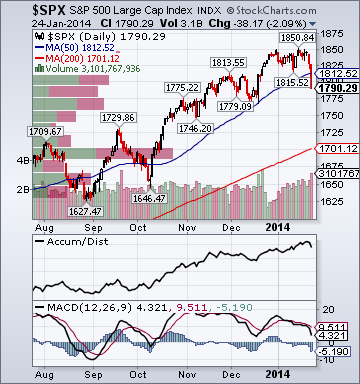
The Weekly Wrap by Briefing.com.
*5-Day Change
Indices
- Russell 2000 1,144.13 -2.47%
- S&P 500 High Beta 29.25 -4.32%
- Wilshire 5000 18,863.93 -2.94%
- Russell 1000 Growth 841.31 -2.67%
- Russell 1000 Value 896.93 -3.30%
- S&P 500 Consumer Staples 426.24 -2.40%
- Morgan Stanley Cyclical 1,411.60 -4.54%
- Morgan Stanley Technology 899.39 -2.20%
- Transports 7,258.72 -2.65%
- Bloomberg European Bank/Financial Services 108.87 -4.51%
- MSCI Emerging Markets 39.14 -2.64%
- HFRX Equity Hedge 1,171.40 -.22%
- HFRX Equity Market Neutral 954.91 -.08%
Sentiment/Internals
- NYSE Cumulative A/D Line 199,214 -.72%
- Bloomberg New Highs-Lows Index 151 -403
- Bloomberg Crude Oil % Bulls 46.81 +22.41%
- CFTC Oil Net Speculative Position 340,049 +3.88%
- CFTC Oil Total Open Interest 1,613,293 -.60%
- Total Put/Call .90 +28.57%
- ISE Sentiment 79.0 -40.15%
- Volatility(VIX) 18.14 +44.77%
- S&P 500 Implied Correlation 57.37 +10.14%
- G7 Currency Volatility (VXY) 8.34 +7.34%
- Emerging Markets Currency Volatility (EM-VXY) 9.78 +13.99%
- Smart Money Flow Index 11,872.55 -.45%
- ICI Money Mkt Mutual Fund Assets $2.707 Trillion +.24%
- ICI US Equity Weekly Net New Cash Flow $4.237 Billion
Futures Spot Prices
- Reformulated Gasoline 266.32 +2.67%
- Heating Oil 313.74 +4.84%
- Bloomberg Base Metals Index 191.79 -1.80%
- US No. 1 Heavy Melt Scrap Steel 383.0 USD/Ton unch.
- China Iron Ore Spot 124.30 USD/Ton -2.36%
- UBS-Bloomberg Agriculture 1,323.65 -.46%
Economy
- ECRI Weekly Leading Economic Index Growth Rate 4.2% +50 basis points
- Philly Fed ADS Real-Time Business Conditions Index .1295 -4.63%
- S&P 500 Blended Forward 12 Months Mean EPS Estimate 120.41 +.07%
- Citi US Economic Surprise Index 62.60 -4.0 points
- Citi Emerging Markets Economic Surprise Index 6.70 +1.9 points
- Fed Fund Futures imply 32.0% chance of no change, 68.0% chance of 25 basis point cut on 1/29
- US Dollar Index 80.46 -.89%
- Euro/Yen Carry Return Index 145.96 -.94%
- Yield Curve 238.0 -7 basis points
- 10-Year US Treasury Yield 2.72% -10 basis points
- Federal Reserve's Balance Sheet $4.055 Trillion +.64%
- U.S. Sovereign Debt Credit Default Swap 27.85 +1.25%
- Illinois Municipal Debt Credit Default Swap 154.0 +2.42%
- Western Europe Sovereign Debt Credit Default Swap Index 53.33 +7.34%
- Asia Pacific Sovereign Debt Credit Default Swap Index 118.97 +11.1%
- Emerging Markets Sovereign Debt CDS Index 247.50 +13.01%
- Israel Sovereign Debt Credit Default Swap 92.0 -1.08%
- South Korea Sovereign Debt Credit Default Swap 73.50 +7.30%
- China Blended Corporate Spread Index 352.75 +19.25 basis points
- 10-Year TIPS Spread 2.13% -12.0 basis points
- TED Spread 19.0 -1.5 basis points
- 2-Year Swap Spread 15.0 +1.75 basis points
- 3-Month EUR/USD Cross-Currency Basis Swap -4.0 -2.75 basis points
- N. America Investment Grade Credit Default Swap Index 71.98 +11.31%
- European Financial Sector Credit Default Swap Index 104.02 +21.66%
- Emerging Markets Credit Default Swap Index 337.41 +15.55%
- CMBS AAA Super Senior 10-Year Treasury Spread to Swaps 110.0 +2.0 basis points
- M1 Money Supply $2.660 Trillion +.87%
- Commercial Paper Outstanding 1,018.50 -1.70%
- 4-Week Moving Average of Jobless Claims 331,500 -3,500
- Continuing Claims Unemployment Rate 2.3%unch.
- Average 30-Year Mortgage Rate 4.39% -2 basis points
- Weekly Mortgage Applications 404.10 +4.7%
- Bloomberg Consumer Comfort -31.0 unch.
- Weekly Retail Sales +3.0% +10 basis points
- Nationwide Gas $3.29/gallon -.01/gallon
- Baltic Dry Index 1,271 -9.08%
- China (Export) Containerized Freight Index 1,128.73 +1.18%
- Oil Tanker Rate(Arabian Gulf to U.S. Gulf Coast) 37.50 +2.5%
- Rail Freight Carloads 267,428 +13.32%
Best Performing Style
Worst Performing Style
Leading Sectors
Lagging Sectors
Weekly High-Volume Stock Gainers (25)
- STML, SMCI, FIO, RENT, NTCT, SBNY, ILMN, RCAP, GMT, NLNK, TTWO, VGR, HURN, SWKS, AA, KERX, GPRE, TSRA, XLRN, STWD, NSC, EWBC, PODD, GD and NKTR
Weekly High-Volume Stock Losers (21)
- OCN, COH, IPHI, FUEL, SKX, AOL, PH, AEO, ATI, LKQ, SGNT, EBS, AAWW, ACAT, SLM, PETS, BBSI, HRC, RDEN, SSNI and CANN
Weekly Charts
ETFs
Stocks
*5-Day Change
Broad Equity Market Tone:
- Advance/Decline Line: Substantially Lower
- Sector Performance: Every Sector Declining
- Market Leading Stocks: Underperforming
Equity Investor Angst:
- Volatility(VIX) 17.06 +23.89%
- Euro/Yen Carry Return Index 145.93 -1.13%
- Emerging Markets Currency Volatility(VXY) 9.77 +6.78%
- S&P 500 Implied Correlation 55.95 +7.19%
- ISE Sentiment Index 84.0 -14.29%
- Total Put/Call .92 +5.75%
Credit Investor Angst:
- North American Investment Grade CDS Index 72.58 +7.06%
- European Financial Sector CDS Index 104.55 +10.48%
- Western Europe Sovereign Debt CDS Index 53.33 +6.66%
- Asia-Pacific Sovereign Debt CDS Index 119.0 +5.01%
- Emerging Market CDS Index 337.90 +5.54%
- 2-Year Swap Spread 15.0 +.75 basis point
- TED Spread 20.0 -.25 basis point
- 3-Month EUR/USD Cross-Currency Basis Swap -4.0 -1.5 basis points
Economic Gauges:
- 3-Month T-Bill Yield .04% unch.
- Yield Curve 239.0 -2.0 basis points
- China Import Iron Ore Spot $124.30/Metric Tonne +.32%
- Citi US Economic Surprise Index 62.60 +.1 point
- Citi Emerging Markets Economic Surprise Index 6.7 +1.5 points
- 10-Year TIPS Spread 2.13 -9.0 basis points
Overseas Futures:
- Nikkei Futures: Indicating -391 open in Japan
- DAX Futures: Indicating -6 open in Germany
Portfolio:
- Slightly Higher: On gains in my index hedges and emerging markets shorts
- Market Exposure: 25% Net Long
Bloomberg:
- Contagion Spreads in Emerging Markets as Crises Grow.
The worst selloff in emerging-market currencies in five years is
beginning to reveal the extent of the fallout from the Federal Reserve’s
tapering of monetary stimulus, compounded by political and financial
instability. The Turkish lira plunged to a record and South Africa’s
rand fell yesterday to a level weaker than 11 per dollar for the first
time since 2008. Argentine policy makers devalued the peso by reducing
support in the foreign-exchange market, allowing the currency to drop
the most in 12 years to an unprecedented low. Investors are losing
confidence in some of the biggest developing nations, extending the
currency-market rout triggered last year when the Fed first signaled it
would scale back stimulus. While Brazil, Russia, India, China and South
Africa were the engines of global growth following the financial crisis
in 2008, emerging markets now pose a threat to world financial stability.
“The current environment is potentially very toxic for emerging
markets,” Eamon Aghdasi, a strategist at Societe Generale SA in New
York, said in a phone interview yesterday. “You have two very troubling
things: uncertainty about the Fed policy, combined with concerns about
growth, particularly in China. It’s difficult to justify that it’s time
to go out and buy emerging markets at the moment.”
- UBS Says Market Wants Default as Risks to Pile Up: China Credit.
UBS AG’s China securities unit, the leading foreign underwriter of debt
sales in the country, says the market wants policy makers to allow the
first onshore bond default to reduce long-term hazards to the financial
system. “Systematic risk will pile up without any default happening,”
Bi Xuewen, head of China debt capital markets at UBS Securities Co.,
said in an interview in Shanghai. “Market participants would like to see
a default in China’s bonds. Only
after defaults can the overall risk pricing system be
normalized.”
- Jiang Tells CNBC That ICBC Won’t Compensate Trust Investors. Industrial & Commercial Bank of
China Ltd. Chairman Jiang Jianqing said the lender won’t
compensate investors for losses tied to a troubled trust product
distributed by the bank, CNBC reported on its website. The incident will be a lesson for investors on moral hazard
and risks associated with such investments, Jiang told CNBC from
the World Economic Forum in Davos, Switzerland. The Beijing-based lender won’t take “rigid responsibility” for the losses
and will review all its partnerships in entities with which it
does business, Jiang said, according to CNBC.
- China Trust Products Gone Awry Evoke Soros ’08 Crisis Echoes. The story of how a 3 billion-yuan
($496 million) Chinese trust investment wound up on the brink of
default shows what billionaire investor George Soros has called
the “eerie resemblances” between the 2008 global financial
crisis and the nation’s debt market. China’s $4.8 trillion in shadow-banking debt, arranged by
trusts and fund managers with less transparency than commercial-bank loans, was equivalent to as much as 55 percent of the
nation’s 2012 economic output at the end of that year, according
to Moody’s latest estimate. Investors argued their case in a
meeting at an ICBC Shanghai branch yesterday, an echo of savers’
appeals to Hong Kong lenders after Lehman Brothers Holdings
Inc.’s failure undermined securities called minibonds. “This case reminds people of Lehman minibonds because
complicated credit-linked products were sold to individual
investors via bank channels,” said Christine Kuo, senior credit
officer at Moody’s in Hong Kong. “It’s not clear whether
misselling was involved due to lack of transparency. It’s also
not clear who will share the loss. Regardless, both the product
packager and distributor have seen their reputation suffer.”
- China Warns U.S. of Consequences After SEC Bans Accounting Firms. China warned the U.S. of
“consequences” after the Securities & Exchange Commission
barred the four largest accounting firms from conducting audits
of U.S.-listed Chinese companies. The decision to ban the Chinese affiliates of the
accounting firms for six months “ignored” China’s efforts and
progress made on cross-border regulatory cooperation, the China
Securities Regulatory Commission said. “We hope the SEC will take into consideration the big
picture of China-U.S. regulatory cooperation, make the right
judgement to resolve the situation properly,” the CSRC, the
nation’s securities body, said on its microblog. “The SEC
should bear all responsibility to possible consequences arising
from the decision.”
- China Bank Regulator Said to Issue Alert on Coal Loans.
China’s banking regulator ordered its regional offices to increase
scrutiny of credit risks in the coal-mining industry, said two people
with knowledge of the matter, signaling government concern about
possible defaults. The
China Banking Regulatory Commission also told its local branches to
closely monitor risks from trust and wealth-management products, said
the people, who asked not to be identified as the matter isn’t public.
The commission issues such alerts for matters that it judges may pose
significant risks to banks, the people said.
- Aussie Drops Below 87 U.S. Cents on China Concerns, RBA Comments. The
Australian dollar dropped below
87 U.S. cents for the first time since July 2010 after China’s bank
regulator ordered regional offices to increase scrutiny of credit risks
in the coal-mining industry, according to people
with knowledge of the matter.
The Aussie slid versus all 16 major peers after the Wall
Street Journal cited central bank board member Heather Ridout as
saying around 80 cents would be a fair deal for everybody.
- Ukraine Unrest Spreads From Kiev as EU Warns of Civil War. Anti-government unrest spread from Ukraine’s capital as the
European Union warned the protests, which turned deadly this week, could
spiral into a civil war. Activists have taken over the
headquarters of governors picked by President Viktor Yanukovych in five
cities, marking a widening of the two-month protest movement. EU justice
chief Viviane Reding told CNBC today that Ukraine must get its “house
in order” as it heads in the “direction of a civil war.”
- Cross-Currency Swap Premium Rises Seventh Day as Banks Pull Back. The
premium that European lenders pay to obtain dollar-denominated cash
flows increased for a seventh day as global central banks said they’ll
wind down emergency funding programs. The rate on a three-month
cross-currency basis swap between euros and dollars was negative four
basis points, after reaching positive 4.8 basis points Jan. 16. A
negative swap rate signals traders are paying a premium to trade
euro-based cash flows for comparable flows denominated in U.S. dollars.
Investor demand
for safety increased amid a deepening selloff in emerging-market
currencies.
“The realization is settling in that there are still a lot
of potential surprises out there, including those in the
liquidity mechanisms and with respect to spillover effects from
market to market,” Jeffrey Caughron, who advises community
banks on investments exceeding $40 billion as an associate partner at Baker Group LP in Oklahoma City, said in a telephone
interview.
- Bond Risk Heads for Biggest Weekly Jump Since June in Europe. The cost of insuring corporate
bonds against losses in Europe is heading for the biggest weekly rise in
seven months on concern a slowdown in emerging-market economies will
curb global growth. The Markit iTraxx Europe index of credit-default swaps on 125
companies with investment-grade ratings rose 9 basis points this week to
80 basis points at 10:25 a.m. in London, the biggest jump since the
week ending June 21. The Markit iTraxx Crossover Index of 50 companies
with mostly speculative-grade ratings climbed 23 basis points to 302
basis points, also the biggest increase since June. Borrowing costs for investment-grade companies in the region fell two
basis points this week to 1.97 percent, the lowest since June. 5, while
the average yield on speculative- grade notes fell three basis points to
a record 4.73 percent on Jan. 21, Bank of America Merrill Lynch index
data show.
- European Stocks Drop as Emerging-Market Currencies Fall.
European stocks fell the most since June, extending the Stoxx Europe
600 Index’s weekly drop, as investors assessed a tumble in
emerging-market currencies amid concern Federal Reserve tapering is
hurting growth. Banco Bilbao Vizcaya Argentaria SA dropped 5.1 percent
on investor concern that its exposure to Turkey and Argentina will hurt
earnings. Novartis (NOVN) AG lost 3 percent after failing to win backing
from a European advisory panel for its Serelaxin treatment for acute
heart failure. Aberdeen Asset Management Plc slumped 5.7 percent as
Morgan Stanley recommended selling the
stock. Celesio AG gained 3.7 percent as McKesson Corp. agreed to
buy majority-owner Franz Haniel & Cie.’s holding in the company.
The Stoxx 600 slid 2.4 percent to 324.75 at the close of
trading, for a weekly loss of 3.3 percent.
- Colder Weather Forecast for U.S. as Freeze Brings Texas Ice. Parts of southern Texas may get a
rare coating of ice as temperatures plunging across the U.S.
portend an even sharper cold snap to come. Temperatures across the eastern U.S. and parts of Ontario
and Quebec will be at least 8 degrees below normal through Jan.
27, said Matt Rogers, president of the Commodity Weather Group
LLC in Bethesda, Maryland. Next week will be colder, he said.
- Starbucks(SBUX) Profit Tops Estimates as U.S. Sales Improve.
Starbucks Corp. (SBUX), the world’s largest coffee-shop chain, advanced
the most in almost six months after posting earnings that topped
analysts’ projections as pumpkin-spice lattes and other seasonal drinks
helped boost U.S. sales. The shares rose as much as 3.8 percent.
Wall Street Journal:
- Dow Transports Get Shellacked. Transportation stocks–one pocket of the market that avoided much of this week’s malaise–are now feeling the pain. The Dow Jones Transportation Average, a 20-member index of airlines,
railroads and trucking companies, slumped more than 3% at session lows
Friday. The decline comes after the index set a record high on Thursday,
bucking the broader trend of declining stocks, currencies and emerging
markets. The divergence raised some eyebrows.
Fox News:
CNBC:
- Why Puerto Rico needs to borrow money—and soon. (video) The
island, a territory of the United States, is in the midst of a debt
crisis. With only 3.7 million people, it owes an eye-watering $70
billion in public debt, behind only New York and California. And much of
that debt is widely held by American investors in municipal bond funds.
- Emerging-market currency 'contagion' spreads.
Emerging-market currencies continued to take a beating on Friday
amid growing worries about political upheaval, slowing growth and U.S.
monetary policy, prompting central bankers and policymakers to scramble
for a response. Turkey's lira hit a new record low against the
dollar, and Argentina's peso was down almost 20 percent on the week
against the dollar.
ZeroHedge:
Business Insider:
- Every American With A Bank Account Should Understand What Jamie Dimon's Pay Raise Says About Wall Street. To review: Let
a trader blow a $6.2 billion hole in the bank's balance sheet with the
bank's money — pay cut. Pay out $20 billion in lawsuits for various
transgressions that took
place at the bank under your watch — pay raise. You're just $3 million
shy of what you got when JP Morgan was America's golden bank, and you
were America's golden boy. Mess with the bank's money, you're toast. Mess with the bank's customers — handle it well, and everything will be fine.
Trucking News:
- Trucking Conditions Soften: FTR. The
November reading of 7.01 was 20% lower than the month before, but still
reflects a positive environment for truckers. The regulatory drag from
hours-of-service changes is reducing capacity, FTR noted, adding the
upside economics have yet to translate into real market tightness,
mitigating a rise in the index.
Reuters:
- Exclusive:Japan government forecasts show Abe missing budget-balance promise. Japanese
government calculations indicate that Prime Minister Shinzo Abe cannot
meet his budget-balancing promise in coming years on the current course,
suggesting he may come under greater pressure from fiscal hawks for
future tax increases.
Forecasts by the
Finance Ministry, reviewed by Reuters on Friday, show that even in the
rosiest of four scenarios, the government will run a primary budget
deficit - which excludes debt service and income from debt sales - for
the fiscal year to March 2021. Private economists have long
considered the government's fiscal-reform goals to be ambitious, but the
new forecasts represent the first time that official figures have
essentially confirmed that view. "Abe
will either have to get serious about spending cuts or raise taxes more
than originally planned," Norio Miyagawa, senior economist at Mizuho
Securities Research & Consulting Co, said of the new ministry
forecasts.
- METALS-Copper hits month low on signs of slowing China growth. Copper fell to its lowest in a
month on Friday and struck its biggest weekly fall since
mid-November as slowing growth in China's factories fueled
worries about demand in the world's top metals consumer. The metal is down 2 percent
for the week.
- Yen and franc soar on emerging market rout.
The yen surged and the Swiss
franc hit its highest in a month against the euro on Friday as investors
sought safe places to stash the stacks of money being pulled out of
stocks and several big emerging markets. Both the dollar and euro fell as much as 1 percent against the yen
in a move centred on more worrying signs of a slowdown in China and
broad expectations of a tightening of monetary conditions this year by
some of the world's biggest central banks.
Telegraph:
Deutschlandradio Kultur:
- Greece Needs Generous Debt Cut, Droutsas. Former Greek Foreign
Minister Dimitris Droutsas says only generous debt forgiveness will
allow Greece to implement the "radical structural reforms" the country
needs for a fresh start.
The Economic Times:
- Gloomy Outlook: India's GDP May Sink Below 5% to an 11-Year Low.
India's statistics office is likely to say in two weeks that growth
this year will slump further to an 11-year low, undermining the
government's optimism that it would at least be flat at 5% on the back
of a recovery in the second half. The advanced estimate for FY14 is set
to come in below that level, said an official who didn't want to be
named.
India's
statistics office is likely to say in two weeks that growth this year
will slump further to an 11-year low, undermining the government's
optimism that it would at least be flat at 5% on the back of a recovery
in the second half.
The advanced estimate for FY14 is set to come in below that level, said an official who didn't want to be named.
The economy expanded 4.6% in the first half and would need to rise
5.4% in the second for growth to come in at 5%, which doesn't lo ..
Gloomy outlook: India's GDP may sink below 5% to an 11-year low
China.org.cn:
- Dagong lowers Philippines rating outlook. China's domestic rating agency
Dagong on Friday downgraded the rating outlook of the Republic of
the Philippines from stable to negative. Ratings for the country's domestic
currency and foreign currency sovereign credit were both maintained
at BB-, the agency said in a statement on its website. "Under the background of the
forthcoming tightening of global monetary policy, the Philippines'
economic growth mode characterized by substantial capital inflows
and fast credit expansion is facing severe challenges," the
statement said. The economy of the Philippines will
face more downward pressure as interest rates rise in both domestic
and overseas markets, Dagong said, forecasting its growth rate at
4.5 percent in 2014 and 3 percent in 2015.
CRIEnglish:
- China Reports 10 New H7N9 Human Cases. Ten human H7N9 bird flu cases were newly reported in China on Friday,
including one in Beijing, one in Guangdong Province, one in Fujian
Province and seven in Zhejiang Province, forcing cities in Zhejiang to
close their live poultry markets.
In the first case reported in the city this year, a man in Beijing
was confirmed to have contracted H7N9 on Thursday night, according to
the Chinese capital's disease control and prevention center.
Style Underperformer:
Sector Underperformers:
- 1) Gaming -5.24% 2) Alt Energy -3.66% 3) Education -3.50%
Stocks Falling on Unusual Volume:
- KSU, NSTG, EOPN, EBS, BDE, PTCT, ABCB, DL, MTCN, BBVA, DGII, CLV, COVS, GNRC, TUP, IGT, BIB, TCBI, GWW, ACAT, SMCI, VNQI, HXL, CE, MATW, FEYE, DDD, QSII, ALGN, CW, HXL, WETF, BYI, GNRC, RMD, SWC, ECYT, BABY, ISRG, ACET, CST, CYN, PNK, AVP, AGCO, RS, CY, LOCK, QLTY, FAST, PNR, JAZZ, OZM, AA, MDC, SMCI, BCC, STT, FLS, CAMP, GWW, MCRS, WYNN, BMY, TRW, CMI, MS, MGM, C, GE and LRCX
Stocks With Unusual Put Option Activity:
- 1) EXC 2) XLV 3) HYG 4) XLF 5) OIH
Stocks With Most Negative News Mentions:
- 1) IGT 2) DDD 3) KSU 4) CMG 5) CAT
Charts:
Style Outperformer:
Sector Outperformers:
- 1) Restaurants +.19% 2) Networking -.71% 3) Food -1.03%
Stocks Rising on Unusual Volume:
- OTEX, LIVE, JNPR, SYNA, DFS and JNPR
Stocks With Unusual Call Option Activity:
- 1) MET 2) HUN 3) KMB 4) BMY 5) LYB
Stocks With Most Positive News Mentions:
- 1) RL 2) JPM 3) CAT 4) ISRG 5) C
Charts:
Night Trading
- Asian equity indices are -1.0% to -.25% on average.
- Asia Ex-Japan Investment Grade CDS Index 146.0 +4.0 basis points.
- Asia Pacific Sovereign CDS Index 113.50 +2.0 basis points.
- NASDAQ 100 futures +.18%.
Morning Preview Links
Earnings of Note
Company/Estimate
- (BMY)/.43
- (HON)/1.22
- (KSU)/1.10
- (KMB)/1.39
- (PG)/1.20
- (SWK)/1.29
- (STT)/1.20
- (GWW)/2.63
Economic Releases
Upcoming Splits
Other Potential Market Movers
- The Italian retail sales report could also impact trading today.
BOTTOM LINE: Asian indices are mostly lower, weighed down by financial and technology shares in the region. I expect US stocks to open modestly higher and to weaken into the afternoon, finishing modestly lower. The Portfolio is 25% net long heading into the day.

