Tuesday, February 20, 2007
Monday, February 19, 2007
Tuesday Watch

Weekend Headlines
Bloomberg:
- Options traders at Denmark’s Saxo Bank A/S are betting that the Bank of Japan will keep interest rates unchanged at a meeting this week and that the US dollar will rally against the yen.
- Crude oil fell .75/bbl. as speculators trimmed bets on forecasts for milder weather and rising inventories.
- The House adopted $1.3 billion in tax cuts for small businesses that will be combined with legislation increasing the minimum wage.
- Blackstone Group LP(BLK), the private equity firm that bought Equity Office Properties(EOP) in the biggest leveraged buyout ever, agreed to sell 23 Southern California buildings it acquired in the purchase to Maguire Properties for about $3 billion.
- Secretary of State Condoleezza Rice said the new Palestinian government being formed must recognize Israel’s right to exist for negotiations on Palestinian statehood to succeed.
- Three senators proposed legislation that would target what they say is $100 billion a year in tax revenue lost each year because of overseas tax havens, in part by forcing hedge funds to track their foreign investors.
- The smallest emerging stock markets are elbowing aside Brazil, Russia, India and China to become the world’s best performers. An index of 22 so-called frontier countries rose 12% in January, the fastest-ever start to a year. Five of them, including Vietnam, Ukraine and Croatia, are among this year’s top 10 markets.
- India said two bomb blasts on a cross-border train to Pakistan killed as many as 64 people, possibly including visitors from the neighboring nation.
- Russia, the world’s largest oil producer after Saudi Arabia, cut its forecast for crude prices this year and next, Deputy Finance Minister Tatiana Golikova told parliament today. The ministry cut its forecast for 2007 to $55/bbl. from $61/bbl. and its 2008 estimate to $53/bbl. from $56, RIA Novosti and Interfax cited Golikova as saying.
- UK property prices accelerated for a second month in February as a shortage of homes for sale mitigated the impact of higher interest rates, a survey showed.
- Iran’s first nuclear reactor won’t start as expected this year because of supply and financing delays and it may be postponed indefinitely, the Russian agency building the power plant said.
- Russia cut its forecast for economic growth this year after lowering its estimate for oil prices.
- A wrinkle treatment derived from a natural substance in skin and other connective tissues may do more than just fill the spaces of crow’s feet or smile lines, according to researchers. A study using Medicis Pharmaceutical’s(MRX) Restylane found that injecting the substance, called hyaluronic acid, stimulated production of collagen.
- Vulcan Materials(VMC), the biggest US producer of highway construction materials, will acquire Florida Rock Industries(FRK) for $4.6 billion in cash and stock to expand in the US Southeast and Mid-Atlantic.
- Farmland from Iowa to Argentina is rising faster in price than apartments in Manhattan and London for the first time in 30 years.
- Sirius Satellite Radio(SIRI) agreed to buy larger rival XM Satellite Radio Holdings(XMSR) for $4.57 billion in stock to combine the only pay radio companies and stem billions of dollars in losses.
Wall Street Journal:
- For years, the big criticism of alternative energy was cost. It was too expensive compared with energy based on traditional fuels like coal and natural gas. Now the equation is showing significant signs of change.
- Apple Inc.(AAPL) retained control of the development and marketing of the iPhone that will be sold by AT&T’s(T) wireless unit in the US, a coup in the mobile phone industry. AT&T agreed to leave its brand off the body of the phone, allow Apply to install its own software and share the monthly subscription fees, citing people familiar with the agreement.
San Francisco Chronicle:
- Technology companies including Yahoo!(YHOO) and Microsoft(MSFT) have led an influx of office workers back to San Francisco, citing commercial real-estate agents and recent lease agreements. Demand for office space by startups and big computer and microchip firms helped slash the vacancy rate for the city’s top-rated office space by half to 8.5% from three years ago.
NY Times:
- At least 31 US states are considering legislation requiring vaccination or funding for vaccination against the human papilloma virus, which causes cervical cancer.
- New York Senator Hillary Rodham Clinton rejected appeals from advisers, friends and political donors to renounce her 2002 vote authorizing military action in Iraq.
- Iraq substantially increased its estimates of the amount of oil and natural gas in deposits on Sunni lands after paying oil companies to evaluate old seismic data across the country. An evaluation of one series of wells running from Taji, north of Baghdad, to the southeast of the capital nearly doubled the estimate of recoverable reserves.
- Thirty to 40% of illegal DVDs sold in the US were made with camcorders smuggled into Canadian cinemas, citing the Motion Picture Assoc. of America.
- NY Governor Eliot Spitzer agreed to allow an Indian tribe to build a $600 million casino in the Catskills.
Anchorage Daily News:
- BP Exploration (Alaska) Inc., a unit of BP Plc(BP), will seek approval this year to develop Liberty, an oil field off the Alaska coast that will cost $1 billion.
Detroit News:
- JPMorgan Chase(JPM) has assigned one of its mergers-and-acquisition specialists to lead efforts to sell DaimlerChrysler AG’s Chrysler unit.
Financial Times:
- EBay Inc.(EBAY) is opposing moves by the US to make it hand over the names of customers who don’t pay taxes earned on auction sites.
Sunday Times:
- South Korea’s Hyundai Motor Co. may be interested in taking over DaimlerChrysler AG’s Chrysler unit in order to get access to the company’s dealer network.
London-based Times:
- Virgin Media’s Mobile USA unit is planning an IPO on the NYSE or Nasdaq in the third quarter of 2007 which may value the company at $2 billion.
Financial Mail:
- Vodafone Group Plc(VOD) is set to put Google’s(GOOG) search engine on the front page of its Internet-enabled mobile phones within weeks.
Daily Telegraph:
- Scottish officials approved the construction of a $975 million wind farm on the Isle of Lewis, which will be Europe’s biggest.
Daily Mirror:
- Prince Harry, third in line to the British crown, will be deployed to southern Iraq with his army regiment “within days.”
Welt am Sonntag:
- Nokia(NOK) expects mobile-phone prices to decline this year as the market grows as much as 10%.
Frankfurter Allgemeine Sonntagszeitung:
- DaimlerChrysler AG(DCX) and General Motors(GM) are discussing cooperating on a few projects such as sport-utility vehicles and small cars.
Scottsman:
- Watching too much television may be to blame for the development among young children of an array of potential illnesses such as cancer, autism and Alzheimer’s, citing psychologist Aric Sigman.
Shanghai Daily:
- McDonald’s Corp.(MCD) plans to increase the number of restaurants it has in China to 1,000 by 2008, from about 780 now.
Khaleej Times:
- Bahrain, Kuwait, Oman, Qatar, Saudi Arabia and the United Arab Emirates will launch a single currency by the scheduled date in 2010.
Islamic Republic News Agency:
- Iranian Oil Minister Kazem Vaziri-Hamaneh said OPEC probably won’t cut output further at its meeting next month if prices continue rising…
Al-Hayat:
- Gulf states are investing $22 billion in aluminum production to meet rising demand.
Weekend Recommendations
Barron's:
- Made positive comments on (WEBX), (BF/B), (ERTS) and (TKR).
Night Trading
Asian indices are -.25% to unch. on average.
S&P 500 indicated +.02%.
NASDAQ 100 indicated +.08%.
Morning Preview
US AM Market Call
NASDAQ 100 Pre-Market Indicator/Heat Map
Pre-market Commentary
Before the Bell CNBC Video(bottom right)
Global Commentary
Asian Indices
European Indices
Top 20 Business Stories
In Play
Bond Ticker
Conference Calendar
Daily Stock Events
Macro Calls
Rasmussen Consumer/Investor Daily Indices
CNBC Guest Schedule
Earnings of Note
Company/Estimate
- (AT)/.58
- (AMT)/.04
- (BYD)/.39
- (CBRL)/.69
- (CROX)/.43
- (FOSL)/.44
- (GPC)/.69
- (HVT)/.11
- (HPQ)/.63
- (HD)/.51
- (IN)/.13
- (MDT)/.58
- (PSA)/.57
- (TTC)/.35
- (WMT)/.90
Upcoming Splits
- (ACLI) 2-for-1
- (SIGI) 2-for-1
- (ZOLL) 2-for-1
- (CMCSA) 3-for-2
Economic Releases
- None of note
Bloomberg:
- Options traders at Denmark’s Saxo Bank A/S are betting that the Bank of Japan will keep interest rates unchanged at a meeting this week and that the US dollar will rally against the yen.
- Crude oil fell .75/bbl. as speculators trimmed bets on forecasts for milder weather and rising inventories.
- The House adopted $1.3 billion in tax cuts for small businesses that will be combined with legislation increasing the minimum wage.
- Blackstone Group LP(BLK), the private equity firm that bought Equity Office Properties(EOP) in the biggest leveraged buyout ever, agreed to sell 23 Southern California buildings it acquired in the purchase to Maguire Properties for about $3 billion.
- Secretary of State Condoleezza Rice said the new Palestinian government being formed must recognize Israel’s right to exist for negotiations on Palestinian statehood to succeed.
- Three senators proposed legislation that would target what they say is $100 billion a year in tax revenue lost each year because of overseas tax havens, in part by forcing hedge funds to track their foreign investors.
- The smallest emerging stock markets are elbowing aside Brazil, Russia, India and China to become the world’s best performers. An index of 22 so-called frontier countries rose 12% in January, the fastest-ever start to a year. Five of them, including Vietnam, Ukraine and Croatia, are among this year’s top 10 markets.
- India said two bomb blasts on a cross-border train to Pakistan killed as many as 64 people, possibly including visitors from the neighboring nation.
- Russia, the world’s largest oil producer after Saudi Arabia, cut its forecast for crude prices this year and next, Deputy Finance Minister Tatiana Golikova told parliament today. The ministry cut its forecast for 2007 to $55/bbl. from $61/bbl. and its 2008 estimate to $53/bbl. from $56, RIA Novosti and Interfax cited Golikova as saying.
- UK property prices accelerated for a second month in February as a shortage of homes for sale mitigated the impact of higher interest rates, a survey showed.
- Iran’s first nuclear reactor won’t start as expected this year because of supply and financing delays and it may be postponed indefinitely, the Russian agency building the power plant said.
- Russia cut its forecast for economic growth this year after lowering its estimate for oil prices.
- A wrinkle treatment derived from a natural substance in skin and other connective tissues may do more than just fill the spaces of crow’s feet or smile lines, according to researchers. A study using Medicis Pharmaceutical’s(MRX) Restylane found that injecting the substance, called hyaluronic acid, stimulated production of collagen.
- Vulcan Materials(VMC), the biggest US producer of highway construction materials, will acquire Florida Rock Industries(FRK) for $4.6 billion in cash and stock to expand in the US Southeast and Mid-Atlantic.
- Farmland from Iowa to Argentina is rising faster in price than apartments in Manhattan and London for the first time in 30 years.
- Sirius Satellite Radio(SIRI) agreed to buy larger rival XM Satellite Radio Holdings(XMSR) for $4.57 billion in stock to combine the only pay radio companies and stem billions of dollars in losses.
Wall Street Journal:
- For years, the big criticism of alternative energy was cost. It was too expensive compared with energy based on traditional fuels like coal and natural gas. Now the equation is showing significant signs of change.
- Apple Inc.(AAPL) retained control of the development and marketing of the iPhone that will be sold by AT&T’s(T) wireless unit in the US, a coup in the mobile phone industry. AT&T agreed to leave its brand off the body of the phone, allow Apply to install its own software and share the monthly subscription fees, citing people familiar with the agreement.
San Francisco Chronicle:
- Technology companies including Yahoo!(YHOO) and Microsoft(MSFT) have led an influx of office workers back to San Francisco, citing commercial real-estate agents and recent lease agreements. Demand for office space by startups and big computer and microchip firms helped slash the vacancy rate for the city’s top-rated office space by half to 8.5% from three years ago.
NY Times:
- At least 31 US states are considering legislation requiring vaccination or funding for vaccination against the human papilloma virus, which causes cervical cancer.
- New York Senator Hillary Rodham Clinton rejected appeals from advisers, friends and political donors to renounce her 2002 vote authorizing military action in Iraq.
- Iraq substantially increased its estimates of the amount of oil and natural gas in deposits on Sunni lands after paying oil companies to evaluate old seismic data across the country. An evaluation of one series of wells running from Taji, north of Baghdad, to the southeast of the capital nearly doubled the estimate of recoverable reserves.
- Thirty to 40% of illegal DVDs sold in the US were made with camcorders smuggled into Canadian cinemas, citing the Motion Picture Assoc. of America.
- NY Governor Eliot Spitzer agreed to allow an Indian tribe to build a $600 million casino in the Catskills.
Anchorage Daily News:
- BP Exploration (Alaska) Inc., a unit of BP Plc(BP), will seek approval this year to develop Liberty, an oil field off the Alaska coast that will cost $1 billion.
Detroit News:
- JPMorgan Chase(JPM) has assigned one of its mergers-and-acquisition specialists to lead efforts to sell DaimlerChrysler AG’s Chrysler unit.
Financial Times:
- EBay Inc.(EBAY) is opposing moves by the US to make it hand over the names of customers who don’t pay taxes earned on auction sites.
Sunday Times:
- South Korea’s Hyundai Motor Co. may be interested in taking over DaimlerChrysler AG’s Chrysler unit in order to get access to the company’s dealer network.
London-based Times:
- Virgin Media’s Mobile USA unit is planning an IPO on the NYSE or Nasdaq in the third quarter of 2007 which may value the company at $2 billion.
Financial Mail:
- Vodafone Group Plc(VOD) is set to put Google’s(GOOG) search engine on the front page of its Internet-enabled mobile phones within weeks.
Daily Telegraph:
- Scottish officials approved the construction of a $975 million wind farm on the Isle of Lewis, which will be Europe’s biggest.
Daily Mirror:
- Prince Harry, third in line to the British crown, will be deployed to southern Iraq with his army regiment “within days.”
Welt am Sonntag:
- Nokia(NOK) expects mobile-phone prices to decline this year as the market grows as much as 10%.
Frankfurter Allgemeine Sonntagszeitung:
- DaimlerChrysler AG(DCX) and General Motors(GM) are discussing cooperating on a few projects such as sport-utility vehicles and small cars.
Scottsman:
- Watching too much television may be to blame for the development among young children of an array of potential illnesses such as cancer, autism and Alzheimer’s, citing psychologist Aric Sigman.
Shanghai Daily:
- McDonald’s Corp.(MCD) plans to increase the number of restaurants it has in China to 1,000 by 2008, from about 780 now.
Khaleej Times:
- Bahrain, Kuwait, Oman, Qatar, Saudi Arabia and the United Arab Emirates will launch a single currency by the scheduled date in 2010.
Islamic Republic News Agency:
- Iranian Oil Minister Kazem Vaziri-Hamaneh said OPEC probably won’t cut output further at its meeting next month if prices continue rising…
Al-Hayat:
- Gulf states are investing $22 billion in aluminum production to meet rising demand.
Weekend Recommendations
Barron's:
- Made positive comments on (WEBX), (BF/B), (ERTS) and (TKR).
Night Trading
Asian indices are -.25% to unch. on average.
S&P 500 indicated +.02%.
NASDAQ 100 indicated +.08%.
Morning Preview
US AM Market Call
NASDAQ 100 Pre-Market Indicator/Heat Map
Pre-market Commentary
Before the Bell CNBC Video(bottom right)
Global Commentary
Asian Indices
European Indices
Top 20 Business Stories
In Play
Bond Ticker
Conference Calendar
Daily Stock Events
Macro Calls
Rasmussen Consumer/Investor Daily Indices
CNBC Guest Schedule
Earnings of Note
Company/Estimate
- (AT)/.58
- (AMT)/.04
- (BYD)/.39
- (CBRL)/.69
- (CROX)/.43
- (FOSL)/.44
- (GPC)/.69
- (HVT)/.11
- (HPQ)/.63
- (HD)/.51
- (IN)/.13
- (MDT)/.58
- (PSA)/.57
- (TTC)/.35
- (WMT)/.90
Upcoming Splits
- (ACLI) 2-for-1
- (SIGI) 2-for-1
- (ZOLL) 2-for-1
- (CMCSA) 3-for-2
Economic Releases
- None of note
BOTTOM LINE: Asian Indices are slightly lower, weighed down by financial shares in the region. I expect US stocks to open mixed and to rally into the afternoon, finishing modestly higher. The Portfolio is 100% net long heading into the week.
Sunday, February 18, 2007
Weekly Outlook
Click here for The Week Ahead by Reuters
Click here for Stocks in Focus for Tuesday by MarketWatch
There are a few economic reports of note and several significant corporate earnings reports scheduled for release this week.
Economic reports for the week include:
Mon. - US Markets Closed
Tues. - None of note
Wed. - MBA Mortgage Applications, Consumer Price Index, Leading Indicators, Minutes of Jan. 31 FOMC Meeting
Thur. - Initial Jobless Claims, Help Wanted Index
Fri. - None of note
Some of the more noteworthy companies that release quarterly earnings this week are:
Mon. - US Markets Closed
Tues. - Alltel Corp.(AT), American Tower(AMT), Boyd Gaming(BYD), CBRL Group(CBRL), CROCS Inc.(CROX), Hewlett-Packard(HPQ), Home Depot(HD), Intermec(IN), Medtronic(MDT), Public Storage(PSA), Toro Co(TTC), Wal-Mart Stores(WMT)
Wed. - Aaron Rents(RNT), Abercrombie & Fitch(ANF), American Power Conversion(APCC), Analog Devices(ADI), Brocade Communications(BRCD), General Maritime(GMR), Georgia Gulf(GGC), Glenborough Realty(GLB), Glimcher Realty(GRT), Jack in the Box(JBX), Medco Health(MHS), OSI Pharma(OSIP), Ruth’s Chris(RUTH), Salesforce.com(CRM), Snopsys Inc.(SNPS), Teekay Shipping(TK), Triad Hospitals(TRI), Valueclick(VCLK), Zale Corp.(ZLC)
Thur. - BEA Systems(BEAS), Chesapeake Energy(CHK), Chiquita Brands(CQB), ENSCO Intl.(ESV), Federal Signal(FSS), GlobalSantaFe Corp.(GSF), H&R Block(HRB), Inuit Inc.(INTU), JC Penney(JCP), Lamar Advertising(LAMR), Morningstar(MORN), Newmont Mining(NEM), OfficeMax(OMX), Patterson-UTI(PTEN), PG&E Corp.(PCG), Toll Brothers(TOL), Williams Cos(WMB)
Fri. - Caremark Rx(CMX), Checkpoint Systems(CKP), Clear Channel(CCU), Dillard’s Inc.(DDS), Domino’s Pizza(DPZ), Lowe’s(LOW), Wynn Resorts(WYNN), Lucent Technologies(LU)
Other events that have market-moving potential this week include:
Mon. - US Markets Closed
Tue. - Morgan Stanley Basic Materials Conference, the Fed’s Bies speaking
Wed. - Piper Jaffray Solar & CleanTech Symposium, Bank of America Tech Conference, RBC Capital Communications/Media/Tech Conference, Morgan Stanley Basic Materials Conference, the Fed’s Kohn speaking, the Fed’s Yellen speaking, weekly retail sales
Thur. - Pacific Crest Digital Media & Entertainment Forum, Bank of America Tech Conference, Morgan Stanley Basic Materials Conference, RBC Capital Communications/Media/Tech Conference, the Fed’s Yellen speaking, EIA Energy Inventory report
Fri. - RBC Capital Communications/Media/Tech Conference
Click here for Stocks in Focus for Tuesday by MarketWatch
There are a few economic reports of note and several significant corporate earnings reports scheduled for release this week.
Economic reports for the week include:
Mon. - US Markets Closed
Tues. - None of note
Wed. - MBA Mortgage Applications, Consumer Price Index, Leading Indicators, Minutes of Jan. 31 FOMC Meeting
Thur. - Initial Jobless Claims, Help Wanted Index
Fri. - None of note
Some of the more noteworthy companies that release quarterly earnings this week are:
Mon. - US Markets Closed
Tues. - Alltel Corp.(AT), American Tower(AMT), Boyd Gaming(BYD), CBRL Group(CBRL), CROCS Inc.(CROX), Hewlett-Packard(HPQ), Home Depot(HD), Intermec(IN), Medtronic(MDT), Public Storage(PSA), Toro Co(TTC), Wal-Mart Stores(WMT)
Wed. - Aaron Rents(RNT), Abercrombie & Fitch(ANF), American Power Conversion(APCC), Analog Devices(ADI), Brocade Communications(BRCD), General Maritime(GMR), Georgia Gulf(GGC), Glenborough Realty(GLB), Glimcher Realty(GRT), Jack in the Box(JBX), Medco Health(MHS), OSI Pharma(OSIP), Ruth’s Chris(RUTH), Salesforce.com(CRM), Snopsys Inc.(SNPS), Teekay Shipping(TK), Triad Hospitals(TRI), Valueclick(VCLK), Zale Corp.(ZLC)
Thur. - BEA Systems(BEAS), Chesapeake Energy(CHK), Chiquita Brands(CQB), ENSCO Intl.(ESV), Federal Signal(FSS), GlobalSantaFe Corp.(GSF), H&R Block(HRB), Inuit Inc.(INTU), JC Penney(JCP), Lamar Advertising(LAMR), Morningstar(MORN), Newmont Mining(NEM), OfficeMax(OMX), Patterson-UTI(PTEN), PG&E Corp.(PCG), Toll Brothers(TOL), Williams Cos(WMB)
Fri. - Caremark Rx(CMX), Checkpoint Systems(CKP), Clear Channel(CCU), Dillard’s Inc.(DDS), Domino’s Pizza(DPZ), Lowe’s(LOW), Wynn Resorts(WYNN), Lucent Technologies(LU)
Other events that have market-moving potential this week include:
Mon. - US Markets Closed
Tue. - Morgan Stanley Basic Materials Conference, the Fed’s Bies speaking
Wed. - Piper Jaffray Solar & CleanTech Symposium, Bank of America Tech Conference, RBC Capital Communications/Media/Tech Conference, Morgan Stanley Basic Materials Conference, the Fed’s Kohn speaking, the Fed’s Yellen speaking, weekly retail sales
Thur. - Pacific Crest Digital Media & Entertainment Forum, Bank of America Tech Conference, Morgan Stanley Basic Materials Conference, RBC Capital Communications/Media/Tech Conference, the Fed’s Yellen speaking, EIA Energy Inventory report
Fri. - RBC Capital Communications/Media/Tech Conference
BOTTOM LINE: I expect US stocks to finish the week modestly higher on mostly positive economic data, mostly positive earnings reports, buyout speculation, lower energy prices, short-covering and stable long-term rates. My trading indicators are now giving bullish signals and the Portfolio is 100% net long heading into the week.
Market Week in Review
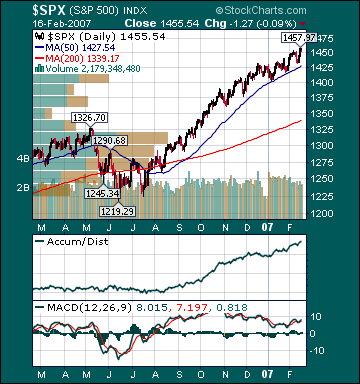
S&P 500 1,455.54 +1.22%*
Click here for the Weekly Wrap by Briefing.com.
*5-day % Change
Click here for the Weekly Wrap by Briefing.com.
BOTTOM LINE: Overall, last week's market performance was very bullish. The advance/decline line rose, most sectors gained and volume was above-average on the week. Measures of investor anxiety were mostly lower. The AAII percentage of Bulls rose to 47.57% this week from 46.15% the prior week. This reading is still at average levels. The AAII percentage of Bears rose to 31.07% this week from 30.0% the prior week. This reading is still slightly above average levels. The 10-week moving average of the percentage of Bears is currently 33.2%, an above-average level. The 10-week moving average of the percentage of Bears peaked at 43.0% at the major bear market low during 2002. Moreover, the 50-week moving average of the percentage of Bears is currently 36.8%, a very high level seen during only two other periods since tracking began in the 1980s. Those periods were October 1990-July 1991 and March-May 2003, both being near major market bottoms.
I continue to believe that steadfastly high bearish sentiment in many quarters is mind-boggling, considering the 20.5% rise in the S&P 500 over a period of about eight months, the cumulative advance/decline line is hitting new record highs, one of the best August/September/October runs in U.S. history, the fact that the Dow made another all-time high this week, the macro backdrop for stocks is improving and that we are in the early stages of what is historically a very strong period for U.S. equities after a midterm election. As well, despite recent gains, the forward P/E on the S&P 500 is a very reasonable 15.8, falling from 16.2 at the beginning of the year, due to the historic run of double-digit profit growth increases. The S&P P/E multiple has contracted for three consecutive years. It has only contracted four consecutive years two times since 1905. Each point of multiple expansion is equivalent to a 6.6% gain in the S&P 500. Bears still remain stunningly complacent, in my opinion. As I have said many times over the last few months, every pullback is seen as a major top and every move higher is just another shorting/selling opportunity. I see few signs of capitulation by the many bears. Even most bulls have raised cash of late, anticipating a correction after the recent surge.
As well, there are many other indicators registering high levels of investor skepticism regarding recent stock market gains. The 50-day moving average of the ISE Sentiment Index just recently crossed above the 200-day moving average for the first time since November 2005 and is already rolling over. The ISE Sentiment Index plunged to a depressed 94.0 just last week. Nasdaq and NYSE short interests are very close again to record highs. Moreover, public short interest continues to soar to record levels, and U.S. stock mutual funds have seen outflows for most of the last year, according to AMG Data Services. The percentage of U.S. mutual fund assets in domestic stocks is the lowest since at least 1984, when record-keeping began.
There has been an historic explosion of hedge funds created with absolute return, low correlation or negative correlation U.S. stock strategies that directly benefit from the perception of a stagnant or declining U.S. stock market. Commodity funds, which typically have a low or negative correlation with stocks, have been created in record numbers. Research boutiques with a negative bias have sprung up to cater to these many new funds. Wall Street analysts have made the fewest "buy" calls on stocks this year since Bloomberg began tracking in 1997. "Buy" calls have been trending lower for seven months through most of last year's rally.
Many of the most widely read stories on financial sites are written with a pessimistic slant to gain readers. Investment blogger bullish sentiment just turned a little bullish for the first time in months at 35.29% Bulls, 32.35% Bears. Finally, the UltraShort QQQQ ProShares (QID) continues to see surging volume. There is still a high wall of worry for stocks to climb substantially from current levels as the public and many professionals remain very skeptical of this bull market.
I continue to believe this is a direct result of the strong belief by the herd that the U.S. is in a long-term trading range or secular bear environment. There is still overwhelming evidence that investment sentiment by the general public regarding U.S. stocks has never been this poor in history, with the Dow registering all-time highs almost weekly. This is serving to further widen the so-called “wealth gap.” I still expect the herd to finally embrace the current bull market this year, which should result in another substantial move higher in the major averages as the S&P 500 breaks out to an all-time high to join the Dow and Russell 2000.
Only in a "negativity bubble" could Wall Street strategists' consensus predictions of a 7% gain for the S&P 500 this year be characterized as "very bullish" by the many bearish pundits. The historical average gain for the S&P 500 is 8.3%. A recent UBS investor sentiment survey hit a three-year high and was characterized as "very bullish," yet only 37% of respondents expected a gain in the DJIA this year. Moreover, of those 37% that expected a gain, only 11% thought the DJIA would rise over 10%.
As well, many of the so-called bullish U.S. investors are only really bullish on commodity stocks and U.S. companies with substantial emerging markets exposure, not the broad U.S. stock market. Finally, how many investors are bullish on growth stocks? There are very few true growth investors even left after six years of underperformance. Based on the action so far this year, I suspect even more cash has piled up on the sidelines. I continue to believe that a significant portion of this cash will be deployed into true growth companies as their outperformance vs. value stocks gains steam throughout the year. Finally, I still believe the coming bullish shift in long-term sentiment with respect to U.S. stocks will result in the "mother of all short-covering rallies."
The average 30-year mortgage rate rose 2 basis points this week to 6.30%, which is still 50 basis points below July 2006 highs. There remains mounting evidence that the worst of the housing downturn is over, despite recent worries over sub-prime lending, and that activity is stabilizing at relatively high levels. About 12% of total mortgage loans are sub-prime. Of those 12%, another 12.6% are delinquent. Thus, only about 2% of total mortgage loans outstanding are currently problematic. I do not believe sub-prime woes are nearly large enough or will become large enough to bring down the U.S. economy. As well, the Fed’s Poole said recently that, “there is no danger to the economy from sub-prime loan defaults.” There are just too many other positives that outweigh this negative. Moreover, the Fed’s Hoenig, Lacker, Fisher and Bies all made positive comments recently regarding the prospects for the US housing market.
Mortgage applications rose 1.5% this week and continue to trend higher with the decline in mortgage rates and healthy job market. The NAHB Housing Market Index came in at 40 in February vs. estimates of 35 and a reading of 35 in January. This is the largest jump since September 2002, notwithstanding colder weather during the month and rising sub-prime worries. Within the NAHB Housing Index for February, the future sales component jumped to 55 vs. 48 in January. The future sales component is now up 49% since its cycle low of 37 in September 2006. It is now only 9 points away from the long-term average of 64. The Mortgage Bankers Association said at year-end that the US housing market will “fully regain its footing” by the middle of this year. Moreover, the California Building Industry Association recently gave an upbeat forecast for housing, saying production would be near last year’s brisk levels.
Housing inventories have been trending meaningfully lower and homebuilding stocks have been moving higher. The Housing Index(HGX) has risen 32.4% from July lows. The Case-Schiller housing futures have improved substantially and are now projecting only a 1.8% decline in the average home price by May, up from projections of a 5.2% decline a few months ago. Considering the median house has appreciated over 50% during the last few years with record high US home ownership, this would be considered a “soft landing.” The overall negative effects of housing on the US economy and the potential for significant price drops are still being exaggerated by the many stock market bears in hopes of dissuading buyers from stepping up, in my opinion. Housing activity and home equity extractions had been slowing substantially for almost 2 years and the negative effects were mostly offset by many other very positive aspects of the US economy.
Home values are more important than stock prices to the average American, but the median home has barely declined in value after a historic run-up, while the S&P 500 has risen 20.5% in about eight months and 96.8% since the Oct. 4, 2002 bear market low. Americans’ median net worth is still very close to or at record high levels as a result, a fact that is generally unrecognized or minimized by the record number of stock market participants that feel it is in their financial and/or political interests to paint a bleak picture of America.
Moreover, energy prices are down significantly, consumer spending remains healthy, unemployment is low by historic standards, interest rates are low, inflation is below average rates, stocks are surging and wages are rising at above-average rates. The economy has created 1.23 million jobs in the last seven months. Challenger, Gray & Christmas reported recently that January job cuts plunged 39.1% from year-ago levels. As well, the Monster Employment Index is just off record highs. The 50-week moving average of initial jobless claims has been lower during only two other periods since the 70s. Finally, the unemployment rate is a historically low 4.6%, down from 5.1% in September 2005, notwithstanding fewer real estate-related jobs and significant auto production cutbacks. The unemployment rate’s current 12-month average is 4.6%. It has only been lower during two other periods since the mid-50s.
The Consumer Price Index for December rose 2.5% year-over-year, down from a 4.7% increase in September of 2005. This is meaningfully below the 20-year average of 3.1%. Moreover, the CPI has only been lower during four other periods since the mid-1960s. Many other measures of inflation have recently shown substantial deceleration to below-average rates. The Producer Price Index for January rose a historically low .2% year-over-year versus the 20-year average of a 2.2% rise. The Import Price Index for January fell -1.2% month-over-month. Moreover, the five-month average of month-over-month import price declines is -0.86%. It has only been lower during three other periods since tracking began in the 1980s. Furthermore, most measures of Americans’ income growth are now almost twice the rate of inflation. Americans’ Average Hourly Earnings rose 4.0% in January, substantially above the 3.2% 20-year average. The 10-month moving-average of Americans’ Average Hourly Earnings is currently 4.0%. 1998 was the only year during the 90s expansion that it exceeded current levels.
The benchmark 10-year T-note yield fell 9 basis points for the week on more dovish-than-expected Fed commentary, mixed economic data and low inflation readings. In my opinion, many investors’ lingering fears over an economic “hard landing” still seem misplaced. The housing slowdown and auto-production cutbacks impacted manufacturing greatly over the last six months, but those drags on growth are subsiding. However, growth is likely unsustainable at the fourth quarter’s pace. 4Q GDP came in at 3.5% versus the long-term average of 3.1%. For all of 2006, US GDP growth was an above-average 3.4%. While the drag from housing is subsiding, housing activity will not add to economic growth in any meaningful way this year. As well, recent substantial inventory de-stocking will produce below-average growth this quarter. However, I still expect a smaller GDP deflator, inventory rebuilding, rising auto production and a still healthy service sector to help produce US economic growth of around 3% for the year.
Manufacturing accounts for roughly 12% of US economic growth, while consumer spending accounts for about 70% of growth. U.S. GDP growth came in at a sluggish 1.1% and 0.7% during the first two quarters of 1995. During May 1995, the ISM Manufacturing Index fell below 50, which signals a contraction in activity. It stayed below 50, reaching a low of 45.5, until August 1996. During that period, the S&P 500 soared 31% as its P/E multiple expanded from 16.0 to 17.2. This was well before the stock market bubble began to inflate. As well, manufacturing was more important to overall US economic growth at that time. Stocks can and will rise as P/E multiples expand, even with more average economic and earnings growth.
Weekly retail sales rose 2.5% for the week. However, retail sales are poised to accelerate. Energy prices are down from this time last year, the job market remains healthy, housing has improved, wage growth has accelerated, stocks are higher and inflation has decelerated to below average rates. Many consumers are chomping at the bit to buy new spring clothing after such a warm fall muted holiday clothing sales. I expect new cycle highs for both measures of consumer sentiment this year.
Just take a look at commodity charts, gauges of commodity sentiment and inflows into commodity-related funds over the last couple of years. Net assets invested in the Goldman Sachs Commodity Index rose to almost $70 billion in 2006 from $15 billion in 2003. There has been a historic mania for commodities. That mania is now in the stages of unwinding. The CRB Commodities Index, the main source of inflation fears has declined -5.0% over the last 12 months and -16.1% from May highs despite a historic flood of capital into commodity-related funds and numerous potential upside catalysts. Oil has declined $19/bbl from July highs.
Last year, oil rose $2.05/bbl. on the first trading day of the year and $7.40/bbl. through the first three weeks of trading as commodity funds, flush with new capital, drove futures prices higher. I suspect, given the average commodity hedge fund fell around double-digits last year as the CRB Index dropped 7.4%, that many energy-related funds saw outflows at year-end. The commodity mania has pumped air into the current US “negativity bubble.” Talk of runaway inflation, drought, world wars, global warming, a US dollar collapse, recession/depression and global pandemics, to name a few, has been fueled by the mania in commodities. In my opinion, that is why it is so easy for most to believe that US housing was in a bubble, but then act shocked when commodities plunge. I continue to believe inflation fears have peaked for this cycle as global economic growth slows to average levels, unit labor costs remain subdued and the mania for commodities continues to reverse course.
The EIA reported this week that gasoline supplies fell more than expectations as refinery utilization declined substantially. U.S. gasoline supplies are at very high levels for this time of the year, notwithstanding declining refinery utilization. Gasoline futures rose for the week, but have plunged 43.1% from September 2005 highs even as some Gulf of Mexico oil production remains shut-in and fears over future production disruptions persist. The still very elevated level of gas prices will further dampen global fuel demand, sending gas prices still lower over the intermediate-term.
The 10-week moving-average of US oil inventories is still approaching 8-year highs. Global demand destruction is pervasive. Oil consumption in the 30 OECD countries fell last year for the first time in over two decades. Since December 2003, global oil demand is only up 2.6%, despite the strongest global growth in almost three decades, while global supplies have increased 5.7%, according to the Energy Intelligence Group. The EIA recently forecast that bio-fuels should rise to the equivalent of more than five million barrels of crude oil production a day within four years. Recently, Energy Secretary Bodman said the US will likely remove tariffs to boost bio-fuel imports, which should reduce fears over a potential corn shortage. As well, OPEC said recently that global crude oil supply would exceed demand by 100 million barrels by the second quarter of this year. Worldwide oil inventories are poised to begin increasing at an accelerated rate over the next year. There is a very fine line in the crude oil market between perceptions of "significantly supply constrained" and "massive oversupply." One of the main reasons I believe OPEC has been slow to actually meet their pledged cuts has been the fear of losing market share to non-OPEC countries. Moreover, OPEC actually needs lower prices to prevent any further long-term demand destruction. I continue to believe oil is priced at elevated levels on record speculation by investment funds, not fundamentals.
The Amaranth Advisors hedge fund blow-up last year was a prime example of the extent to which many investment funds have been speculating on ever higher energy prices through futures contracts, thus driving the price of the underlying commodity to absurd levels for consumers and businesses. Amaranth, a multi-strategy hedge fund, lost about $6.5 billion of its $9.5 billion under management in less than two months speculating mostly on higher natural gas prices. I continue to believe a number of other funds will experience similar fates over the coming months after managers “pressed their bets” in hopes of making up for recent poor performance, which will further pressure energy prices as these funds unwind their leveraged long positions to meet rising investor redemptions. Moreover, the same rampant speculation that has driven the commodity mania will work against energy as downside speculation increases and drives down prices even further than the fundamentals would otherwise dictate.
Cambridge Energy Research, one of the most respected energy research firms in the world, put out a report late last year that drills gaping holes in the belief by most investors of imminent "peak oil" production. Cambridge said that its analysis indicates that the remaining global oil base is actually 3.74 trillion barrels, three times greater than "peak oil" theory proponents say and that the "peak oil" theory is based on faulty analysis. I suspect the substantial contango that still exists in energy futures, which encourages hoarding, will begin to reverse over the coming months as more investors come to the realization that the "peak oil" theory is hugely flawed, global storage tanks fill and Chinese/US demand slows further.
Global crude oil storage capacity utilization is running around 98%. Recent OPEC production cuts have resulted in a complete technical breakdown in crude futures, notwithstanding the recent bounce higher. Spare production capacity, which had been one of the main sources of angst among the many oil bulls, rises with each OPEC cut. As well, demand destruction which is already pervasive globally will only intensify over the coming years as many more alternative energy projects come to the fore. Moreover, many Americans feel as though they are helping fund terrorism or hurting the environment every time they fill up their gas tanks. I do not believe we will ever again see the demand for gas-guzzling vehicles that we saw in recent years, even if gas prices plunge further from current levels, as I expect. If OPEC actually implements all their announced production cuts, with oil still at very high levels and weakening global growth, it will only further deepen resentment towards the cartel and result in even greater long-term demand destruction.
I continue to believe oil made a major top last year during the period of historic euphoria surrounding the commodity with prices above $70/bbl. Falling demand growth for oil in emerging market economies, an explosion in alternatives, rising spare production capacity, increasing global refining capacity, the complete debunking of the hugely flawed "peak oil" theory, a firmer U.S. dollar, less demand for gas guzzling vehicles, accelerating non-OPEC production, a reversal of the "contango" in the futures market, a smaller risk premium and essentially full global storage should provide the catalysts for oil to fall to $35 per barrel to $40 per barrel this year. I fully expect oil to test $20 per barrel to $25 per barrel within the next three years.
Natural gas inventories fell slightly more than expectations this week. Prices for the commodity declined as historic investment fund speculation subsided with supplies now 14.7% above the 5-year average and near all-time high levels for this time of year, even as some daily Gulf of Mexico production remains shut-in. Moreover, inventories are still around 80% of their pre-season capacity. Usually natural gas supplies are down to 58% at this point in the year. Furthermore, the EIA recently projected global liquefied natural gas production to soar this year, with the US poised to see a 34.5% surge in imports and another 38.5% increase in 2008. Natural gas prices have collapsed 52.7% since December 2005 highs. Notwithstanding this severe decline, natural gas anywhere near current prices is still ridiculous with absolute inventories poised to hit new records this year. The long-term average price of natural gas is $4.63 with inventories much lower than current levels.
Gold was about even on the week as historic investment fund speculation and a lower dollar offset declining inflation worries. Copper rose this week on short-covering and speculation that demand is improving. Copper is now 34.9% lower from euphoric highs set last year. Natural gas, oil and copper still look both fundamentally and technically weak. The US dollar fell on more dovish-than-expected Fed comments, a strong Japanese economic growth report and decelerating inflation readings. The monthly US budget surplus for January was large once again. The US budget deficit is now 1.4% of GDP, well below the 40-year average of 2.3% of GDP.
I continue to believe there is very little chance of another Fed rate hike anytime soon. An eventual rate cut is more likely this year as inflation continues to decelerate substantially. An eventual Fed rate cut should actually boost the dollar as currency speculators anticipate faster US economic activity relative to other developed economies. I expect foreign investors’ demand for US securities to remain strong despite last year’s dollar weakness. Steel stocks outperformed for the week on earnings optimism and buyout speculation. Oil Service shares underperformed on earnings worries and a fall in natural gas prices.
Current US stock prices are still providing longer-term investors very attractive opportunities, in my opinion. In my entire investment career, I have never seen the best “growth” companies in the world priced as cheaply as they are now relative to the broad market. By contrast, “value” stocks are quite expensive in many cases. A CSFB report late last year confirmed this view. The report concluded that on a price-to-cash flow basis growth stocks are cheaper than value stocks for the first time since at least 1977. The entire decline in the S&P 500’s p/e, since the bubble burst in 2000, is attributable to growth stock multiple contraction. Many “value” investors point to the still “low” price/earnings ratios of commodity stocks, notwithstanding their historic price runs over the last few years. However, commodity equities always appear the “cheapest” right before significant price declines. I still expect the most overvalued economically sensitive and emerging market stocks to continue underperforming over the intermediate-term as the manias for those shares subside as global growth slows to more average rates.
The emerging markets’ mania, which has mainly been the by-product of the commodity mania, is likely nearing an end, as well. I am keeping a close eye on the Vietnam Stock Index(VNINDEX), which has recently dwarfed the Nasdaq’s meteoric rise in the late 90s, rocketing 227.21% higher over the last 12 months. Moreover, it is already 44.09% higher this year. Vietnam said this week that it may impose capital controls to curb gains in the dong next month. The country may require overseas investors to hold investments in stocks and bonds for a minimum of 12 months, and withdrawal of funds after the 12-month holding period may require 30-days written notice. The bursting of this bubble in Vietnam, which I suspect will begin very soon, may well signal the end of the mania for emerging market stocks. I continue to believe a chain reaction of events has already begun that will result in a substantial increase in demand for US equities.
S&P 500 profits have risen at double-digit rates for 17 consecutive quarters, the best streak since recording keeping began in 1936. Another double-digit gain is likely for the fourth quarter despite a number of pundits proclaiming the end of the historic streak earlier in the reporting season. Notwithstanding a 96.8% total return(which is equivalent to a 16.8% average annual return) for the S&P 500 since the October 2002 bottom, its forward p/e has contracted relentlessly and now stands at a very reasonable 15.8. The 20-year average p/e for the S&P 500 is 23.0.
In my opinion, the US stock market is still factoring in way too much bad news at current levels, notwithstanding recent gains. One of the characteristics of the current US “negativity bubble” is that most potential positives are undermined, downplayed or completely ignored, while almost every potential negative is exaggerated, trumpeted and promptly priced in to stock prices. “Irrational pessimism” by investors has resulted in a dramatic decrease in the supply of stock. Booming merger and acquisition activity is also greatly constricting supply. Many commodity funds, which have received a historic flood of capital inflows over the last few years are likely now seeing redemptions as the CRB Index continues to languish near bear market territory. Some of this capital will likely find its way back to US stocks. As well, money market funds are brimming with cash. There is massive bull firepower available on the sidelines for US equities at a time when the supply of stock has contracted.
A recent Citigroup report said that the total value of U.S. shares dropped last year, despite rising stock prices, by the most in 22 years. Last year, supply contracted, but demand for U.S. equities was muted. While overall US public sentiment is still depressed given the macro backdrop, I am seeing some signs that irrational pessimism is lifting a bit. US stock mutual funds have seen decent cash inflows for two consecutive weeks. This should make the many bears very nervous as keeping the public excessively pessimistic on U.S. stocks has been one of their main weapons. Furthermore, the “shoot first” short-sighted mentality that has dominated trading for a number of years is developing cracks as several high-profile stocks were recently punished severely in after-hours trading on supposed “weak” earnings reports only to surge substantially higher by the close of trading the following day. Moreover, for the first time in several years I am seeing numerous violent upside reactions to “positive” earnings reports. I suspect accelerating demand for U.S. stocks, combined with shrinking supply, will make for a lethally bullish combination this year.
Considering the overwhelming majority of investment funds failed to meet the S&P 500's 15.8% return last year, I suspect most portfolio managers have a very low threshold of pain this year for falling substantially behind their benchmark once again. The fact that last year the US economy withstood one of the sharpest downturns in the housing market in history and economic growth never dipped below 2% illustrates the underlying strength of the economy as a whole. A stronger US dollar, lower commodity prices, seasonal strength, decelerating inflation readings, a pick-up in consumer spending, lower long-term rates, increased consumer/investor confidence, short-covering, investment manager performance anxiety, rising demand for US stocks and the realization that economic growth is poised to rise around average rates should provide the catalysts for another substantial push higher in the major averages this year as p/e multiples expand significantly. I expect the S&P 500 to return a total of about 17% for the year. "Growth" stocks will likely lead the broad market higher, with the Russell 1000 Growth iShares(IWF) rising a total of 25%. Finally, the ECRI Weekly Leading Index fell slightly this week and is forecasting a modest deceleration in US economic activity.
*5-day % Change
Friday, February 16, 2007
Weekly Scoreboard*
Indices
S&P 500 1,455.54 +1.22%
DJIA 12,767.57 +1.48%
NASDAQ 2,496.31 +1.48%
Russell 2000 818.15 +1.38%
Wilshire 5000 14,676.62 +1.22%
Russell 1000 Growth 574.12 +1.24%
Russell 1000 Value 840.01 +1.25%
Morgan Stanley Consumer 714.63 +1.34%
Morgan Stanley Cyclical 968.46 +3.23%
Morgan Stanley Technology 585.91 +2.28%
Transports 5,105.97 +3.79%
Utilities 474.93 +.29%
MSCI Emerging Markets 117.70 +2.13%
Sentiment/Internals
S&P 500 Cumulative A/D Line 12,585 +3.0%
Bloomberg Crude Oil % Bulls 24.0 -27.3%
CFTC Oil Large Speculative Longs 172,152 +13.0%
Total Put/Call .76 -5.38%
NYSE Arms .98 -8.33%
Volatility(VIX) 10.02 -9.82%
ISE Sentiment 165.0 +48.65%
AAII % Bulls 47.57 +3.08%
AAII % Bears 31.07 +3.57%
Futures Spot Prices
Crude Oil 59.26 -.72%
Reformulated Gasoline 164.60 +1.95%
Natural Gas 7.47 -3.87%
Heating Oil 166.90 -3.14%
Gold 673.0 +.07%
Base Metals 232.49 +6.5%
Copper 265.35 +4.75%
Economy
10-year US Treasury Yield 4.69% -9 basis points
4-Wk MA of Jobless Claims 326,300 +5.7%
Average 30-year Mortgage Rate 6.30% +2 basis points
Weekly Mortgage Applications +1.5%
Weekly Retail Sales +2.5%
Nationwide Gas $2.25/gallon +.05
US Heating Demand Next 7 Days 2.8% above normal
ECRI Weekly Leading Economic Index 138.90 -.93%
US Dollar Index 84.09 -.93%
CRB Index 306.71 +.50%
Leading Sectors
Steel +7.11%
HMOs +4.14%
Wireless +3.54%
Hospitals +3.24%
Computer Services +2.77%
Lagging Sectors
Utilities +.29%
REITs -.41%
Energy -.98%
Gaming -1.0%
Oil Service -1.58%
One-Week High-Volume Gainers
One-Week High-Volume Losers
*5-Day Change
S&P 500 1,455.54 +1.22%
DJIA 12,767.57 +1.48%
NASDAQ 2,496.31 +1.48%
Russell 2000 818.15 +1.38%
Wilshire 5000 14,676.62 +1.22%
Russell 1000 Growth 574.12 +1.24%
Russell 1000 Value 840.01 +1.25%
Morgan Stanley Consumer 714.63 +1.34%
Morgan Stanley Cyclical 968.46 +3.23%
Morgan Stanley Technology 585.91 +2.28%
Transports 5,105.97 +3.79%
Utilities 474.93 +.29%
MSCI Emerging Markets 117.70 +2.13%
Sentiment/Internals
S&P 500 Cumulative A/D Line 12,585 +3.0%
Bloomberg Crude Oil % Bulls 24.0 -27.3%
CFTC Oil Large Speculative Longs 172,152 +13.0%
Total Put/Call .76 -5.38%
NYSE Arms .98 -8.33%
Volatility(VIX) 10.02 -9.82%
ISE Sentiment 165.0 +48.65%
AAII % Bulls 47.57 +3.08%
AAII % Bears 31.07 +3.57%
Futures Spot Prices
Crude Oil 59.26 -.72%
Reformulated Gasoline 164.60 +1.95%
Natural Gas 7.47 -3.87%
Heating Oil 166.90 -3.14%
Gold 673.0 +.07%
Base Metals 232.49 +6.5%
Copper 265.35 +4.75%
Economy
10-year US Treasury Yield 4.69% -9 basis points
4-Wk MA of Jobless Claims 326,300 +5.7%
Average 30-year Mortgage Rate 6.30% +2 basis points
Weekly Mortgage Applications +1.5%
Weekly Retail Sales +2.5%
Nationwide Gas $2.25/gallon +.05
US Heating Demand Next 7 Days 2.8% above normal
ECRI Weekly Leading Economic Index 138.90 -.93%
US Dollar Index 84.09 -.93%
CRB Index 306.71 +.50%
Leading Sectors
Steel +7.11%
HMOs +4.14%
Wireless +3.54%
Hospitals +3.24%
Computer Services +2.77%
Lagging Sectors
Utilities +.29%
REITs -.41%
Energy -.98%
Gaming -1.0%
Oil Service -1.58%
One-Week High-Volume Gainers
One-Week High-Volume Losers
*5-Day Change
Subscribe to:
Comments (Atom)