Style Outperformer:
Sector Outperformers:
- 1) Alt Energy +4.44% 2) Gold & Silver +3.50% 3) Coal +3.14%
Stocks Rising on Unusual Volume:
- PXP, WPX, RBS, IBKC, WBSN, WCRX, NOAH, SCTY, ACT, GIVN, AMBA, QIHU, FWLT, INSM, YELP, BYI, UNXL, YRCW, YY, TSO, WWWW, CBI, ACAD, FSLR, SPWR, BKS, INFI, VOYA, KBR, SZYM, CVI, XONE, TSO, RH and SN
Stocks With Unusual Call Option Activity:
- 1) FLR 2) HCA 3) PPHM 4) FXY 5) KSS
Stocks With Most Positive News Mentions:
- 1) NOV 2) MMR 3) WBSN 4) C 5) CAT
Charts:
Weekend Headlines
Bloomberg:
- Europe's Debt Frenzy Undeterred by Record Recession: Euro Credit.
Investors are snapping up long-dated bonds from Europe's high debt and
deficit nations even as prices reach the most expensive levels since
2010 and the region's deepening recession threatens to hamper
deficit-reduction plans. Bonds maturing in more than 10 years from Greece, Spain, Portugal,
Italy and Ireland are the best performers in the world this quarter.
"At the moment, the power of monetary policy and the hunt for yields are
outweighing the growth factors," said Joost van Leenders, who helps
oversee $657 billion as a strategist at BNP Paribas Investment Partners in Amsterdam. "We are not sure how much patience the markets have. Growth prospects in Europe are really a problem and a risk for government finances, so we don't see that as a positive for markets. The rally has gone a bit too far."
- Yen Climbs as Japan Signals Negative Impact From Further Losses. The
yen climbed versus all 16 major
peers after Japan’s Economy Minister Akira Amari said further losses in
the currency would threaten to negatively affect people and the
government’s job is to minimize that. The yen retreated from near its weakest in more than four
years versus the dollar after Amari said yesterday there’s
speculation the Japanese currency’s past strength has “been
corrected a lot.”
- China Small-Cap Bubble Seen Bursting by Chen. Chen Li,
the UBS AG strategist who predicted the tumble in China’s smallest
shares two years ago, says the companies are poised to retreat again
after valuations rose to the biggest premium over larger stocks since
2010. The smaller-company gauge trades for 4.6 times net assets versus 1.7 for the CSI index,
the widest gap since June 2010, data compiled by Bloomberg show.
- China’s Aluminum Producers Seen Having to Make Cuts Amid Surplus. China, the world’s largest producer of aluminum, will have a “manageable” surplus of the metal for
the next five years if companies cut back 4 million to 5 million
metric tons of production, according to researcher CRU. China has cut output 1 million metric tons this year and
will probably reduce it 2 million tons by 2015, with about 24
million tons produced this year, according to Marco Georgiou, an
analyst at CRU in London. Aluminum fell 3.8 percent this year in
China and 10 percent in London.
- Asia Stocks Head For Highest Close in Nearly Five Years. Asian
stocks rose the first time in three days, with the regional gauge
heading for the highest close since June 2008, after U.S. consumer
sentiment topped
estimates and Tokyo Electric Power Co. led Japanese utilities
higher. Li & Fung Ltd., a supplier of toys and clothing that
gets
63 percent of its sales in the U.S., gained 2.2 percent in Hong
Kong. Osaka Gas Co. advanced to the highest in more than five years
after the U.S. conditionally approved a Texas liquefied natural gas
project partially owned by the energy supplier. Tokyo Electric Power
soared 14 percent after the Yomiuri newspaper said it will apply to
restart reactors. The MSCI Asia Pacific Index gained 1.3 percent to 144.28 as
of 10:13 a.m. in Hong Kong.
- Silver Plunges to Lowest Since 2010 as Gold Drops for Eighth Day. Silver
plunged to the lowest level
since September 2010, sending its ratio to gold to the highest
in 33 months, while bullion extended the longest slump in four
years as investment holdings contracted and stocks rallied. Silver for
immediate delivery tumbled as much as 7 percent to $20.6985 an ounce,
and was at $21.345 at 11:32 a.m. in Singapore. The ratio surged to 64.89, the highest since August 2010. Gold lost as much as 1.5 percent to $1,338.85 an ounce,
the lowest price since April 18, and was at $1,347.23.
- Copper Declines for First Day in Three on China Demand Concerns. Copper dropped for the first time in
three days on speculation that China will continue to curb its
property market, reducing demand from the world’s biggest
consumer. Tin, lead and zinc also fell. Copper for delivery in three months on the London Metal
Exchange fell as much as 0.6 percent to $7,260 a metric ton and
was at $7,265 at 10:45 a.m. in Tokyo. The metal retreated 1
percent last week. Futures for delivery in July on the Comex
were down 0.8 percent at $3.2970 per pound. China’s new-home prices rose last month in 68 of 70 cities
tracked by the government, indicating Premier Li Keqiang will
need to maintain efforts to cool the property market even as
economic growth slows. The nation’s policy makers are trying to
avoid property bubbles and make homes more affordable while bolstering an economy that lost steam in the first quarter. “Any measures to cool down China’s property market would
be negative for metals,” Hwang Il Doo, a senior trader at Korea
Exchange Bank Futures Co. in Seoul. An increase in LME
stockpiles and an outflow of funds to stock markets also weighed
on copper, he said. Copper stockpiles monitored by the LME rose 0.9 percent to
629,950 tons, the highest since Aug. 20, 2003, data from the
bourse showed on May 17.
- Intelligence Panel Head Says Justice’s AP Probe ’Large Dragnet’. The Justice Department’s subpoena of
Associated Press phone records appears to be “a large dragnet”
that lacked a clear focus, Michigan Republican Representative
Mike Rogers said. “It doesn’t appear to me to be appropriate,” Rogers said
in an interview on Bloomberg Television’s “Political Capital
with Al Hunt,” airing this weekend. Rogers’ criticism of the Justice Department is significant
because the lawmaker is chairman of the House Intelligence
committee and a former FBI agent who had asked for an
investigation into leaks of national security information.
Wall Street Journal:
- Obama's Counsel Told of IRS Audit Findings Weeks Ago. The White House's chief lawyer learned weeks ago that an audit of the
Internal Revenue Service likely would show that agency employees
inappropriately targeted conservative groups, a senior White House
official said Sunday.
That disclosure has prompted a debate over whether the president should have been notified at that time.
- Embassy Threats Grow in Mideast. The U.S. is seeing a spike in al Qaeda-related terror plots and
threats against its embassies in Libya, Yemen and Egypt, say current and
former U.S. officials citing domestic and foreign intelligence reports.
The threats against U.S. missions in
Tripoli and Yemen's capital, Sana'a, are believed to involve bomb plots
by Sunni extremists and perhaps al Qaeda-linked individuals, and have
set off alarms among U.S. officials still shaken by last September's
attack on a diplomatic outpost in Benghazi, Libya.
- Senate Launches Pension-Sale Probe. A Senate committee launched an investigation of a controversial business
in which retirees sell pieces of their future pension income to
investors for a lump-sum cash payment.
- Criminal Charges Weighed Against SAC. Hedge-Fund Company Has Discussed Alternatives Such as Deferred-Prosecution Agreement. U.S. prosecutors are considering possible criminal charges against
SAC Capital Advisors LP as a result of the government's insider-trading
investigation of the hedge-fund firm, according to people familiar with
the matter. The move came before the company told clients Friday that it will no
longer provide "unconditional" cooperation with the multiyear probe of
SAC and billionaire founder Steven A. Cohen. The firm didn't tell
clients the reason for the reversal.
- China Property Gains Defy Government Plans. Rapid Rise in Prices Comes Despite Beijing's Efforts to Keep Homes Affordable for First-Time Buyers. Surging credit has kept China's real estate-sector humming despite a
renewed attempt by the government to bring prices under control,
supporting short-term economic growth but risking a destabilizing
decline in prices down the line.
- Syria Sweeps Into Rebel Stronghold.
Syrian government forces, backed by members of Lebanese militant
group Hezbollah, launched a sweeping operation Sunday to capture a rebel
stronghold near the Lebanese border, according to Syrian state media
and activists opposed to the regime.
Taking the town of Qusayr, southwest
of the city of Homs, would bolster recent gains by regime forces in
central Syria and around the capital, Damascus. It also could further
embolden Syrian President Bashar al-Assad, who told an Argentine
newspaper over the weekend that his fate would be decided in elections
scheduled for next year.
- Big Government Loses Control. Tea party and other groups use social media to spread the news about IRS abuse world-wide. What to make of the political scandals that are dominating the headlines
and forcing the Obama administration into Nixonian damage control?
Technology is finally doing to big government what it has done to big
business, big media and other institutions that once could operate with
nearly full control over information. The government is losing the
ability to manipulate information to avoid accountability.
Marketwatch.com:
- Too big to fail is now bigger than ever: Andy Xie. The flawed global financial system essentially holds all major
governments hostage. Whenever a crisis happens, the policy priority is
to stabilize the financial system for short-term economic stability.
This tends to favor TBTF financial institutions. Every crisis makes the
problem bigger.
- Republicans link IRS scandal, health reform. “Just think about the fact that it’s the IRS that will be responsible
for enforcing many of these regulations. If we’ve learned anything this
week, it’s that the IRS needs less power, not more,” said Rep. Andy
Harris of Maryland, who delivered the Republican response.
Fox News:
- Top Obama adviser stakes out defiant defense on IRS, Benghazi, AP scandals. A top White House adviser staked out a defiant defense Sunday on a
series of scandals that have hit the Obama administration, going so far
as to say it was an “irrelevant fact” where the president was the night
of the Benghazi terror attacks and saying the Obama administration
wouldn’t cooperate in “partisan fishing expeditions” over IRS officials
targeting Tea Party groups. Dan Pfeiffer went on five Sunday talk shows where he tried to reverse
the damage done to the Obama administration this week by a series of
scandals. On “Fox News Sunday” he tried to hammer home that the
president only heard that the IRS unfairly targeted Tea Party groups
“when it came out in the news.”
CNBC:
- China April Housing Inflation Quickens.
China's housing inflation quickened in April, marking the fourth
consecutive year-on-year rise and challenging policymakers who are
trying to cool record home prices while supporting economic expansion.
Average new home prices rose 4.9 percent last month from a year ago,
after a year-on-year increase of 3.6 percent in March, according to
Reuters calculations from data released by the National Bureau of
Statistics (NBS) on Saturday. Rising
home prices have reignited concerns about property inflation, adding to
pressure on policymakers who are struggling to curb house prices and
still spur a strong economic recovery. "The market expectations
on rising home prices have not changed thoroughly and the property
tightening campaign is still at a critical stage to strictly enforce
(curbing measures)," Liu Jianwei, a senior statistician at the NBS, said
in a statement.
- Bernanke’s Testimony Critical to Oil Prices. The U.S. dollar and its reaction to the Federal Reserve Chairman Ben
Bernanke's Congress testimony on Wednesday will prove central for crude
oil price direction this week, according to CNBC's weekly survey of
market sentiment.
Business Insider:
IBD:
San Francisco Chronicle:
- Gun control: Cartridge ID law to take effect. A
hotly contested gun-control law that was passed in 2007 is finally
ready to be implemented, Attorney General Kamala Harris said Friday: a
requirement that every new semiautomatic handgun contain
"micro-stamping" technology that would allow police to trace a weapon
from cartridges found at a crime scene. The law, signed by then-Gov.
Arnold Schwarzenegger, made California the first state to require
micro-stamping, which engraves the gun's serial number on each
cartridge. But the legislation specified that it would take effect only
when the technology was available and all private patents had expired.
The gun owners' group Calguns Foundation tried to forestall the law at
one point by paying a $555 fee in an attempt to extend a patent held by
the inventor, who wanted it to lapse. Gun manufacturers said the
technology was expensive and ineffective, and a National Rifle
Association lawyer has threatened a lawsuit. But at a Los Angeles news
conference Friday, Harris announced that micro-stamping had cleared all
technological and patenting hurdles and
would be required on newly sold semiautomatics, effective immediately.
Washington Post:
- A rare peek into a Justice Department leak probe. When the Justice Department began investigating possible leaks of
classified information about North Korea in 2009, investigators did more
than obtain telephone records of a working journalist suspected of
receiving the secret material. They used security badge access records to track the reporter’s
comings and goings from the State Department, according to a newly
obtained court affidavit. They traced the timing of his calls with a
State Department security adviser suspected of sharing the classified
report. They obtained a search warrant for the reporter’s personal
e-mails.
ValueWalk:
Reuters:
- Bundesbank
President Jens Weidmann says France must take deficit cut rules
seriously to reduce budget deficits. Weidmann points out that Germany
and France have special responsibilities in the eurozone.
France
has a special responsibility as a euro zone heavyweight to take deficit
reduction rules seriously, even though its budget deficit is above
target, Bundesbank President Jens Weidmann said in an interview
published yesterday. Weidmann told the Bild am Sonntag newspaper that
the credibility of the new euro zone rules would be hurt if their
flexibility were pushed to the limit right at the start. “The
economic developments in some countries have indeed been weaker than
expected and the European rules offer in such cases a certain amount of
flexibility,” Weidmann said when asked about Italy, France and Slovenia
getting more time to fulfill the stability criteria. “France, but also
Germany, has a special responsibility, as heavyweights in the euro zone,
to take seriously the new deficit reduction rules created last year to
reduce budget deficits.” Weidmann noted that France’s budget deficit was still “far above 3 percent.”
- Analysis: High speed trading a stiff challenge for U.S. regulators. Financial trading in world markets has grown so lightning-fast that
effective regulation is growing tougher by the second, increasing the
threat of crashes sparked by hoaxes, electronic glitches or yet-unknown
causes. The latest alarm was
triggered by a fake tweet saying that the White House was bombed,
prompting a U.S. market nosedive that ended minutes later when the
Associated Press said its Twitter account had been hacked. In 2010 U.S.
stocks plunged in a "flash crash" following aggressive sales of
stock-index futures by a mutual fund.
Financial Times:
- Portugal’s banks fear ‘Cyprus virus’.
Portugal’s top bankers have called on Europe’s leaders to stop “playing
with fire” and moderate their stance towards the eurozone periphery, or
risk instilling alarm among bank depositors in future. In separate
interviews, the heads of the country’s two biggest banks – Millennium
BCP and Banco Espírito Santo – said they were concerned that the
precedent set by Europe’s treatment of Cyprus’s recent troubles had
increased nervousness across the eurozone to dangerous levels.
Telegraph:
- Meet the man who is betting against China. Carson Block, the founder of Muddy Waters Research, believes that China’s
banks hold more toxic assets than Western peers did ahead of the 2008
financial crash. He is listened to by institutional investors, regulators and politicians but
he rarely speaks publicly. Last week, his analysis of Standard Chartered’s
exposure to China caused a tremble in its share price and its backers to
leap to the bank’s defence. Carson Block has broken his silence this weekend to reveal his fears for the
global economy. The secretive fund manager said the risks within China’s
banking system are more severe than those in Western financial institutions
before the crisis.
Frankfurt Allgemeine Sonntagszeitung:
- German SPD to Introduce Referendum Law Next Month. Germany's Social Democratic Party may push for a new law on country-wide referendums. Draft law due to be debated in mid-June allows for referendum to repeal legislation already passed in parliament. Chancellor Angela Merkel's CDU/CSU opposed the introduction of country-wide referendums.
Kathimerini:
- EU's Barnier Says ESM Is Last Resort. The ESM will intervene to directly recapitalize euro-area banks only after lenders have exhausted all alternatives, citing an interview with European Commissioner Michel Barnier. Barnier says alternatives include imposing losses on uninsured deposits as in Cyprus.
Apple Daily:
- Hong Kong Competitiveness Waning on Possible Bubble. Hong Kong economy shows
signs of a possible bubble because of its high dependency on financials
and real estate industries, citing the latest Chinese cities
competitiveness report from the Chinese Academy of Social Sciences.
Shanghai Securities News:
- BOC
President Wants Lending-Rate Floor Canceled. Bank of China Ltd.
President Li Lihui suggested that China cancel the floor on lending
rates and let banks price credit risk, citing Li's speech at a forum yesterday.
People's Daily:
- China faces "relatively large pressures" from capital inflows and
yuan appreciation, citing Ji Zhihong, an official at the research
bureau of the People's Bank of China.
China Securities Journal:
- China May Expand Property Tax Trial This Year. China may expand
property tax trail to several new cities this year, citing people
familiar with the matter.
- China Needs Restructuring for
Outstanding Debt. China should proactively push forward restructuring of
banks' outstanding debt to eliminate possible "external risks," Liu
Yuhui, a researcher at the Chinese Academy of Social Sciences, writes in
a commentary. China's total debt-to-GDP ratio rose by nearly 60
percentage points between 2009 and 2012, according to the commentary.
Debt ratio is still rising as the social financing growth in 1Q was 12
percentage points faster than nominal GDP, Liu wrote. U.S. monetary
policy may normalized, putting pressure on capital markets in the
Asia-Pacific, he said.
Weekend Recommendations
Barron's:
- Bullish commentary on (C), (S), (R) and (RIG).
Night Trading
- Asian indices are unch. to +1.25% on average.
- Asia Ex-Japan Investment Grade CDS Index 101.0 -1.5 basis points.
- Asia Pacific Sovereign CDS Index 84.75 unch.
- NASDAQ 100 futures -.01%.
Morning Preview Links
Earnings of Note
Company/Estimate
Economic Releases
Upcoming Splits
Other Potential Market Movers
- The Fed's Evans speaking, Fed's Williams speaking, Chicago Fed Nat Activity Index for April, RBA minutes, Stifel Nicolaus Internet/Media/Communications Conference, UBS Healthcare Conference and the UBS Oil & Gas Conference could also impact trading today.
BOTTOM LINE: Asian indices are mostly higher, boosted by automaker and financial shares in the region. I expect US stocks to open modestly higher and to weaken into the afternoon, finishing mixed. The Portfolio is 75% net long heading into the week.
U.S. Week Ahead by MarketWatch (video).
Wall St. Week Ahead by Reuters.
Stocks to Watch Monday by MarketWatch.
Weekly Economic Calendar by Briefing.com.
BOTTOM LINE: I expect US stocks to finish the week modestly lower on rising global growth fears, more Mideast unrest, Eurozone debt angst, profit-taking, more shorting and technical selling. My intermediate-term trading indicators are giving neutral signals and the Portfolio is 75% net long heading into the week.
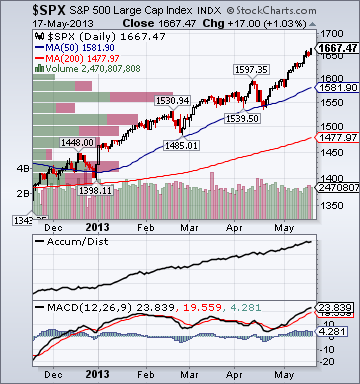
S&P 500 1,667.47 +2.07%*
The Weekly Wrap by Briefing.com.
*5-Day Change
Indices
- Russell 2000 996.28 +2.17%
- S&P 500 High Beta 25.99 +2.61%
- Value Line Geometric(broad market) 430.82 +1.93%
- Russell 1000 Growth 763.92 +1.66%
- Russell 1000 Value 846.21 +2.31%
- Morgan Stanley Consumer 1,032.47 +1.90%
- Morgan Stanley Cyclical 1,236.52 +1.92%
- Morgan Stanley Technology 773.72 +2.26%
- Transports 6,549.16 +2.72%
- Bloomberg European Bank/Financial Services 101.02 +2.45%
- MSCI Emerging Markets 43.30 -.55%
- HFRX Equity Hedge 1,127.74 +.66%
- HFRX Equity Market Neutral 939.92 +.03%
Sentiment/Internals
- NYSE Cumulative A/D Line 192,643 +.71%
- Bloomberg New Highs-Lows Index 609 -202
- Bloomberg Crude Oil % Bulls 20.0 -49.23%
- CFTC Oil Net Speculative Position 232,590 +5.42%
- CFTC Oil Total Open Interest 1,758,686 -.66%
- Total Put/Call .80 +8.11%
- ISE Sentiment 90.0 -27.42%
- Volatility(VIX) 12.45 -1.11%
- S&P 500 Implied Correlation 56.74 +.05%
- G7 Currency Volatility (VXY) 9.94 +3.76%
- Emerging Markets Currency Volatility (EM-VXY) 7.97 +11.2%
- Smart Money Flow Index 12,138.95 +1.28%
- Money Mkt Mutual Fund Assets $2.582 Trillion unch.
Futures Spot Prices
- Reformulated Gasoline 290.69 +1.74%
- Heating Oil 293.70 +1.13%
- Bloomberg Base Metals Index 192.81 -.75%
- US No. 1 Heavy Melt Scrap Steel 349.33 USD/Ton unch.
- China Iron Ore Spot 123.10 USD/Ton -5.01%
- UBS-Bloomberg Agriculture 1,470.69 -.73%
Economy
- ECRI Weekly Leading Economic Index Growth Rate 7.0% -30 basis points
- Philly Fed ADS Real-Time Business Conditions Index -.4709 +2.61%
- S&P 500 Blended Forward 12 Months Mean EPS Estimate 115.56 +.17%
- Citi US Economic Surprise Index -17.50 -10.2 points
- Citi Emerging Mkts Economic Surprise Index -47.40 +2.8 points
- Fed Fund Futures imply 52.0% chance of no change, 48.0% chance of 25 basis point cut on 6/19
- US Dollar Index 84.25 +1.39%
- Euro/Yen Carry Return Index 138.13 +.38%
- Yield Curve 171.0 +5 basis points
- 10-Year US Treasury Yield 1.95% +5 basis points
- Federal Reserve's Balance Sheet $3.312 Trillion +.93%
- U.S. Sovereign Debt Credit Default Swap 29.81 -5.35%
- Illinois Municipal Debt Credit Default Swap 117.0 -4.1%
- Western Europe Sovereign Debt Credit Default Swap Index 85.50 -2.84%
- Emerging Markets Sovereign Debt CDS Index 176.76 +4.45%
- Israel Sovereign Debt Credit Default Swap 122.0 +8.54%
- China Blended Corporate Spread Index 400.0 -1 basis point
- 10-Year TIPS Spread 2.26% -8 basis points
- TED Spread 24.25 +.25 basis point
- 2-Year Swap Spread 14.5 +1.0 basis point
- 3-Month EUR/USD Cross-Currency Basis Swap -17.25 -3.25 basis points
- N. America Investment Grade Credit Default Swap Index 70.20 -2.70%
- European Financial Sector Credit Default Swap Index 130.83 -2.83%
- Emerging Markets Credit Default Swap Index 246.51 +5.61%
- CMBS AAA Super Senior 10-Year Treasury Spread to Swaps 98.0 +13 basis points
- M1 Money Supply $2.517 Trillion -2.21%
- Commercial Paper Outstanding 1,013.60 +2.1%
- 4-Week Moving Average of Jobless Claims 339,300 +2,500
- Continuing Claims Unemployment Rate 2.3% unch.
- Average 30-Year Mortgage Rate 3.51% +9 basis points
- Weekly Mortgage Applications 876.60 -7.3%
- Bloomberg Consumer Comfort -30.2 -.7 point
- Weekly Retail Sales +2.80% +60 basis points
- Nationwide Gas $3.62/gallon +.06/gallon
- Baltic Dry Index 841.0 -4.86%
- China (Export) Containerized Freight Index 1,069.97 -1.19%
- Oil Tanker Rate(Arabian Gulf to U.S. Gulf Coast) 22.50 unch.
- Rail Freight Carloads 248,266 +1.05%
Best Performing Style
Worst Performing Style
Leading Sectors
Lagging Sectors
Weekly High-Volume Stock Gainers (24)
- SCTY, MGMB, TEAR, MRIN, TSLA, OPTR, RH, OLP, ENV, SRI, PANL, FANG, ONE, HTH, NNI, WWAV, UBNT, CUB, BBOX, WAGE, CUBI, SSYS, ACET and EOPN
Weekly High-Volume Stock Losers (5)
- PIKE, GEVA, WLH, CSC and INFI
Weekly Charts
ETFs
Stocks
*5-Day Change
Today's Market Take:
Broad Market Tone:
- Advance/Decline Line: Higher
- Sector Performance: Most Sectors Rising
- Market Leading Stocks: Outperforming
Equity Investor Angst:
- ISE Sentiment Index 77.0 -28.7%
- Total Put/Call .82 -15.46%
Credit Investor Angst:
- North American Investment Grade CDS Index 70.08 -2.16%
- European Financial Sector CDS Index 130.83 -2.24%
- Western Europe Sovereign Debt CDS Index 87.17 -3.51%
- Emerging Market CDS Index 246.38 +.58%
- 2-Year Swap Spread 14.5 +.5 bp
- 3-Month EUR/USD Cross-Currency Basis Swap -17.25 -.5 bp
Economic Gauges:
- 3-Month T-Bill Yield .03% unch.
- China Import Iron Ore Spot $123.10/Metric Tonne -1.52%
- Citi US Economic Surprise Index -17.5 +5.6 points
- 10-Year TIPS Spread 2.26 unch.
Overseas Futures:
- Nikkei Futures: Indicating +272 open in Japan
- DAX Futures: Indicating +57 open in Germany
Portfolio:
- Higher: On gains in my biotech/retail/tech sector longs and emerging markets shorts
- Disclosed Trades: Covered some of my (IWM)/(QQQ) hedges
- Market Exposure: Moved to 75% Net Long

