Style Underperformer:
Sector Underperformers:
- 1) Homebuilders -1.51% 2) Restaurants -1.48% 3) Semis -.63%
Stocks Falling on Unusual Volume:
- MCD, CVBF, MKC, CVI, INFN, NTLS, TOWR, BHLB, SILC, MAN, MLNX, DWA, YHOO, UTEK, SAP, SKS, CKEC, SSTK, RCII, CAKE, CPHD, YELP, BC, SRE, RLI, IR, TGP, NGVC, KMB and VFC
Stocks With Unusual Put Option Activity:
- 1) MCD 2) HCA 3) JNK 4) AMTD 5) ITB
Stocks With Most Negative News Mentions:
- 1) BKW 2) MAT 3) DELL 4) YHOO 5) WFC
Charts:
Style Outperformer:
Sector Outperformers:
- Gold & Silver +5.38% 2) Alt Energy +1.56% 3) Steel +1.16%
Stocks Rising on Unusual Volume:
- MCP, UBS, FDML, PETS and NQ
Stocks With Unusual Call Option Activity:
- 1) EA 2) NSC 3) TAP 4) TXN 5) CY
Stocks With Most Positive News Mentions:
- 1) SON 2) DKS 3) TWX 4) LMT 5) HAL
Charts:
Weekend Headlines
Bloomberg:
- China Move to Free Lending Rates Puts Focus on Low Saver Returns. The biggest step yet by China’s new
leaders to move the nation’s financial system toward market-set
lending rates heightens focus on what the central bank says is
an even tougher reform: lifting restrictions on savers’ returns. The
People’s Bank of China ended a floor on borrowing costs previously set
at 30 percent below the benchmark, it said July 19. The limit on
mortgage rates will stay to curb property speculation, the PBOC said.
Also unchanged was a 10 percent limit on what banks can offer over
PBOC-set deposit rates. Forcing banks to compete for funds would offer consumers
more spending power, while undermining the model of state-directed, subsidized credit bequeathed to Premier Li Keqiang, who took office in March. At stake is phasing in reform without exacerbating a slowdown in the world’s second-largest economy.
“Reducing controls on deposit rates would have a far bigger impact,
boosting household income but also raising costs for large borrowers
that have become addicted to cheap credit,” said David Loevinger, former
U.S. Treasury Department senior coordinator for China affairs and now an emerging-markets analyst at TCW Group Inc. in Los Angeles.
- China Shipyards Squeezed by Low Down Payments Amid Credit Crunch. During
the 2007 shipping boom, China’s shipyards charged down payments of as
much as 60 percent of a vessel’s value. Now, shipbuilders are cutting
those payments to as little as 2 percent, giving an advantage to
state-owned companies that can tap the government’s cash. With flagging
demand pushing shipyards to compete by cutting down payments and China
taking measures to rein in lending, the nation’s privately owned yards
are getting squeezed by state-owned rivals that enjoy greater access
to financing. China Rongsheng Heavy Industries Group Holdings Ltd.
(1101), the largest shipbuilder outside state control by order book,
said this month it’s seeking government support after failing to win any
new vessel orders this year.
- Beijing Airport Bomber Highlights Threat to Social Stability. The
man who detonated a bomb at Beijing Capital International Airport, the
world’s second busiest by passengers, highlights the growing threat to
social stability in China from frustration at perceived injustice. The wheelchair-bound man, identified as Ji Zhongxing, 34, exploded the home-made device outside the exit to an arrival
hall on July 20 to draw attention to his grievances, according
to the official Xinhua News Agency. Ji, who sustained injuries
to his arm, was the only one hurt in the blast, it said.
- Tycoons Usurped by SOEs in China IPOs as Returns Tumble.
In December, China Machinery Engineering Corp., a builder of power
stations, went public in Hong Kong thanks to five Chinese
government-owned companies that bought almost a third of the $575
million offering. The stock
has since fallen 24 percent. China Machinery is among a growing number of state-owned
enterprises forced to rely on so-called cornerstone investments
by other state firms to get initial public offerings done, as
wealthy individuals like Li Ka-shing stopped investing. The
results haven’t been stellar.
- Abe Victory Sets Up Next Battle as Japan Reform Fight Looms. Japanese Prime Minister Shinzo Abe’s
winning of the first bicameral majority for the ruling coalition
in six years sets up an internal government battle as he seeks
to revamp economic to defense policies. Abe’s Liberal Democratic Party and its New Komeito ally
will have at least 133 of the 242 seats in the upper house,
according to estimates by state broadcaster NHK. The former
ruling Democratic Party of Japan slid further into the margins
of politics after its collapse in lower house elections in
December, with the worst showing since its formation in 1998. With the Diet avenues now cleared for the government’s
bills, the fight for Abe, 58, turns inward -- to convince his
enlarged party, and a public that turned out in fewer numbers
yesterday, that his program of change is worth enacting. Vested
interests are lined up against him on everything from making it
easier to fire workers to entering a U.S.-led free-trade zone.
- Australia’s Waning Boom Saps Mining Area Housing Demand. After slashing the price of three
planned townhouses by a third in the coal-mining town of
Moranbah in remote northeastern Australia, agent Ricardo Baggio
still can’t find buyers. “No one’s got confidence,” said Baggio from broker Ray
White Group’s Townsville franchise, about 550 kilometers (341
miles) north of Moranbah in Queensland state. “There are a few
mines around the town but they’re not hiring or they’re
downsizing.”
- China’s Stocks Fall, Led by Financial Companies. Chinese
stocks fell for a fourth day as banks slumped on concern lending
margins will shrink, while investors speculated looser interest-rate
controls will benefit smaller companies. Industrial & Commercial
Bank of China Ltd. and China Construction Bank Corp. led declines for
lenders after the People’s Bank of China ended a floor on borrowing
costs while keeping a cap on deposit rates. The Shanghai Composite Index (SHCOMP) lost 0.4 percent to 1,984.76
at 11:13 a.m. local time. The CSI 300 Index dropped 0.5 percent
to 2,180.38.
- Asia Stocks Gain on Abe as Yen to Gold Jump Amid Earnings.
Asian stocks advanced, with the regional benchmark snapping a three-day
drop, after Japanese Prime Minister Shinzo Abe cemented control of the
government in elections. The yen rose against its major peers and gold
gained. The MSCI Asia Pacific Index added 0.7 percent at 10:45 a.m. in Tokyo.
- Spanish Sunshine Season Overshadowed by Growth Doubts: Economy.
In Almeria’s Cabo de Gata natural
park, one of the only unspoilt stretches left of Spain’s southern coast,
Hotel Tio Kiko is close to full. Its owner, Jose Venzal Alonso, isn’t
optimistic though. “I can’t say I see an economic recovery,” the 51-year-old hotel manager says in a telephone interview, speaking with a
heavy southern Spanish accent. “All our clients are saying so,
that they can’t afford to stay more than three days when they
would happily come for six before the crisis. We used to have a
full house much earlier in the season.” “Jobless numbers adjusted for
the seasonal boost due to
tourism show unemployment is still climbing,” said James Howat,
an economist at Capital Economics Ltd. in London. “Fast enough economic
growth to generate net increases in employment remains a distant
prospect.”
- Sabic Looks at U.S. Investments as Europe Slowdown Hurts Sales. Saudi
Basic Industries Corp. (SABIC), the world’s biggest petrochemicals
maker by market value, is studying investment opportunities in the U.S.
as the economic slowdown in Europe and China hurt its second-quarter
sales. “It is very important that Sabic is not left out from investments in the U.S. as it is a huge market in terms of the presence of shale gas
and also proximity to other markets,” Chief Executive Officer Mohamed
Al-Mady told reporters in Riyadh yesterday. “We are studying
opportunities in the U.S. to expand
Sabic’s presence in the chemical and polymer businesses.”
- Yen Surges After Abe Election Win; Dollar Drops on Fed Outlook. The yen rose against most major
peers after Japan’s ruling party failed to win an independent
majority in upper-house elections and as traders speculated on
Prime Minister Shinzo Abe’s ability to push through reforms. The yen strengthened 0.7 percent to 99.98 yen as of 1:10 p.m. in Tokyo after earlier surging as much as 1 percent. It
rose 0.6 percent to 131.53 per euro.
- Gold Bulls Bet Right as Prices Rally Most Since ’11: Commodities.
Hedge funds raised bets on a gold rally before prices capped the
biggest two-week gain in 20 months as Federal Reserve Chairman Ben S.
Bernanke damped speculation that a cut in stimulus is imminent. Speculators
increased their net-long position by 56 percent to 55,535 futures and
options by July 16, the highest since June 4, U.S. Commodity Futures
Trading Commission data show. Short contracts fell the most since
November after reaching a record the previous week. Net-bullish wagers
across 18 U.S.-traded
commodities jumped 28 percent, the biggest gain since March.
- Netflix(NFLX) Rules as S&P 500 Index’s Top Stock Spurring Bubble Talk. Netflix
Inc. (NFLX:US) has become the best performing U.S. stock in the
Standard & Poor’s 500 Index in 2013 and the second most expensive,
and therein lies a tale of disagreement. Investors who dig into
company filings can find negative free cash flow, a surge in liabilities
for new movie and TV-show content and a long-term increase in unpaid
subscribers. Moreover, perceived limits on customer numbers and the high
price of shares have led 26 of the 37 Bloomberg-listed analysts
(NFLX:US) covering the stock to advise investors to sell or hold stakes.
Most shareholders aren’t listening to talk about a bubble
or other bad news. They love Netflix.
Wall Street Journal:
- Beijing Lending Shift May Force Banks to Raise Capital. Removal of Floor on Loan Rates Is Seen Hitting Smaller Lenders Hardest. China's banks will need up to $100 billion in new funding over the
next two years following Beijing's move to shake up lending, according
to an analysis by a research firm, and that could spur banks to tap
investors for capital even amid growing worries over the strength of
their balance sheets. China's central bank on Saturday removed a government floor on the
interest rates banks can charge their clients for credit, allowing
financial institutions to price loans at whatever level they want.
Authorities hope the action will foster competition among banks and
result in easier access to loans for businesses and individual
borrowers, especially small and private manufacturers long shunned by
big state-owned lenders.
- U.S. Growth Outlook Stuck in Neutral. GDP Expectations Dialed Back as Retailer, Restaurant Sales Falter. The long-anticipated acceleration in the U.S. economy has been put on hold once again.
Disappointing economic and corporate-earnings reports in recent weeks
have dashed hopes that the U.S. was at last entering a phase of solid,
self-sustaining growth. Instead, while economists expect a modest
second-half pickup in growth, few are predicting the kind of substantial
rebound needed to quickly bring down unemployment, raise wages and
insulate the U.S. from economic threats abroad. There also are signs that consumers—whose spending has helped prop up
the economy for much of the past year—are beginning to tighten their
belts.
- Chemical in Indian School Deaths Was Five Times Regular Strength, Experts Say. Even Smelling the Fumes of Such a Compound Could Be Fatal, Says Police Chief. Forensic experts investigating poisoned food that killed 23 children
at an Indian school found traces of a chemical compound five times
stronger than its level used in commercial pesticide, the chief of
police in Bihar state said Saturday. Abhayanand, who uses only one name, said investigators had discovered
the compound, monocrotophos, in a plastic container that stored mustard
oil for cooking at the school, as well as on eating utensils and
leftover vegetables from Tuesday's meal.
- Detroit's Bust Stings European Banks. UBS and Others Are Hurt by Motor City Deals Dating Back to 2005. Detroit's broken finances are intersecting with the troubled European
banking industry, causing further distress for both the Motor City and
its European lenders. The situation demonstrates the ways in which European banks are still
paying the price for flawed decisions made in the run-up to the global
financial crisis. The trouble dates back to 2005, when Detroit was
trying to find a way to replenish its depleted pension funds for
municipal workers and its police and fire departments. The city turned to a giant Swiss bank, UBS AG, UBSN.VX +1.32% for help.
Fox News:
- Snyder shoulders Detroit bankruptcy decision, won't ask for federal help. Michigan Gov. Rick Snyder and the bankruptcy specialist he appointed
to fix Detroit’s unprecedented financial problems put the blame Sunday
squarely on the city and defended their decision to file for Chapter 9. The Republican governor said Detroit created the problems and stood
steadfast behind his decision to file Thursday for bankruptcy, with the
city roughly $19 billion in debt. “This is a tragic, difficult decision, but a right one,” he told CBS'
"Face the Nation." “It’s not about just more money, it’s about
accountable government.”
CNBC:
Business Insider:
New York Times:
- A Black Box for Car Crashes.
When Timothy P. Murray crashed his government-issued Ford Crown
Victoria in 2011, he was fortunate, as car accidents go. Mr. Murray,
then the lieutenant governor of Massachusetts, was not seriously hurt,
and he told the police he was wearing a seat belt and was not speeding.
But a different story soon emerged. Mr. Murray was driving over 100
miles an hour and was not wearing a seat belt, according to the computer
in his car that tracks certain actions. He was given a $555 ticket; he
later said he had fallen asleep.
Real Clear Politics:
Reuters:
- Deutsche Bank(DB) set to trim balance sheet by 20 percent: FT. Germany's biggest lender, Deutsche Bank
(DBKGn.DE), is expected to announce during its second-quarter results
its plans to reach a minimum 3 percent overall equity to loans ratio in
the next two and a half years, the Financial Times reported on Sunday,
citing people briefed on the plans. The bank is set to cut its balance
sheet by 20 percent to 1 trillion euros ($1.31 trillion) by the end of
2015 to comply with tougher rules that are expected to require banks to
use more equity capital to fund their business, to make them more robust
in the aftermath of the 2007-09 credit meltdown, the newspaper said.
- Syrian forces kill at least 49 rebels near Damascus: monitors.
Syrian President Bashar al-Assad's forces ambushed rebels in a
strategic suburb near the capital Damascus on Sunday, killing at least
49 people, a pro-opposition monitoring group said. The
Syrian Observatory for Human Rights said the opposition fighters had
been killed near Adra, a town that rebels have been fighting to
recapture from Assad's forces. It lies on a route that the rebels had
been using to smuggle weapons into Damascus until the army captured it a
few months ago.
- Minor miners face major headache from iron ore giants. From
Africa to Australia, opportunities to develop small iron mines are fast
disappearing, as cash dries up and miners are unable to compete with
the crushingly low production costs of the sector's heavyweights. In
Australia alone, a half a dozen or more projects pegged by prospectors
in better times sit stranded in the outback with no timetable for
development. Most are running short on money and have stripped payrolls
and equipment spending to a bare minimum, awaiting a turnaround that
forecasters predict is a long way off at best.
- Cost of weeding out criminals and tax cheats hits private banks. Private banks managing the financial affairs of the world's wealthy face
spending millions of dollars every year on vetting new clients, as
regulators get tough on banks that harbor tax cheats and money
launderers. While the world's rich
are getting wealthier and putting more money into private banks, a
growing proportion of the cash is from geo-political troublespots in the
Middle East and Asia.
USA Today:
- Court renews NSA telephone surveillance program. The secret Foreign Intelligence Surveillance Court renewed the
government's authority Friday to continue the collection of millions of
Americans' telephone records, one of the classified counter-terrorism
programs disclosed by former National Security Agency contractor Edward
Snowden. In an unusual public statement, the Office of the
Director of National Intelligence acknowledged that the court renewed
the authority that was set to expire Friday.
Financial Times:
- House prices in euro area hit seven-year low. House
prices in the euro area have fallen to a seven-year low, with some of
the steepest declines felt in countries worst hit by the financial
crisis, where a large share of household wealth is stored in property. European Central Bank figures also highlight gaping
disparities between eurozone countries – partly echoing their divergent
economic fates.
Telegraph:
- China risks deflation trap as true GDP crumbles. China is sliding towards a deflation trap and may be in outright recession
already if data are measured accurately, with serious knock-on risks for the
global economy. “It is too late to avoid a hard-landing,” said Patrick Chovanec from
Silvercrest Asset Management and a former professor at Beijing’s Tsinghua
University. “To keep growth going they have to push extremely high levels of
investment to even more extreme levels, and that is becoming very hard to do
and very hard to finance.” “The economic return on credit is rapidly declining. They increased loans by
$1 trillion in the first quarter, but growth slid anyway and is now below
levels seen in early 2009 after the Lehman crisis. It is no longer out of
the question that GDP will actually fall,” he said.
Boersen-Zeitung:
- Dexia Could Lose About EU100m on Detroit's Bankruptcy. Dexia
could lose EU100m on top of provisions already made for losses on
taxable certificates of participation the city of Detroit issued in 2006
to finance public employee pension funds.
To Vima:
- Talk of Greek Writedown Must Stop, Schaeuble Says. Such talk
doesn't help country, citing German Finance Minister Wolfgang Schaeuble.
A writedown on public loans to Greece would mean euro area wouldn't get
back money it afforded as help, he said. Such a move would increase
insecurity and wouldn't be possible for Germany given legal reasons,
Schaeuble said.
Estado de S. Paulo:
- Tombini Sees Confidence Drop Hurting Brazil Economy. Newspaper
reports on interview with Brazil central bank President Alexandre
Tombini. Fight against inflation helps to restore confidence, which is
necessary for economy to continue process of gradual recuperation,
Tombini said. Central bank doesn't have data for June and July, appears
that economy isn't good in that period. Bank's mission is to bring
inflation to target and that's what it's doing. Government must define
fiscal adjustment, and must define it clearly, describing in detail how
it will be carried out.
Xinhua:
- China Needs Long-Term Mechanism for Property Sector: Lou. China's
State Council needs to continue researching a long-term mechanism for
the development of the property sector, Finance Minister Lou Jiwei says
in an interview. The G-20 didn't discuss a hard landing in China. Some
finance chiefs expressed hopes that China will grow faster to support
global growth, but Lou says he told them "don't even think about it, you
have your own homework to do," Xinhua said.
- Xi Says
Strong China Needs 'Real Economy'. China President Xi Jinping said a
strong China needs development of the "real economy," and not asset
bubbles.
- Abe Govt May Lead to Regional Instability.
Japan's Liberal Democratic Party coalition's victory is based on a
disguise of Shinzo Abe's historical views and militarization agenda
under Abenomics, according to a Xinhua commentary. Abe governing for the
long term may lead to Japan becoming a source of instability for the
region and the world, the commentary said.
Securities Daily:
- China has great determination on curbing overcapacity of high
energy consumers or heavy polluters, especially those in steel, cement
and aluminum industries, citing Minister of environmental protection
Zhou Shengxian.
China Securities Journal:
- China Data Underestimates Aggregate Financing. People's Bank of
China Deputy Governor Pan Gongsheng says China's current reported
aggregate financing underestimates actual total financing by financial
institutions to the real economy. Pan made the comments at a conference
in Shanghai. Changes in the mode of transaction in the financial markets
lowered the detectability of monetary supply and weakened the impact of
the central bank's liquidity adjustments, according to the report.
Weekend Recommendations
Barron's:
- Bullish commentary on (FTNT), (SAI), (CHKP), (IPG), (GLD) and (GCA).
Night Trading
- Asian indices are -.50% to +.50% on average.
- Asia Ex-Japan Investment Grade CDS Index 128.0 unch.
- Asia Pacific Sovereign CDS Index 102.0 +1.25 basis points.
- NASDAQ 100 futures +.24%.
Morning Preview Links
Earnings of Note
Company/Estimate
Economic Releases
8:30 am EST
- The Chicago Fed Nat Activity Index for June is estimated to rise to 0.0 versus -.3 in May.
10:00 am EST
- Existing Home Sales for June are estimated to rise to 5.25M versus 5.18M in May.
Upcoming Splits
Other Potential Market Movers
- The BoJ's Sato speaking could also impact trading today.
BOTTOM LINE: Asian indices are mostly higher, boosted by consumer staple and commodity shares in the region. I expect US stocks to open modestly higher and to weaken into the afternoon, finishing modestly lower. The Portfolio is 50% net long heading into the week.
U.S. Week Ahead by MarketWatch (video).
Wall St. Week Ahead by Reuters.
Stocks to Watch Monday by MarketWatch.
Weekly Economic Calendar by Briefing.com.
BOTTOM LINE: I expect US stocks to finish the week modestly lower on rising global growth fears, surging energy prices, more emerging
markets unrest, earnings outlook concerns, profit-taking and technical
selling. My intermediate-term trading indicators are giving neutral
signals and the Portfolio is 50% net long heading into the week.
S&P 500 1,692.09 +.71%*
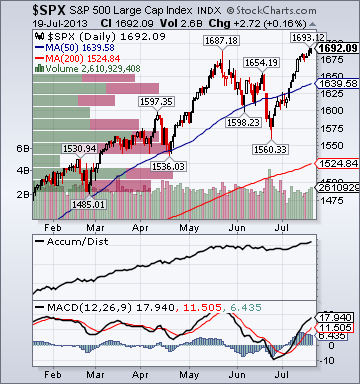
The Weekly Wrap by Briefing.com.
*5-Day Change
Indices
- Russell 2000 1,050.48 +1.35%
- S&P 500 High Beta 26.58 +1.57%
- Value Line Geometric(broad market) 446.56 +1.06%
- Russell 1000 Growth 766.22 -.01%
- Russell 1000 Value 868.56 +1.41%
- Morgan Stanley Consumer 1,043.83 +.94%
- Morgan Stanley Cyclical 1,264.55 +1.59%
- Morgan Stanley Technology 777.29 -1.24%
- Transports 6,586.57 +2.32%
- Bloomberg European Bank/Financial Services 95.84 +3.24%
- MSCI Emerging Markets 39.23 +.61%
- HFRX Equity Hedge 1,120.77 +.79%
- HFRX Equity Market Neutral 940.81 +.35%
Sentiment/Internals
- NYSE Cumulative A/D Line 193,154 +1.0%
- Bloomberg New Highs-Lows Index 846-47
- Bloomberg Crude Oil % Bulls 21.21 -57.58%
- CFTC Oil Net Speculative Position 329,449 +7.9%
- CFTC Oil Total Open Interest 1,880,612 +3.43%
- Total Put/Call .79 -11.24%
- OEX Put/Call 1.22 +56.41%
- ISE Sentiment 133.0 +84.72%
- Volatility(VIX) 12.54 -9.39%
- S&P 500 Implied Correlation 51.36 -2.65%
- G7 Currency Volatility (VXY) 9.78 -9.44%
- Emerging Markets Currency Volatility (EM-VXY) 9.42 -8.19%
- Smart Money Flow Index 11,503.51 +.10%
- Money Mkt Mutual Fund Assets $2.631 Trillion +.33%
Futures Spot Prices
- Reformulated Gasoline 312.34 +.38%
- Heating Oil 308.94 +1.70%
- Bloomberg Base Metals Index 184.62 -.13%
- US No. 1 Heavy Melt Scrap Steel 321.33 USD/Ton -.92%
- China Iron Ore Spot 131.70 USD/Ton +3.86%
- UBS-Bloomberg Agriculture 1,435.86 +.29%
Economy
- ECRI Weekly Leading Economic Index Growth Rate 4.5% -10 basis points
- Philly Fed ADS Real-Time Business Conditions Index .0556 +23.0%
- S&P 500 Blended Forward 12 Months Mean EPS Estimate 117.62 +.23%
- Citi US Economic Surprise Index -9.50 +2.2 points
- Citi Emerging Markets Economic Surprise Index -31.0 +6.7 points
- Fed Fund Futures imply 40.0% chance of no change, 60.0% chance of 25 basis point cut on 7/31
- US Dollar Index 82.61 -.40%
- Euro/Yen Carry Return Index 137.83 +1.96%
- Yield Curve 218.0 -6 basis points
- 10-Year US Treasury Yield 2.48% -10 basis points
- Federal Reserve's Balance Sheet $3.495 Trillion +.97%
- U.S. Sovereign Debt Credit Default Swap 23.6 -10.38%
- Illinois Municipal Debt Credit Default Swap 167.0 -8.24%
- Western Europe Sovereign Debt Credit Default Swap Index 93.0 -3.12%
- Emerging Markets Sovereign Debt CDS Index 214.66 -9.42%
- Israel Sovereign Debt Credit Default Swap 107.0 -6.96%
- Egypt Sovereign Debt Credit Default Swap 748.69 +14.24%
- China Blended Corporate Spread Index 378.0 -7 basis points
- 10-Year TIPS Spread 2.20% +15 basis points
- TED Spread 24.5 +.75 basis point
- 2-Year Swap Spread 17.75 +.25 basis point
- 3-Month EUR/USD Cross-Currency Basis Swap -9.0 -2.0 basis points
- N. America Investment Grade Credit Default Swap Index 73.80 -6.39%
- European Financial Sector Credit Default Swap Index 149.82 -5.58%
- Emerging Markets Credit Default Swap Index 278.62 -12.79%
- CMBS AAA Super Senior 10-Year Treasury Spread to Swaps 120.0 -10 basis points
- M1 Money Supply $2.504 Trillion -1.3%
- Commercial Paper Outstanding 999.20 +.90%
- 4-Week Moving Average of Jobless Claims 346,000 -5,800
- Continuing Claims Unemployment Rate 2.4% +10 basis points
- Average 30-Year Mortgage Rate 4.37% -14 basis points
- Weekly Mortgage Applications 519.40 -2.61%
- Bloomberg Consumer Comfort -28.4 -1.1 points
- Weekly Retail Sales +3.0% unch.
- Nationwide Gas $3.67/gallon +.12/gallon
- Baltic Dry Index 1,138 -.96%
- China (Export) Containerized Freight Index 1,074.85 +2.69%
- Oil Tanker Rate(Arabian Gulf to U.S. Gulf Coast) 25.0 -9.1%
- Rail Freight Carloads 248,201 +20.7%
Best Performing Style
Worst Performing Style
Leading Sectors
Lagging Sectors
Weekly High-Volume Stock Gainers (9)
- LEAP, SHFL, TAYC, XPO, POWI, BYI, NTLS, WWAV and FBRC
Weekly High-Volume Stock Losers (7)
- SHW, VSTM, MAT, INGR, LQDT, RGLS and UTEK
Weekly Charts
ETFs
Stocks
*5-Day Change

