BOTTOM LINE: The index of leading economic indicators fell for the fourth month in five, pulled down by a flattening of the yield curve. The University of Michigan’s Consumer Confidence Index fell in May which also contributed to the overall decline, however it has since rebounded. The Conference Board has stated that they believe a six-moth annualized decline of 3.5% or more would suggest imminent risk of recession. However, the six-moth annualized decline in May was 2.2%.
Monday, June 20, 2005
Leading Indicators Signal Slower Growth

- Leading Indicators for May fell .5% versus estimates of a .3% decline and an upwardly revised unchanged reading in April.
Monday Watch
Weekend Headlines
Bloomberg:
- Wal-Mart Stores said June sales at its US stores open at least a year are rising within its forecast range, led for the second straight week by apparel and other general merchandise.
- Secretary of State Condoleezza Rice said Israelis and Palestinians agreed that Israeli settlers' homes will be destroyed after Israel leaves the Gaza Strip.
- The fight to legalize gay marriage is headed to the highest court in New Jersey, where advocates say past decisions may give them an advantage.
- Brain scans can detect Alzheimer's disease in people who don't have symptoms, suggesting that early diagnosis may become more common for the elderly.
- The euro may resume its decline against the dollar and yen on indications European officials favor a weaker currency to help boost exports.
- Walter Industries, a homebuilder and maker of iron pipe for water and sewer systems, agreed to buy Mueller Water Products for $860 million to add sales of fire hydrants and valves.
- The euro had its biggest drop in 10 days after European Union officials failed to agree on a seven-year budget at a meeting late last week.
- China picked 42 companies including China Yangtze Power and Baoshan Iron & Steel, the second and third-largest on the Shanghai stock exchange, to sell shares in a plan to trim $250 billion of state holdings.
- Crude oil rose above $59 a barrel in New York for the first time, reinforcing concern record oil prices may hinder global economic growth.
Wall Street Journal:
- News Corp. is close to an agreement with Time Warner's cable unit to begin broadcasting a Fox News business channel as early as next year.
New York Times:
- GM's share of the US auto market rose 8 percentage points in the first 12 days of a discounting program begun June 1 compared to last month, citing research by JD Power & Assoc.
- Aviation industry experts, including officials at the FAA, say a so-called air-taxi system by provide US travelers with a safe and reliable alternative way of flying.
- Chewing gum sales are on the rise, and some industry experts say the increase is because more adults who are trying to quit smoking or lose weight are chewing.
Washington Post:
- Chinese farmers compromised an antiviral drug for humans and violated international livestock guidelines by using it to control bird flu in chicken flocks.
- President Bush will choose either Attorney General Alberto Gonzales or federal appeals Judges John Roberts or J. Mchael Luttig to be the next Supreme Court chief justice.
- Senator Robert Byrd, a West Virginia Democrat, wrote in his new book that he is embarrassed by his involvement with the Ku Klux Klan in the 1940s.
Boston Globe:
- A Massachusetts law that would have allowed the state to suspend the driver's licenses of some 4,600 unregistered sex offenders has never been put into effect, two years after it was passed.
Detroit News:
- Ford Motor and DaimlerChrysler AG plan to ask for the same concessions that General Motors negotiates with its workers as it seeks to cut health-care costs.
Time Magazine:
- CIA Director Porter Goss said he has an "excellent idea" about the location of al-Qaeda leader Osama bin Laden.
AP:
- MasterCard Intl. said that 68,000 of the 13.9 million credit cards that were exposed to possible fraud are considered to be at high risk.
Reuters:
- BHP Billiton expects to restart its Tintaya copper mine, the third largest in Peru, "in the short term" after talks with local residents who forced its closure last month.
Financial Times:
- General Electric may buy Westinghouse, the US nuclear power group of British Nuclear Fuels Plc.
Independent on Sunday:
- GLG Partners LP, Europe's largest hedge fund manager, may have to repay investors about $1 billion after losses at two of its main funds.
- Former Citigroup vice chairman Deryck Maughan may be considered for the position of chief executive at Morgan Stanley.
Sunday Telegraph:
- The UK government may change a plan to ban smoking in some public places by 2008, to outlaw it in all of them.
- French President Chirac is planning to make UK Prime Minister Tony Blair's presidency of the European Union difficult after their spat over the EU budget.
Het Financieele Dagblad:
- Corus Group Plc CEO Varin said Europe may be facing a rush of cheaper steel from countries such as China, South Korea, India and Idonesia.
De Telegraaf:
- A Royal Dutch/Shell Group think-tank expects China to overtake Europe as an economic and political superpower by 2025.
Finanz und Wirtschaft:
- Interest from large drug companies in the anti-infective drug industry is likely to rise following an acquisition by Pfizer in the sector.
Bild am Sonntag:
- The European Union cannot make any more promises to countries seeking entry into the union beyond those agreed with Bulgaria and Romania, following the collapse of the bloc's planned constitution.
Xinhua News Agency:
- TRW Automotive Holdings will set up an automobile parts venture with China South Industry Group.
- One of northeast China's richest men, Cai Kuanxi, and his family were stabbed to death over the weekend.
Asian Wall Street Journal:
- Two US congressman wrote to President Bush on June 17 seeking a review of any bid by CNOOC Ltd. for Unocal Corp. on national-security concerns.
Weekend Recommendations
Bulls and Bears:
- Had guests that were positive on PLT, AGIX, MEOH, PIR, FWRD, mixed on FRO, and negative on BBY.
Forbes on Fox:
- Had guests that were positive on WMT and mixed on LTD, CAJ, VIA, NKE, AIG.
Cashin' In:
- Had guests that were positive on UHCO, MO, PTF, SNE, RTU and mixed on MWD.
Cavuto on Business:
- Had guests that were positive on HDI, BC, EPP, IMCL, WTR, EXC and mixed on RL.
Barron's:
- Had positive comments on SQA/A, KAMNA, TOPP, WTS, ITT, NBR, LYO, DRL, STFC, NOVL, BORL, C, ROH, MSFT, NVL, PHRM, IPG and STA.
- Had negative comments on GOOG, RIMM, AMED and TOL.
Goldman Sachs:
- Reiterated Outperform on KRB and BAC.
Morgan Stanley:
- Morgan Stanley's chief Asian economist is calling for an oil price collapse as Chinese imports of the commodity fall.
Night Trading
Asian indices are -.50% to +.50% on average.
S&P 500 indicated -.18%.
NASDAQ 100 indicated -.23%.
Morning Preview
US AM Market Call
NASDAQ 100 Pre-Market Indicator/Heat Map
Pre-market Commentary
Before the Bell CNBC Video(bottom right)
Global Commentary
Asian Indices
European Indices
Top 20 Business Stories
In Play
Bond Ticker
Daily Stock Events
Macro Calls
Rasmussen Consumer/Investor Daily Indices
CNBC Guest Schedule
Earnings of Note
Company/Estimate
AMHC/.23
KMX/.36
VTS/.47
Upcoming Splits
ASCA 2-for-1
DGX 2-for-1
Economic Releases
10:00 EST
- Leading Indicators for May is estimated to fall .3% versus a .2% decline in April.
Bloomberg:
- Wal-Mart Stores said June sales at its US stores open at least a year are rising within its forecast range, led for the second straight week by apparel and other general merchandise.
- Secretary of State Condoleezza Rice said Israelis and Palestinians agreed that Israeli settlers' homes will be destroyed after Israel leaves the Gaza Strip.
- The fight to legalize gay marriage is headed to the highest court in New Jersey, where advocates say past decisions may give them an advantage.
- Brain scans can detect Alzheimer's disease in people who don't have symptoms, suggesting that early diagnosis may become more common for the elderly.
- The euro may resume its decline against the dollar and yen on indications European officials favor a weaker currency to help boost exports.
- Walter Industries, a homebuilder and maker of iron pipe for water and sewer systems, agreed to buy Mueller Water Products for $860 million to add sales of fire hydrants and valves.
- The euro had its biggest drop in 10 days after European Union officials failed to agree on a seven-year budget at a meeting late last week.
- China picked 42 companies including China Yangtze Power and Baoshan Iron & Steel, the second and third-largest on the Shanghai stock exchange, to sell shares in a plan to trim $250 billion of state holdings.
- Crude oil rose above $59 a barrel in New York for the first time, reinforcing concern record oil prices may hinder global economic growth.
Wall Street Journal:
- News Corp. is close to an agreement with Time Warner's cable unit to begin broadcasting a Fox News business channel as early as next year.
New York Times:
- GM's share of the US auto market rose 8 percentage points in the first 12 days of a discounting program begun June 1 compared to last month, citing research by JD Power & Assoc.
- Aviation industry experts, including officials at the FAA, say a so-called air-taxi system by provide US travelers with a safe and reliable alternative way of flying.
- Chewing gum sales are on the rise, and some industry experts say the increase is because more adults who are trying to quit smoking or lose weight are chewing.
Washington Post:
- Chinese farmers compromised an antiviral drug for humans and violated international livestock guidelines by using it to control bird flu in chicken flocks.
- President Bush will choose either Attorney General Alberto Gonzales or federal appeals Judges John Roberts or J. Mchael Luttig to be the next Supreme Court chief justice.
- Senator Robert Byrd, a West Virginia Democrat, wrote in his new book that he is embarrassed by his involvement with the Ku Klux Klan in the 1940s.
Boston Globe:
- A Massachusetts law that would have allowed the state to suspend the driver's licenses of some 4,600 unregistered sex offenders has never been put into effect, two years after it was passed.
Detroit News:
- Ford Motor and DaimlerChrysler AG plan to ask for the same concessions that General Motors negotiates with its workers as it seeks to cut health-care costs.
Time Magazine:
- CIA Director Porter Goss said he has an "excellent idea" about the location of al-Qaeda leader Osama bin Laden.
AP:
- MasterCard Intl. said that 68,000 of the 13.9 million credit cards that were exposed to possible fraud are considered to be at high risk.
Reuters:
- BHP Billiton expects to restart its Tintaya copper mine, the third largest in Peru, "in the short term" after talks with local residents who forced its closure last month.
Financial Times:
- General Electric may buy Westinghouse, the US nuclear power group of British Nuclear Fuels Plc.
Independent on Sunday:
- GLG Partners LP, Europe's largest hedge fund manager, may have to repay investors about $1 billion after losses at two of its main funds.
- Former Citigroup vice chairman Deryck Maughan may be considered for the position of chief executive at Morgan Stanley.
Sunday Telegraph:
- The UK government may change a plan to ban smoking in some public places by 2008, to outlaw it in all of them.
- French President Chirac is planning to make UK Prime Minister Tony Blair's presidency of the European Union difficult after their spat over the EU budget.
Het Financieele Dagblad:
- Corus Group Plc CEO Varin said Europe may be facing a rush of cheaper steel from countries such as China, South Korea, India and Idonesia.
De Telegraaf:
- A Royal Dutch/Shell Group think-tank expects China to overtake Europe as an economic and political superpower by 2025.
Finanz und Wirtschaft:
- Interest from large drug companies in the anti-infective drug industry is likely to rise following an acquisition by Pfizer in the sector.
Bild am Sonntag:
- The European Union cannot make any more promises to countries seeking entry into the union beyond those agreed with Bulgaria and Romania, following the collapse of the bloc's planned constitution.
Xinhua News Agency:
- TRW Automotive Holdings will set up an automobile parts venture with China South Industry Group.
- One of northeast China's richest men, Cai Kuanxi, and his family were stabbed to death over the weekend.
Asian Wall Street Journal:
- Two US congressman wrote to President Bush on June 17 seeking a review of any bid by CNOOC Ltd. for Unocal Corp. on national-security concerns.
Weekend Recommendations
Bulls and Bears:
- Had guests that were positive on PLT, AGIX, MEOH, PIR, FWRD, mixed on FRO, and negative on BBY.
Forbes on Fox:
- Had guests that were positive on WMT and mixed on LTD, CAJ, VIA, NKE, AIG.
Cashin' In:
- Had guests that were positive on UHCO, MO, PTF, SNE, RTU and mixed on MWD.
Cavuto on Business:
- Had guests that were positive on HDI, BC, EPP, IMCL, WTR, EXC and mixed on RL.
Barron's:
- Had positive comments on SQA/A, KAMNA, TOPP, WTS, ITT, NBR, LYO, DRL, STFC, NOVL, BORL, C, ROH, MSFT, NVL, PHRM, IPG and STA.
- Had negative comments on GOOG, RIMM, AMED and TOL.
Goldman Sachs:
- Reiterated Outperform on KRB and BAC.
Morgan Stanley:
- Morgan Stanley's chief Asian economist is calling for an oil price collapse as Chinese imports of the commodity fall.
Night Trading
Asian indices are -.50% to +.50% on average.
S&P 500 indicated -.18%.
NASDAQ 100 indicated -.23%.
Morning Preview
US AM Market Call
NASDAQ 100 Pre-Market Indicator/Heat Map
Pre-market Commentary
Before the Bell CNBC Video(bottom right)
Global Commentary
Asian Indices
European Indices
Top 20 Business Stories
In Play
Bond Ticker
Daily Stock Events
Macro Calls
Rasmussen Consumer/Investor Daily Indices
CNBC Guest Schedule
Earnings of Note
Company/Estimate
AMHC/.23
KMX/.36
VTS/.47
Upcoming Splits
ASCA 2-for-1
DGX 2-for-1
Economic Releases
10:00 EST
- Leading Indicators for May is estimated to fall .3% versus a .2% decline in April.
BOTTOM LINE: Asian Indices are mixed as strength in energy-related stocks in the region is offsetting weakness in exporting shares. I expect US stocks to open modestly lower on another rise in energy prices and comments by the Fed's Stern that the US economy will continue to expand between 3-4% and there's "no reason" the Fed should cease raising rates. The Portfolio is 100% net long heading into the week.
Sunday, June 19, 2005
Weekly Outlook
There are several important economic reports and a few significant corporate earnings reports scheduled for release this week.
Economic reports for the week include:
Mon. - Leading Indicators
Tues. - None of note
Wed. - None of note
Thur. - Initial Jobless Claims, Existing Home Sales
Fri. - Durable Goods Orders, New Home Sales
Some of the more noteworthy companies that release quarterly earnings this week are:
Mon. - Carmax(KMX)
Tues. - Darden Restaurants(DRI), Lennar Corp.(LEN), Jabil Circuit(JBL)
Wed. - Bed, Bath & Beyond(BBBY), Morgan Stanley(MWD)
Thur. - Family Dollar(FDO), FedEx(FDX), Micron Technology(MU), Nike(NKE)
Fri. - None of note
Other events that have market-moving potential this week include:
Mon. - Fed's Lacker speaks
Tue. - None of note
Wed. - CSFB Small/Mid-cap Semi Equipment Conference
Thur. - CSFB Small/Mid-cap Semi Equipment Conference
Fri. - None of note
Economic reports for the week include:
Mon. - Leading Indicators
Tues. - None of note
Wed. - None of note
Thur. - Initial Jobless Claims, Existing Home Sales
Fri. - Durable Goods Orders, New Home Sales
Some of the more noteworthy companies that release quarterly earnings this week are:
Mon. - Carmax(KMX)
Tues. - Darden Restaurants(DRI), Lennar Corp.(LEN), Jabil Circuit(JBL)
Wed. - Bed, Bath & Beyond(BBBY), Morgan Stanley(MWD)
Thur. - Family Dollar(FDO), FedEx(FDX), Micron Technology(MU), Nike(NKE)
Fri. - None of note
Other events that have market-moving potential this week include:
Mon. - Fed's Lacker speaks
Tue. - None of note
Wed. - CSFB Small/Mid-cap Semi Equipment Conference
Thur. - CSFB Small/Mid-cap Semi Equipment Conference
Fri. - None of note
BOTTOM LINE: I expect US stocks to finish the week mixed as high energy prices offset strong housing data. So far equities have mostly ignored the recent rise in energy. However, a rise in oil above $60/bbl. would likely pressure stocks. Conversely, a decline in oil back below $50 would likely send stocks meaningfully higher. My trading indicators are still giving bullish signals and the Portfolio is 100% net long heading into the week.
Economic Week in Review
ECRI Weekly Leading Index 134.10 +.98%
The May Producer Price Index fell .6% versus estimates of a .2% decline and a .6% increase in April. The May PPI Ex Food & Energy rose .1% versus estimates of a .2% increase and a .3% gain in April. US wholesale prices declined more than forecast in May as costs fell for gasoline, computers and automobiles. This was the largest decline since April 2003. Prices of raw materials, used at the earliest stage of the production process, declined 2.0%. Food prices fell .3%, computer prices declined 4.8% and passenger car prices fell .2%. The data reinforces comments last week from Fed Chairman Greenspan that inflation remains "modest." "As we see the activity level in manufacturing soften, that increases the possibility of further declines in prices," said Nobert Ore, chairman of the Institute's manufacturing survey.
Advance Retail Sales for May fell .5% versus estimates of a .2% decline and an upwardly revised 1.5% increase in April. Retail Sales Less Autos for May fell .2% versus estimates of a .2% increase and an upwardly revised 1.4% gain in April. Stripping out autos and gasoline, retail sales were unchanged after rising a vigorous 1.3% the prior month. "Retail sales soared in April, so a small cutback was not surprising," said Joel Naroff, president of Narof Economic Advisors. Consumer spending in the second quarter is projected to increase at a 3.2% pace, better than the 3.1% expected in a prior survey, according to the median forecast in a survey of 65 economists by Bloomberg. "Job growth and rising incomes have been and will continue to support growth in consumer spending overall," the Fed's Santomero said.
The Consumer Price Index for May fell .1% versus estimates of unchanged and a .5% increase in April. The CPI Ex Food & Energy for May rose .1% versus estimates of a .2% gain and an unchanged reading in April. Cheaper energy costs unexpectedly drove down consumer prices last month, the first decline since July 2004. The cost of all goods including cars, apparel and food fell .4% last month. "The economy has absorbed a surge of prices, mostly energy related, and things are simmering down," said Ken Mayland, president of ClearView Economics. The decline in prices may "cause the Fed to think it's reaching a neutral interest rate level and reaching the point where it can move to the sidelines," said Mayland.
Business Inventories for April rose .3% versus estimates of a .4% gain and a .5% increase in March. Inventories at US businesses rose .3% in April, the smallest increase this year, as sales surged. The increase in sales pushed the inventory-sales ratio down to 1.3 months, an all-time low. "If people are waiting for some kind of fallout from the consumer end of the economy, they'll have to wait a little longer," said Michael McNamara, vice president of research and analysis at MasterCard.
Empire Manufacturing for June rose to 11.7 versus estimates of 1.0 and a reading of -11.1 in May. The Empire Manufacturing Index rose by the largest amount since May 2003. The new orders component of the index rose to 8.2 from minus 8.2 a month earlier. The prices paid index fell to 30.6 from 41.6 in May. The index has "gone to a moderate growth reading after a very weak one in May," said Stephen Gallagher, chief US economist at Societe Generale.
Net Foreign Security Purchases for April rose to $47.4B versus estimates of $70.0B and $40.6B in March. International investors accumulated US assets at a slower-than-expected pace in April, amid evidence that hedge funds cut holdings of Treasuries. "Less hedge fund money is a good thing," said Joshua Shapiro, chief economist at Maria Fiorini Ramirez. Japan, the largest foreign holder of US government securities, bought a net 5.7 billion in April. "The overall level is not terribly relevant, since we know the dollar has strengthened significantly since April," Shapiro said.
Industrial Production for May rose .4% versus estimates of a .2% increase and a .3% decline in April. Capacity Utilization for May rose .4% versus estimates of a .2% increase and a .3% fall in April. US industrial production rose .4% in May, more than expected, helped by a rebound in demand for business equipment and consumer goods. Production of autos and parts increased 1.2% in May after a 2.3% decline in April. "The weakening in manufacturing has run its course," said James O'Sullivan, a senior economist at UBS Securities.
The NAHB Housing Market Index for June rose to 71 versus estimates of 71 and a reading of 70 in May. The gauge of US homebuilder optimism rose in June to the highest level this year as record home sales, mortgage rates below 6% and rising wages stoked demand. Mortgage rates near record lows and improving wages are supporting the housing market, even as soaring home prices and speculative purchases prompt concern from policy makers such as Fed Chairman Greenspan, Bloomberg said. "The favorable financing climate for new homes is proving too attractive for many buyers to pass up, so builders are staying very busy," said Dave Wilson, president of the homebuilding group.
Housing Starts for May rose to 2009K versus estimates of 2050K and 2005K in April. Building Permits for May fell to 2050K versus estimates of 2109K and 2148K in April. US housing starts rose .2% in May to the best pace since February as low interest rates and job growth continued to fuel demand. These numbers reinforce the view that this will be the best year for homebuilding since 1978 and the best year ever for home sales. Starts increased in all regions but the South, where they fell 12%. US home sales will top 8 million this year, the fifth consecutive record. "I would characterize it as robust activity in almost every market," said Richard Dugas, CEO of Pulte Homes. "This is an extremely strong reading," said Ken Mayland, president of ClearView Economics.
Initial Jobless Claims for last week rose to 333K versus estimates of 330K and 332K the prior week. Continuing Claims were 2641K versus estimates of 2587K and 2583K prior. The four-week moving-average of jobless claims rose to 335,000 from 332,250. Jobless claims fell to an average of about 328,000 this year from 343,000 for all of last year. The four-week moving-average of continuing claims rose to 2.597 million from 2.585 million. The insured unemployment rate rose to 2.1% in the week from 2% the week before. Employers have added jobs at a monthly rate of about 180,000 this year, compared with a monthly average of 183,000 for all of last year. The economy generated 2.2 million new jobs last year, the most in five years, Bloomberg said. "While we would like to see claims falling, the current level is low enough to be consistent with a continued, gradual tightening of the labor market," said Ian Shepherdson, chief US economist at High Frequency Economics.
Philly Fed. for June fell to -2.2 versus estimates of 10.0 and a reading of 7.3 in May. Manufacturing unexpectedly contracted in the Philly region for the first time in two years, Bloomberg reported. "The general picture is that manufacturing has been slowing," said David Sloan, chief economist at 4Cast.com. "The slowdown in the manufacturing sector is real but temporary," said Stephen Stanley, chief economist at RBS Greenwich.
The 1Q Current Account Balance widened to -$195.1B versus estimates of -$190.0B and -$188.4B in 4Q. Higher-priced oil and strong demand for goods from US consumers propelled the current account deficit higher. "The deficit is growing because US consumers are so enthusiastic," said Neil Wolfson, chief investment officer at Wilmington Trust. "They're going out and spending on plasma TVs and other electronics," and "that is translating into overseas sales," said Wolfson.
Preliminary Univ. of Mich. Consumer Confidence for June rose to 94.8 versus estimates of 88.8 and a reading of 86.9 in May. US consumer sentiment rose more than expected in June as the job market improved and gasoline prices eased in recent months. The index is the highest in five months and showed the biggest improvement since January 2004. The unemployment rate fell to 5.1% last month, the best level since September 2001. As well, the average price for a gallon of gasoline at the pump fell to $2.17 for the week ended June 13 from a record $2.32 in the week ended April 11. The current conditions component of the index, which reflects Americans’ perception of their financial situation and whether it’s a good time to buy big-ticket items, rose to 110.4 from 104.9 in May. The expectations component of the index jumped to 84.8 from 75.3 last month. This was the largest gain since the US economy began a significant acceleration in the first half of 2003.
The May Producer Price Index fell .6% versus estimates of a .2% decline and a .6% increase in April. The May PPI Ex Food & Energy rose .1% versus estimates of a .2% increase and a .3% gain in April. US wholesale prices declined more than forecast in May as costs fell for gasoline, computers and automobiles. This was the largest decline since April 2003. Prices of raw materials, used at the earliest stage of the production process, declined 2.0%. Food prices fell .3%, computer prices declined 4.8% and passenger car prices fell .2%. The data reinforces comments last week from Fed Chairman Greenspan that inflation remains "modest." "As we see the activity level in manufacturing soften, that increases the possibility of further declines in prices," said Nobert Ore, chairman of the Institute's manufacturing survey.
Advance Retail Sales for May fell .5% versus estimates of a .2% decline and an upwardly revised 1.5% increase in April. Retail Sales Less Autos for May fell .2% versus estimates of a .2% increase and an upwardly revised 1.4% gain in April. Stripping out autos and gasoline, retail sales were unchanged after rising a vigorous 1.3% the prior month. "Retail sales soared in April, so a small cutback was not surprising," said Joel Naroff, president of Narof Economic Advisors. Consumer spending in the second quarter is projected to increase at a 3.2% pace, better than the 3.1% expected in a prior survey, according to the median forecast in a survey of 65 economists by Bloomberg. "Job growth and rising incomes have been and will continue to support growth in consumer spending overall," the Fed's Santomero said.
The Consumer Price Index for May fell .1% versus estimates of unchanged and a .5% increase in April. The CPI Ex Food & Energy for May rose .1% versus estimates of a .2% gain and an unchanged reading in April. Cheaper energy costs unexpectedly drove down consumer prices last month, the first decline since July 2004. The cost of all goods including cars, apparel and food fell .4% last month. "The economy has absorbed a surge of prices, mostly energy related, and things are simmering down," said Ken Mayland, president of ClearView Economics. The decline in prices may "cause the Fed to think it's reaching a neutral interest rate level and reaching the point where it can move to the sidelines," said Mayland.
Business Inventories for April rose .3% versus estimates of a .4% gain and a .5% increase in March. Inventories at US businesses rose .3% in April, the smallest increase this year, as sales surged. The increase in sales pushed the inventory-sales ratio down to 1.3 months, an all-time low. "If people are waiting for some kind of fallout from the consumer end of the economy, they'll have to wait a little longer," said Michael McNamara, vice president of research and analysis at MasterCard.
Empire Manufacturing for June rose to 11.7 versus estimates of 1.0 and a reading of -11.1 in May. The Empire Manufacturing Index rose by the largest amount since May 2003. The new orders component of the index rose to 8.2 from minus 8.2 a month earlier. The prices paid index fell to 30.6 from 41.6 in May. The index has "gone to a moderate growth reading after a very weak one in May," said Stephen Gallagher, chief US economist at Societe Generale.
Net Foreign Security Purchases for April rose to $47.4B versus estimates of $70.0B and $40.6B in March. International investors accumulated US assets at a slower-than-expected pace in April, amid evidence that hedge funds cut holdings of Treasuries. "Less hedge fund money is a good thing," said Joshua Shapiro, chief economist at Maria Fiorini Ramirez. Japan, the largest foreign holder of US government securities, bought a net 5.7 billion in April. "The overall level is not terribly relevant, since we know the dollar has strengthened significantly since April," Shapiro said.
Industrial Production for May rose .4% versus estimates of a .2% increase and a .3% decline in April. Capacity Utilization for May rose .4% versus estimates of a .2% increase and a .3% fall in April. US industrial production rose .4% in May, more than expected, helped by a rebound in demand for business equipment and consumer goods. Production of autos and parts increased 1.2% in May after a 2.3% decline in April. "The weakening in manufacturing has run its course," said James O'Sullivan, a senior economist at UBS Securities.
The NAHB Housing Market Index for June rose to 71 versus estimates of 71 and a reading of 70 in May. The gauge of US homebuilder optimism rose in June to the highest level this year as record home sales, mortgage rates below 6% and rising wages stoked demand. Mortgage rates near record lows and improving wages are supporting the housing market, even as soaring home prices and speculative purchases prompt concern from policy makers such as Fed Chairman Greenspan, Bloomberg said. "The favorable financing climate for new homes is proving too attractive for many buyers to pass up, so builders are staying very busy," said Dave Wilson, president of the homebuilding group.
Housing Starts for May rose to 2009K versus estimates of 2050K and 2005K in April. Building Permits for May fell to 2050K versus estimates of 2109K and 2148K in April. US housing starts rose .2% in May to the best pace since February as low interest rates and job growth continued to fuel demand. These numbers reinforce the view that this will be the best year for homebuilding since 1978 and the best year ever for home sales. Starts increased in all regions but the South, where they fell 12%. US home sales will top 8 million this year, the fifth consecutive record. "I would characterize it as robust activity in almost every market," said Richard Dugas, CEO of Pulte Homes. "This is an extremely strong reading," said Ken Mayland, president of ClearView Economics.
Initial Jobless Claims for last week rose to 333K versus estimates of 330K and 332K the prior week. Continuing Claims were 2641K versus estimates of 2587K and 2583K prior. The four-week moving-average of jobless claims rose to 335,000 from 332,250. Jobless claims fell to an average of about 328,000 this year from 343,000 for all of last year. The four-week moving-average of continuing claims rose to 2.597 million from 2.585 million. The insured unemployment rate rose to 2.1% in the week from 2% the week before. Employers have added jobs at a monthly rate of about 180,000 this year, compared with a monthly average of 183,000 for all of last year. The economy generated 2.2 million new jobs last year, the most in five years, Bloomberg said. "While we would like to see claims falling, the current level is low enough to be consistent with a continued, gradual tightening of the labor market," said Ian Shepherdson, chief US economist at High Frequency Economics.
Philly Fed. for June fell to -2.2 versus estimates of 10.0 and a reading of 7.3 in May. Manufacturing unexpectedly contracted in the Philly region for the first time in two years, Bloomberg reported. "The general picture is that manufacturing has been slowing," said David Sloan, chief economist at 4Cast.com. "The slowdown in the manufacturing sector is real but temporary," said Stephen Stanley, chief economist at RBS Greenwich.
The 1Q Current Account Balance widened to -$195.1B versus estimates of -$190.0B and -$188.4B in 4Q. Higher-priced oil and strong demand for goods from US consumers propelled the current account deficit higher. "The deficit is growing because US consumers are so enthusiastic," said Neil Wolfson, chief investment officer at Wilmington Trust. "They're going out and spending on plasma TVs and other electronics," and "that is translating into overseas sales," said Wolfson.
Preliminary Univ. of Mich. Consumer Confidence for June rose to 94.8 versus estimates of 88.8 and a reading of 86.9 in May. US consumer sentiment rose more than expected in June as the job market improved and gasoline prices eased in recent months. The index is the highest in five months and showed the biggest improvement since January 2004. The unemployment rate fell to 5.1% last month, the best level since September 2001. As well, the average price for a gallon of gasoline at the pump fell to $2.17 for the week ended June 13 from a record $2.32 in the week ended April 11. The current conditions component of the index, which reflects Americans’ perception of their financial situation and whether it’s a good time to buy big-ticket items, rose to 110.4 from 104.9 in May. The expectations component of the index jumped to 84.8 from 75.3 last month. This was the largest gain since the US economy began a significant acceleration in the first half of 2003.
BOTTOM LINE: Overall, last week's economic data were modestly positive. Consumer prices were up 2.8% for the 12 months ended in May, below the 40-year average of 3.0%. As I predicted at the beginning of the year, numerous measures of inflation are decelerating meaningfully. This is the main reason that long-term rates remain very low by historic standards. Globalization, immigration, lingering overcapacity from the 90s bubble, technological innovation, a firming US dollar and slowing global growth will keep inflation low for the foreseeable future. As well, foreign nations will likely boost US asset exposure over the coming months as the dollar continues to strengthen which should also help keep long-term rates low. US retail sales fell by a larger-than-expected .5% in May, however an average gain of .5% over the last three months paints a healthy picture of consumer spending. Rising incomes, a booming housing market, better sentiment, a rebound in stock prices and decelerating inflation should lead to a continuation of recent strong consumer trends. As well, I continue to believe a decline in energy prices during the second half of the year will further boost the consumer. While manufacturing appears to have stabilized after a recent slowdown, I do not expect a meaningful acceleration from current levels for a few more months. The US economy is significantly stronger than that of Europe and Japan, which is the main reason for the widening trade deficit. As well, high costs for imported oil are to blame. The budget deficit is already improving in a meaningful way. I expect the trade deficit to improve modestly during the second half of the year as energy prices decline. However, the relative strength of the US economy compared to that of most other industrialized nations will continue, thus preventing any meaningful improvement. I expect price appreciation in the national housing market to plateau soon at relatively high levels. I continue to believe the nation as a whole does not have to worry about a "housing bubble." The labor market is cooling from more vigorous levels, which should result in a deceleration in unit labor costs over the coming months. This is likely the Fed's main area of concern as almost every other measure of inflation is already decelerating. Finally, the ECRI Weekly Leading Index rose .98% to 134.10 and is forecasting moderately improving US economic activity. This index is now approaching cycle highs of 135.90 set in mid-March.
Saturday, June 18, 2005
Market Week in Review
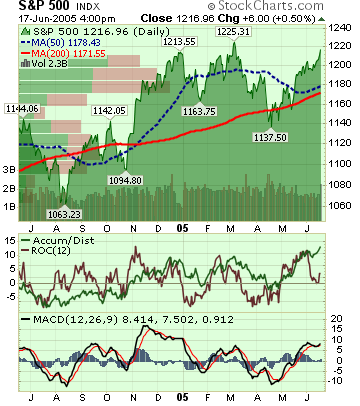
S&P 500 1,216.96 +1.57%
Click here for the Weekly Wrap by Briefing.com.
Click here for the Weekly Wrap by Briefing.com.
BOTTOM LINE: Overall, last week's market performance was positive. It was especially impressive considering the steep gains in commodity prices. The advance/decline line rose, most sectors gained and volume was average on the week. Measures of investor anxiety were mostly lower. The AAII % Bulls rose and is slightly above average levels. Mortgage rates rose for the first time in a month and are now 41 basis points away from all-time lows set in June 2003. Long-term Treasury yields were about unchanged for the week as much better inflation readings offset optimism for an acceleration of US economic activity. This optimism also led to outperformance by cyclical and commodity-related stocks. Homebuilders continued to shine on the strength of exceptional earnings from KB Home and strong housing data. I expect the recent rally in cyclicals and commodities to peak soon, while homebuilders should outperform through year-end. The US dollar fell on the week as traders took profits and the current account gap widened. I expect bit more short-term weakness in the currency before a resumption of the recent uptrend.
Subscribe to:
Comments (Atom)